
A famine strikes the Land of Canaan and Avraham seeks refuge in Egypt. Why? Did he not believe Hashem would provide him food in the land to which He had directed him? Furthermore, how could he risk the virtue of his wife Sarah?
The Ramban famously writes that Avraham “sinned greatly” by behaving as he did. Rav Samson Raphael Hirsch doesn’t reject this verdict out of hand. “The Torah never presents our great men as being perfect,” he writes, “it deifies no man, says of none ‘here you have the ideal, in this man the Divine becomes human.’”
He continues: “The Torah never hides from us the faults, errors, and weaknesses of our great men.” In fact: “Just by that it gives the stamp of veracity to what it relates” (since a dishonest narrative would surely portray its heroes in a more flattering fashion).
Rav Hirsch also argues that knowing the imperfections of our forefathers enables us to walk in their footsteps. “Were they without passion, without internal struggles, their virtues would seem to us the outcome of some higher nature, hardly a merit and certainly no model that we would hope to emulate,” he writes.
All that said, Rav Hirsch doesn’t think Avraham fundamentally erred in going down to Egypt. After all, we’re not supposed to rely on miracles in the absence of a Divine assurance. And although Avraham put Sarah’s virtue in danger, he felt he had no choice. If he stayed in Canaan, they were liable to starve.
Interestingly, Sarah didn’t foresee any problem in Egypt. She didn’t fear anyone desiring her since “she did not think she was beautiful.” Avraham, though, knew better. “Hinei na… See now, after all, I know that you are a beautiful woman” (Genesis 12:11, Rav Hirsch’s translation). (According to Rav Hirsch, “hineh, ‘after all,’ implies a preceding conversation.”)
In ancient Egypt, people felt more comfortable taking a married woman by force than they did an unmarried virgin. So Avraham urged his wife to pretend she was the latter. That way anyone who desired her would feel honor-bound to seek her hand from Avraham, her “brother.” This process of asking rather than snatching “takes longer, postpones the matter, and in the meantime G-d can help.” Avraham figured: “As a married woman, [Sarah] would certainly be lost [morally]; as unmarried there was still a possible chance.”
When he explained his plan to Sarah, Avraham says, “I shall remain alive through you” (ibid., 12:13). Without understanding the nature of Avraham’s plan, the words come across as selfish. But they of course weren’t. He said them, according to Rav Hirsch, because he saw Sarah hesitating, so he effectively said to her, “[I]f you will not do it for your own sake, do it for mine.”
And Avraham’s plan may very well have worked (without miraculous intervention from G-d) had not the leader of Egypt himself - Pharaoh - taken an interest in Sarah. On that eventuality, Avraham had not reckoned.
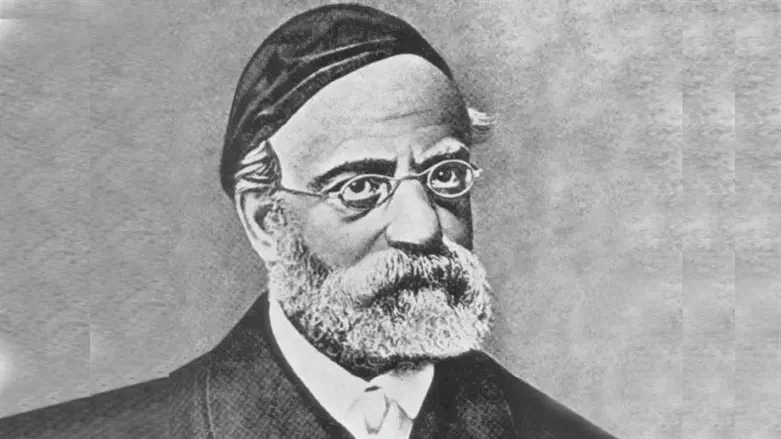
Rav Samson Raphael Hirsch (1808-1888) - head of the Jewish community in Frankfurt, Germany for over 35 years - was a prolific writer whose ideas, passion, and brilliance helped save German Jewry from the onslaught of modernity.
Elliot Resnick, PhD, is the author/editor of 10 books, including “The Rav Samson Raphael Hirsch Dictionary.”