
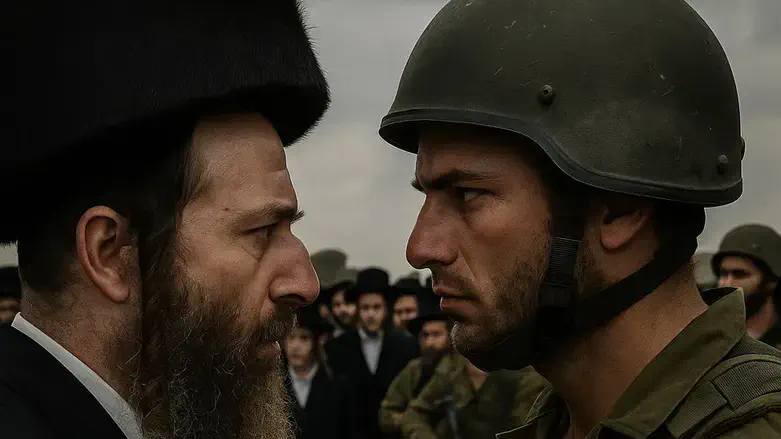
Having served myself throughout this war, and with four of my own children serving in the IDF, I find it difficult to put into words the emotions I feel on this matter of haredi enlistment. The sacrifices are not abstract to me-they are personal, daily, and deeply painful.
For two years we have buried soldier after soldier, endured funerals that tore apart entire communities, and seen young men and women return home physically wounded and emotionally scarred. We have watched as hostages were paraded, bodies were swapped, and the Jewish people endured grief not seen since the Holocaust. Through it all, hundreds of thousands stepped forward, proudly donning the uniform of the IDF, leaving behind families, careers, and comforts to defend the nation.
And yet, yesterday in Israel, there was a so-called “million man march.” Not against terror. Not against corruption. But against the idea that haredi Jews should share in the national burden of physically defending our homeland.
The refrain is familiar: תורתם אמונתם - “their Torah is their profession.” (meaning that they do nothing but study Torah, mandating learning three full study sessions a day.) Some claim they are the heirs of the tribe of Levi, exempt from military service in the Torah. They insist their learning and prayers alone guard the nation. What is more shocking is that a few Religious Zionist roshei yeshiva have joined in this chorus.
I do not discount the threat army service poses to the hareidi way of life, or the sociological upheaval that comes with asking an insular community-perhaps intentionally never taught to survive in the outside world-to suddenly adjust. That is real and it must be addressed. But not at the expense of those who are already sacrificing their lives on the front lines.
The hareidi world has refused any adjustments. Symbolically, they cling to the dress, speech, and social codes of the Russian and Polish ghettos, awaiting Eliyahu HaNavi to tell them when it is time to change. But will Moshe Rabbeinu really return in a shtreimel, wearing a fur hat designed for Siberian winters, under the blazing sun of the Middle East? We are witnessing a painful but necessary sociological evolution. Some have even threatened to leave Israel if forced to change. For them, exile feels safer than the steady approach of Geula-Lakewood or London more comfortable than Jerusalem.
Divisions are not new to the Jewish people. In fact, the Talmud itself is one long conversation of disagreements. Debate, when rooted in mutual respect and responsibility, can sharpen and elevate us. But when one group refuses to acknowledge the sacrifices of another, the fabric tears.
Behind the scenes, one always hears: “If you knew what I know, you’d understand.” Perhaps. Some argue the draft fight is a left-wing ploy to topple the government. Maybe. Others insist the real danger is lack of unity. Maybe. But from the battlefield, these debates are irrelevant. Soldiers must focus only on survival and victory. Our enemies are trying to destroy us, and everyone has a Torah and moral obligation to contribute.
Let us be honest: this is not just about the draft. It is about whether we continue to anchor ourselves in exile mentality or step boldly into redemption. Torah is not only about study and prayer. National survival requires soldiers, medics, farmers, and builders. A Geula-minded Torah would demand that we rally in support of our defenders, fill the newly created genuinely religious frameworks for service, offer meaningful alternative national service options, and grant exemptions only to truly dedicated Torah scholars - unless they, too, wish to enlist. That would honor both the Torah and the battlefield. The thousands of young haredi men who cannot be found in the yeshiva but received automatic exemptions, must be drafted.
Meanwhile, Arab citizens of Israel remain exempt from military or national service without protest from the left. The hypocrisy is glaring, and perhaps deliberate. The left doesn’t truly want the hareidim drafted-they want the wedge issue. The hareidi parties, in turn, exploit it to galvanize their base. And who pays the price? The tens of thousands of soldiers manning the borders, risking-and sometimes tragically giving-their lives.
Yes, many haredi families live in poverty for the sake of Torah, and that is a sacrifice in its own right. But it cannot be an excuse to ignore the blood spilled by their brothers in uniform. Basic gratitude is not too much to ask.
The truth is that we are living through a dismantling of what we once knew and entering a new, unknown era. This evolution is frightening but necessary. We must throw off the slave mentality of exile and redesign our worldview to fit the unfolding Geula. At the same time, we must beware the pitfalls of Haskalah and reform, which promised “progress” but delivered assimilation and spiritual destruction. Advancement cannot mean abandoning Torah; it must mean elevating it into the framework of redemption.
In the end, the debate over the draft is not really about politics or sociology. It is about Galut vs Geula. Is Israel to be seen only as a country willing to support yeshivas or one to fight for, one with which to identify? One path anchors us in exile; the other pushes us toward our national destiny. The line is fine and dangerous, but it is unavoidable. We must choose whether to cling to the safety of yesterday or step forward into the challenge-and promise-of tomorrow.
Through it all, one fact remains: our soldiers are holding the line, not for themselves alone, but for all of us. They deserve not scorn or dismissal, but honor, gratitude, and the backing of an entire nation.
Op-ed Editor Rochel Sylvetky notes (added with writer's permission):
Yesterday, I walked to the supermarket in a direction opposite to a stream of hundreds of haredim walking from Bayit Vegan to the city entrance and blocking the light rail tracks (which is why I was walking).
Someone squirted acid from an overhanging roof, hitting me and another elderly man instead of the haredim they were aiming for. Unable to open my eyes and in terrific pain I was helped by a young haredi man and taken to Shaarei Tzedek hospital by ambulance where the doctor said it was definitely not tear gas or pepper spray but acid. I could have been blinded, but am Baruch Hashem okay despite some pain and burning. For or against haredi draft, Binyamin Netanyahu, judicial reform, the war or anything else - there are lines we must not cross. Yesterday, someone did.
2. In my opinion, the haredim made a terrible mistake in organizing this prayer rally, not because I disagree with Torah scholars staying in yeshiva, not because I think the arrests they were protesting are the way this should be handled. I believe in Torato umanuto for those who are really learning, but that the many thousands of eligible haredim not learning must enlist (especially since the Hasmonaim haredi framework is tailored to them). However, that aside, the massive number of young haredi men blithely out on the streets showed how many boys do not go to the army and that sight, like nothing else, alienated the Israeli public. Nothing can explain those numbers to secular Israelis. Are the haredi leaders unaware that it was like a slap in the face to people whose children and grandchildren are putting their lives on the line - or have, sadly, sacrificed them - in this war? Such insensitiivity, chutzpa, both supercilious and uncaring. How could they? The young men should have stayed in yeshiva and let the politicians do the work. They gained no supporters yesterday and probably lost qutie a few.
Josh Wander received his Bachelor’s degree in Talmudic law from a prestigious rabbinical college in Jerusalem. He then served as a commander in the IDF and officer in the United States Air Force aux. before graduating from the University of Pittsburgh with a Master’s degree in Public and International Affairs and a global studies certificate in conflict resolution with a regional concentration in the Middle East. Politically in Israel, he served as an adviser in the Israeli parliament and as the online content editor and political corespondent for The Jerusalem Post. In the US, he was an elected PA State Constable, an appointed Committeeman and a commissioned Notary Public. He was also the Republican nominee for mayor of Pittsburgh. Wander has been assigned and loyally served in global hot spots including: Iraq, Lebanon, Haiti, Northern Ireland and Israel. A certified NRA instructor and a Range Safety Officer, he founded Jewish Preppers and has been featured in the National Geographic series “Doomsday Preppers”.