

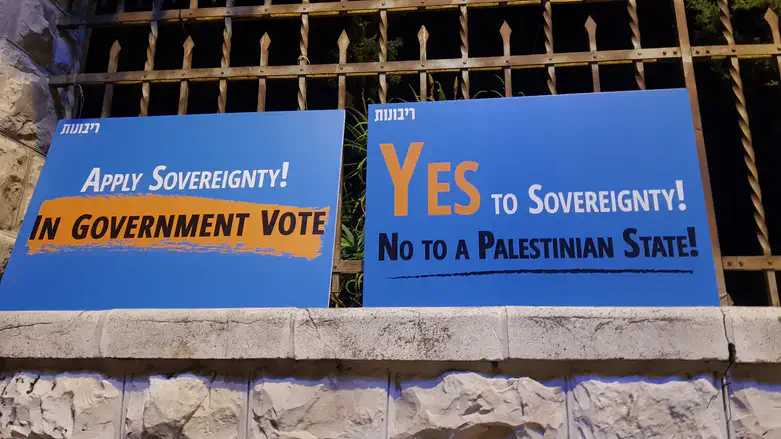
It certainly seems like last week’s preliminary Knesset vote declaring sovereignty over most of Judea and Samaria was ill-timed. It was an opposition maneuver meant to embarrass the government, especially considering that US Vice-President Vance was in Israel at the time. Probably a better time would have been any other time in the last 58 years, including last month, last year, five years ago, and next week.
If anything, the move set back our ability to exercise Israel law over Judea and Samaria, as it moved the Americans from a position of studied neutrality to vehement objection. It was a cynical move at the wrong time.
That being said, we have to ask ourselves, if last week was the wrong time, when is the right time?
Most often people who remonstrate against a worthy deed by saying it is the “wrong time” never quite articulate when would be the right time. It is a classic politician’s (and occasionally, rabbi’s) trick to avoid making tough decisions by embracing something wholeheartedly but then failing to implement it out of cowardice or other concerns, often described as “the big picture.” It works well, and we should ask our government, many of whose leaders have been promising sovereignty over Judea and Samaria for decades - especially during election season - when is the right time?
In a sense, it is analogous to successive Israeli governments publicly proclaiming the imperative of all nations recognizing Jerusalem as Israel’s capital but then privately urging foreign governments (such as the United States) not to do it.
What does sovereignty mean?
It is unwise and unjust to keep territories and its resident population in legal limbo for more than half-century. More than 500,000 residents do not deserve to have to seek army approval for construction issues. Worse, a reluctance to declare sovereignty over Judea and Samaria nurtures the fantasy that this land - the heartland of Israel, after all - is not really ours, and that one day it will be the foundation of a Palestinian Arab state. We keep that diabolical dream alive by playing semantic games, failing to promote our own interests, and cowering before the dictates of even friendly allies who, it must be said, have their own interests like all nations have their own interests.
What would be the effect of defying the United States and the world and passing the Knesset law in its second and third readings?
We should distinguish between the practical and the political effects.
The immediate response of all nations including the US would be non-recognition of Judea and Samaria as part of the State of Israel. Much would be made of that, too much. Historians could remind us that when Jordan annexed Judea and Samaria in 1950 - necessitating the change of that country’s name from Transjordan to Jordan - until two countries on the globe recognized that annexation, Britain and Pakistan. Only two. Yet, did anyone in the world doubt that Jordan was the claimant and that the land was part of Jordan? Of course not. It is a semantic and legal game.
For that matter, Israel formally annexed Jerusalem in June 1967, then cementing its status as part of Israel and our eternal, undivided capital in 1980. How many countries have recognized that annexation? Who cares? Practically, Jerusalem is Israel, which in legal terms is considered a de facto annexation. To the extent that we tolerate those nations which trample on Israeli sovereignty in Jerusalem by maintaining consulates that function as embassies to the Palestinians is shameful, and an indictment of our government for several generations. Why doesn’t the government shutter these consulates? Apparently, it is never the right time.
Consider, as well, Israel’s annexation of the Golan Heights in 1981. The UN Security Council declared it “null and void.” No country recognized it until the United States did in 2019. Who cares? Does anyone doubt that the Golan is part of Israel? It is worthwhile to add parenthetically that Israel’s annexation of the Golan did not stop Israel’s government in the 1990’s from negotiating a possible surrender of this vital land to Syria despite such negotiations violating Israeli law.
There are other cases of countries across the world declaring sovereignty over specific parcels of land, and other nations either recognize it or do not, and life goes on. What is missing in terms of international recognition is gained through clarity, an expression of national will, and a desire for some measure of finality in a nation’s borders.
Those are practical considerations. The political and diplomatic factors receive the most attention. Several Israeli governments have begun the process of declaring sovereignty and then abruptly aborted them. PM Netanyahu’s governments had several opportunities to declare sovereignty when Trump declared himself an agnostic on the question, and flubbed them all, caving in for one reason or another.
It seems clear that our reluctance to apply Israeli law to much of Judea and Samaria is rooted in a fear of what the Americans will say or do. The threats - in line with President Trump’s style - are blustery, thunderous, and vague, including, perhaps, loss of support at the UN, boycott of weapons sales, etc., and all, like most of Trump’s threats to sundry countries across the world, unlikely in the extreme to materialize.
Will the US turn on Israel for declaring sovereignty over land that is in our possession for almost sixty years and is an integral part of our biblical patrimony? How that aligns with American interests is a mystery.
If anything, putting another nail in the coffin of Palestinian Arab statehood is in the interest of Israel, the United States, and what passes for the moderate Arab world. A Palestinian state would constitute a threat to us and to much of the Arab world, and a new and even larger terror base than was Gaza. It should be obvious to us that any country that opposes our sovereignty over Judea and Samaria because such is perceived as the death knell for an independent "Palestine" does not have our best interests at heart.
Do we?
Does the Israeli government have the capacity to act in our national interest without our hand being held tight by our greatest patron? Based on past experience, the answer is no - except if we insist and we demonstrate clearly to the US why this is in our and their interest.
To the Americans, sovereignty over Judea and Samaria takes a back seat to expanding the Abraham Accords to include Saudi Arabia who, along with other countries, apparently threaten to walk away from negotiations if a pathway to an independent "Palestine" is not created. But such is not in our national interest, and if we don’t assert our national interests forcefully, and explain cogently why, we will find ourselves under enormous pressure to midwife a Palestinian Arab state into existence with eastern Jerusalem as its capital.
For sure, it is incomprehensible at this point to see how Israeli society would ever agree to such a situation, which would be both a reward for past terror and an incentive for future terror. Now the political establishment is largely against it but our leaders can be as fickle as the people they lead. PM Netanyahu was a sworn opponent of Palestinian Arab statehood, then supported it, and now opposes it again. The opposition leaders keep their fingers to the wind to see which way the public weathervane blows.
In truth, only those whose commitment to the land of Israel is rooted in religious doctrine are inflexible and will remain implacably opposed to again partitioning the land of Israel. All others, whose world views are based on politics, history, security, and the like, will necessarily be more malleable. Under pressure, they will succumb and then rationalize it quite eloquently.
If we do not declare sovereignty over Judea and Samaria, the day will soon come when a Palestinian Arab state is back on the global agenda, and vigorously. We must preempt that. One way to do it sensibly is to make it part of the negotiations on the Abraham Accords.
Let’s face it: The Abraham Accords is mostly about trade and business, in other words, money. That is the American interest, more than a Trump Nobel Peace Prize. (After all, how prestigious can such an award be if Yasser Arafat was a recipient?) Our peace treaties are quite similar. Neither Egypt nor Jordan has maintained an ambassador in Israel for several years. Relatively few Israelis visit those countries, and even fewer Egyptians and Jordanians visit Israel.
Business aside, these treaties and the Abraham Accords engender an absence of war, itself quite valuable, but not the type of peace that exists between countries with warm relations and shared values. Yes, a cold peace is better than a hot war, but what if the cold peace eventually paves the road to a scorching hot war because we have allowed ourselves to be lulled into complacency?
We erred in not annexing Judea, Samaria, and Gaza decades ago, and we have paid a terrible price in life and blood for that neglect, which has also whetted the appetite of our enemies that they can ultimately wear us down and destroy us. Arabs who live there need not become citizens; there are tens of millions of people who live in the United States who are not citizens. We need not twist ourselves like a pretzel trying to find the right legal formulation.
A rapprochement with Saudi Arabia is not worth it if the price is a Palestinian Arab state, the redivision of Jerusalem, and/or a repudiation of our rights and claims to Judea, Samaria, and our eternal capital.
After all, Trump cherishes agreements, ceremonies, and deals far more than substance, but we have to live with the substance. Thus, our soldiers can be killed during a “cease fire,” which again goes into effect when the shooting stops, and then when the shooting continues and stops again. It is a fantasy to think that Hamas will disarm and depart on its own, and an even deadlier fantasy to think that the United States or any Arab countries will go to war in Gaza to do it.
We have to live in reality.
Part of reality is defining our national interests and pursuing them sedulously. The reaction to our declaration of sovereignty over Judea and Samaria is likely to be quite similar to the reaction to the US recognition of Jerusalem as Israel’s capital eight years ago (which was then followed by a handful of other nations). That is, predictions that the heavens will collapse, the Arab street across the Middle East will explode, and the region will descend into war.
The reality was otherwise. The reality was some public handwringing from a few countries, followed by … nothing. The dogs bark and the caravan moves on, as the Turkish proverb says. We are not needy beggars at the trough of world recognition. We are a generation that has been blessed to return to our ancient homeland, as promised in the Bible, a generation of dedicated warriors and fighters who have been given nothing by the world on a silver platter.
It is time we act like it.
Rabbi Steven Pruzansky is a rabbi and attorney who lives in Israel and serves as the Senior Research Associate at the Jerusalem Center for Applied Policy. He is the author of six books.