
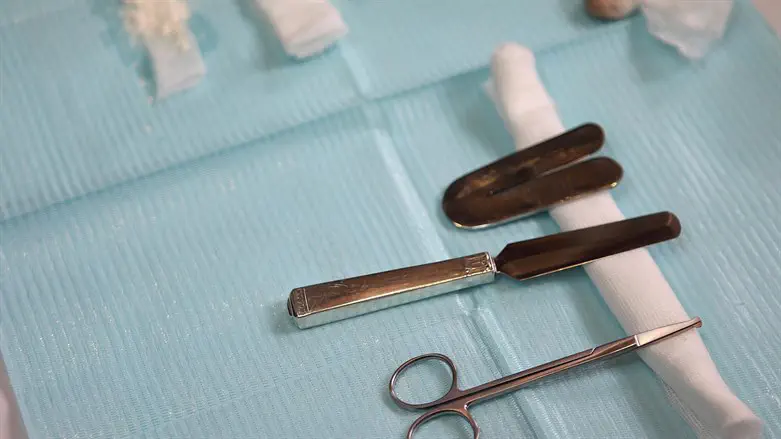
As a mohel, I see the current panic swirling around Brit Milah from a distinct perspective.
Roughly 80% of the country’s mohalim have the certification of their teacher alone. While that might sound controversial, this is how the practice has been handed down from time immemorial. Anyone who desired to learn the craft would apprentice with a competent mohel until his teacher deemed him ready. Until the establishment of the state, there was no other option. And the truth is, there’s nothing necessarily wrong with this system.
What the recent Ynet article titled, “The Brit Milah ended in a partial amputation: dozens of complications and calls for oversight” wants you to believe is that complications are soaring in Israel and the only solution is more oversight from the Rabbinut and the Health Ministry. But this is not true.
When it comes to the statistics quoted in the article, 25 complications in one month sounds frightening. But on a statistical level, this is actually lower than what's probable. On average, close to 6,000 Britot are performed monthly in Israel.
Complications occur at the staggeringly low rate of 0.34% of the time. That means roughly 20 complications are expected monthly, no matter if the Brit is being performed by a doctor or a mohel. These numbers reflect the normal range of medical risk present with any surgery.
The key to the alarmism in the piece is in the subtext. According to the article, most of the reported cases were bleeding issues - easily remedied and leaving no lasting damage. Such incidents are unavoidable unless we stop performing Brit Milah altogether. The same is true for any surgical procedure. No matter how skilled the practitioner, complications can occur. Yet no one would argue to halt the practice of medicine because risks exist.
Every mohel should be held to the highest standard of care, but bureaucratic oversight doesn’t guarantee that. The Rabbinut is a political body ill-suited for the task. It represents only a small segment of the population - alienating the non-religious and ignored by the Ultra Orthodox who operate within their own closed system.
In practice, the Rabbinut will not take a stance against direct Metziztah b’Peh, even though it accounts for some of the more serious Brit Milah complications. When Metzitzah is performed without a sterile tube, the baby can contract herpes, leading to brain damage or even death. Granting the Rabbinut authority would not necessarily make the practice safer.
Some suggest that it’s safer if doctors perform circumcisions because they know anatomy. But this misses the point. It depends on whether the individual is a mohel-doctor or a doctor-mohel. A medical degree doesn't automatically confer skill in Brit Milah and lack of one doesn't mean a practitioner is any less competent. The true measure of ability is experience - the number and frequency of Britot performed, not the letters after one’s name.
The Johns Hopkins study quoted in the article also lacks context. While it is true that fewer than half of newborns in the U.S. are now circumcised before leaving the hospital, those statistics don’t include circumcisions performed afterward - Jewish or otherwise. This might actually indicate a trend away from the medical establishment. There’s no way to know because the study didn’t report those numbers.
However, more importantly, the study indicates nothing about the trends of Brit Milah in the State of Israel. Although the movement against the practice has a limited following here, there is no indication that it's growing. Brit Milah is still kept by more than 90% of the population - and that is a good thing because it’s our most hallowed mitzvah.
The world is becoming more hostile towards Jews and the practice of Brit Milah has become a target of that hostility. Across Europe, ritual slaughter has already been banned, and efforts are underway to restrict our most sacred rite as well. The last thing we need is for our own homeland to join in chorus. Complications and oversight may make headlines, but our commitment to this Mitzvah should take precedence over a manufactured controversy.
Rabbi Hayim Leiter is a rabbi, a wedding officiant, and a mohel who performs britot (ritual circumcisions) and conversions in Israel and worldwide. Based in Efrat, he is the founder of Magen HaBrit, an organization protecting the practice of brit milah and the children who undergo it.