

Matriarch Rachel’s yahrzeit is on the 11th of the Hebrew month of Cheshvan, which falls on Saturday night and Sunday, November 2nd this year and large crowds of worshipers, especially girls and women, are expected to fill the ancient location of her tomb on the outskirts of Bethlehem in her honor. Although there are other places that vie for the title of her burial place, based on differing readings of the verses mentioning her grave in the Tanach, the Jewish people turned this site on the road to Efrata into the accepted tomb by going there to pray throughout the ages, followed today by the multitudes who make their way there since the area became accessible after the Six Day War.
True, high walls now surround the once scenic entrance road and tomb due to the unending violence of the descendants of Rachel’s Uncle (by marriage) Ishmael, but the visitors are undaunted and the IDF at the ready.
About Rochel Imenu:
What is the special magnet that draws so many thousands to the tomb? What is its special connection to women thousands of years after Mother Rachel’s death?
Mother (Mameh) Rachel symbolizes much that speaks to a woman’s heart:She epitomized kindness - to her sister; love at first sight that turned into marital love - for her beloved Yaakov;the indescribable yearning of a woman for a child - as she cries to her husband in despair; the ultimatetragedy of not living to raise the children she finally bore with such difficulty - as she dies giving birth to Binyamin, her second son.
Rachel Imenu (our mother) symbolizes coping courageously with the unexpected vicissitudes of life with selfless kindness - that shown to her sister Leah, and when necessary, standing up for what one feels is right - like taking her father’s idols - and for what, in her view, is deserved - obtaining the mandrake roots found by Leah’s son Reuven.
And she was not forgotten, even in the Bible itself.
Years later, when talking to Pharaoh, Yaakov proves the love he still has for her, saying: “And I, as I came from Padan Aram [Laban’s home, ed.] Rachel died on me”- causing Rashi to comment that a woman's death is most deeply mourned by her husband.
Rachel is the symbol of G-d’s promise to His children in Jeremiah 31, where the prophet describes the voice, heard in Ramah, of Mother Rachel weeping unconsolably for her children because they are gone. G-d tells her to wipe her tears, then promises to reward her with her sons' return from the lands of their enemies one day, a return to their borders…
And it has come to pass. Mother Rachel's children have come home.
Our living hostages have returned, and there is a renewed awakening of tribute to Mother Rachel, a new understanding of G-d's eternal promise.
The Breishit Ensemble:
Women pray and “separate challah” at Rachel Imenu’s Tomb because they wish to emulate her middot tovot (positive character traits), they cry because they identify with her travails and feel that she understands them.
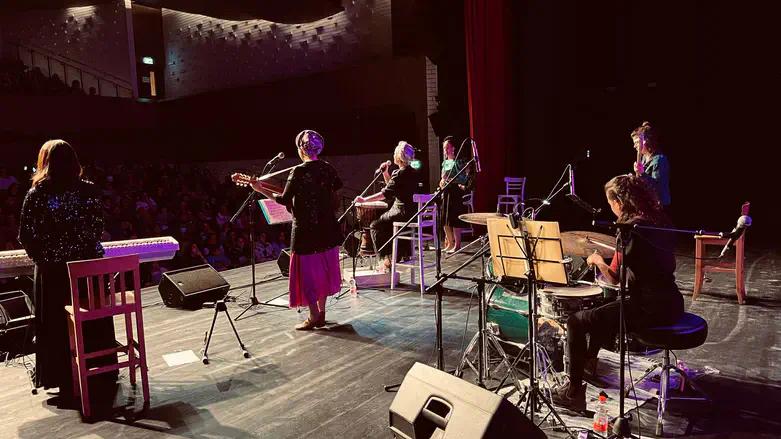
Jerusalem’s Breishit Ensemble, however, composed entirely of musically talented observant women, will be remembering Mother Rachel on Sunday night, November 2, as well as all the women who prayed for their children's safety for the past two years, by performingin Jerusalem’s Zappa in honor of their first single “Soft waters”.
Rachel Bergman, pianist, and one of the founders of the ensemble, spoke to Arutz Sheva, saying:
“The ensemble, which includes haredi, religious Zionist and newly observant women- is based on the commonality of all women, performs for women only, and will shortly be issuing its first album.
“Breishit’s songs are original because each performer brings her inner world to the group, leading to a varied program with jazz, blues, liturgical poems, soul music and even traces of the Beatles. This is a trailblazing effort that was not accepted in the past. The ensemble performs music of quality at appropriate venues - all our efforts embued with holiness. Observant women deserve superior. music and art.
"Our songs deal with Rachel’s world, the world of women - motherhood, marriage, faith and connecting to G-d in a woman’s way. Women’s power mixed with women’s gentleness, just like Rochel Imenu - the mother who does not give up on her children fo 2000 years.
“The song 'Soft water' talks about a woman’s ability to renew herself and find inner strength and faith. It symbolizes the journey embarked on by each one of us, including that of the ensemble itself, a spiritual group that brings gentleness to music as well as power, rhythm and joy," explains Rochel Bergman.
Mother Rachel would have agreed.