
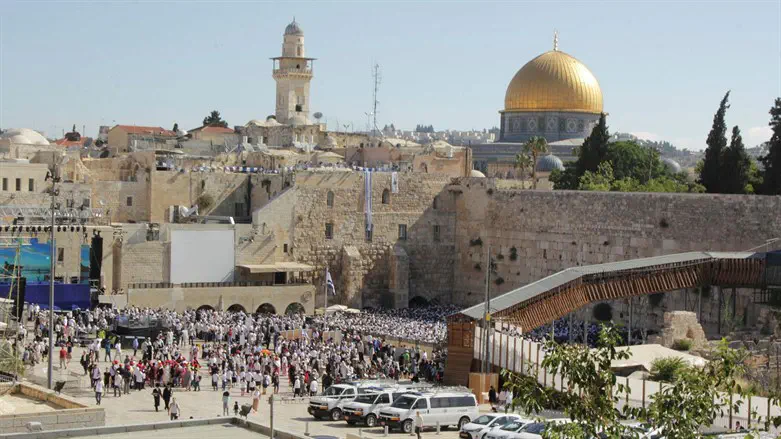
The Temple Mount in Jerusalem is more than merely a point of contention. It has been a major flashpoint that has initiated major conflicts and mass killings of Muslims and Jews for decades:
-Over a hundred years ago in April 1920 Nebi Musa Riots erupted in large measure due to Moslem fears of Jewish encroachment on the Temple Mount and the Wailing Wall, with four Arabs and five Jews killed and 18 Arabs and over 200 Jews injured. As bad as that seemed, it was merely the precursor for what followed later that decade:
-In August 1929, disputes over access to the Western Wall resulted in Arab riots with 116 Arabs and 133 Jews being killed, including the massacre of the Jewish community of Hebron.
-Although the 1936 riots which lasted several years were not directly triggered by the Temple Mount issue, much incitement inflamed the situation by imams claiming that Jewish immigration into Palestine endangered the Muslim holy site of Al Aksa Mosque on the Temple Mount.
-In 1969 an Australian Christian tourist tried to set Al-Aqsa on fire which sparked widespread violence throughout Israel.
-“Black Monday,” The Al Aqsa Massacre on October 8, 1990. When the Temple Mount Faithful planned to lay a cornerstone for the Third Temple on the Temple Mount, violent conflict resulted in shooting and riots throughout the country.
-In late September 1996, the opening of a tunnel near the Western Wall of the Temple Mount triggered riots that lasted days.
-On 28 September 2000, Ariel Sharon’s visit to the Temple Mount was seen as provocative, setting off the Second Intifada which resulted in 4300 lost lives.
-From September 27, 2000, clashes between Moslem worshippers and Israeli security in and around the Temple Mount continued for days due to restrictions imposed at Al-Aqsa.
-After two Israeli policemen were killed by armed assailants on the Temple Mount in 2017, Israeli security decided to put a metal detector at the entrance, resulting in violent protests.
-Rumors of Jews planning to sacrifice a goat on the Temple Mount resulted in conflict. Muslims barricaded themselves in Al-Aqsa and police stormed Al-Aqsa in April 2023.
-The October 7, 2023 massacre was labeled “The Al-Aqsa Flood,” where now tens of thousands have fallen in two years or war.
Not only is it clear the Temple Mount issue has triggered conflict and agony, but the frequency of these flashpoints has been increasing over the years. And it is no wonder: much of the incitement has emanated from the Jerusalem WAQF.
The tradition of inflammatory pronouncements began with the Grand Mufti of Jerusalem early in the 20th Century, but continued into the 21st Century. The previous WAQF head, Ekrima Sa’id Sabri, made starkly inciteful pronouncements around the turn of the century and beyond accusing the Jews of preparing to destroy Al-Aqsa.
After his appointment as WAQF Head in 2006, Muhammed Ahmad Hussein has publicly stated that suicide bombings could be considered “legitimate resistance.” There is a plethora of examples of call-to-arms sermons from Temple Mount imams in the past couple decades resulting in violence on the mount and beyond.
Is there any hope on the horizon for a reversal from this seemingly universal Muslim antagonism toward the “devious Jew” to peaceful accommodation with the Jewish Abrahamic brother?
One member of two WAQFs, namely the Islamic Waqf Council in Jerusalem and the Jerusalem Endowments Council (Jordanian Waqf), was Dr. Mahdi Abdul Hadi. His rich resume includes earning his PhD in Peace Studies from University of Bradford, UK.
Before his death 15 January 2025, I spoke with him about the problem of this seemingly endless incitement and conflict. While the vast majority of Palestinian Arabs believe the Jew have devious, hidden intentions with respect to control of the Temple Mount, the WAQF could easily neutralize this prime cause for anger and hate and become the prime-mover for peaceful accommodation with the Jews instead of being the prime source of this incitement. He spoke to the idea of the WAQF inviting the Jews to share the Temple Mount and build Solomon’s Temple there anew.
Dr. Mahdi Abdul Hadi said, however, that there is a “slight problem” in initiating this innovative invitation to the Jews: the knowledgeable doctor noted that the Israeli Chief Rabbinate formally prohibits Jews from ascending the Temple Mount. In respect of this official Jewish rabbinic prohibition, it would be undiplomatic, Dr. Abdul Hadi stated regretfully, to begin the process of presenting a public invitation to the Jews: according to proper protocol, the prohibition would need first to be rescinded (and only definitive archaological findings of where the Temple itself stood on the mount, at the present time not agreed upon, could lead to that happening, ed.).
Say, the Israeli Rabbinate responds favorably to Dr. Abdul Hadi’s observation and officially reverse their decades-long prohibition of Jews ascending the Temple Mount (not a simple halakhic issue and therefore, not likely, ed.). The next question is, what then? Would Al-Aqsa need to be dismantled and replaced?
In fact, a Muslim scholar supports this very idea (“godsholymountain.org’ Website), which sees the mosque presently there alongside a Third Temple,
So, the knotty stumbling block to the Jews rebuilding the Third Temple and by so doing [possibly] engendering world peace is Israel’s Chief Rabbinate and many other well known rabbis. (These far from trivial reasons in the observant Jewish world are ritual impurity and the difficulty of finding the exact locations of the areas Jews are allowed to walk on halakhically, among other problems. There are rabbis, such as the late Chief Rabbi Shlomo Goren, who thought they knew the permitted areas, but others disagreed with his findings, ed.)
But even if the Chief Rabbinate is not forthcoming with an affirmative response, the simple fact that the WAQF made the offer would neutralize all Arab underlying suspicion of “scheming Jewish intentions” regarding the Temple Mount.
Bruce Brill is an independent journalist and former U.S. National Security Agency Middle East analyst (1972-74), Head of the American friends of the Jerusalem Temple Mount (1987, 88), and Executive Director of the Islam-Israel Fellowship (1999-2002). He has been published in Jerusalem Post, Washington Times, Christian Science Monitor, Midstream, Jewish Spectator, and Jerusalem Report.