
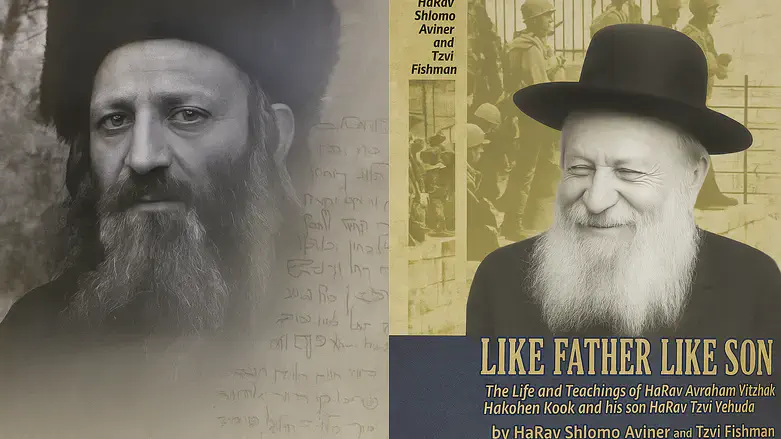
Shehechyanu, v’kiyemanu….
I write this brief book review with unlimited pleasure. Just off the press, the book “Like Father, Like Son” sets forth the life and teachings of HaRav Avraham Yitzhak HaKohen Kook and his son, HaRav Tzvi Yehuda. Written by two widely-published authors, HaRav Shlomo Aviner and Tzvi Fishman, the dual biographies both shine with the “new light on Zion,” Torat Eretz Yisrael, what HaRav Tzvi Yehuda termed “HaTorah HaGoelet” - the Redeeming Torah, or, in a slightly different translation, the Torah of Redemption.
The father and son biographies present intimate descriptions of two giants of Torah and their teachings, set against the dramatic rebirth of the Land of Israel and the Statehood of Israel in our times.
During the past 150 years, the world has witnessed the miraculous ingathering of the Jewish People to the Land of Israel in clear fulfilment of biblical prophecy. The two Torah luminaries who taught Am Yisrael to recognize this colossal undertaking as the beginnings of Israel’s long-awaited Redemption were HaRav Avraham Yitzhak HaKohen Kook and his only son HaRav Tzvi Yehuda.
Father and son were the towering beacons of light who taught their generations to see the Divine Hand behind the Zionist enterprise. They called upon the entire Nation to embrace the miraculous events of the time with joy and great gratitude to the Almighty. Both of them strove to revive Torah study to its original meaning - “Torat Eretz Yisrael” - which returned the all-encompassing NATIONAL foundation of the Torah to the forefront of Jewish life, something which had been lost during the Exile when the Jewish People were scattered minorities in foreign Gentile lands, lacking sovereignty of their own.
While Rabbi Kook, the father, is more universally famous than his son, it was HaRav Tzvi Yehuda who explained and implemented his father’s teachings to the reborn Israelite Nation upon the establishment of the State of Israel. As head of the Mercaz HaRav Yeshiva in Jerusalem, he taught his students the absolute necessity of returning the all-encompassing, national foundation of the Torah to the forefront of Jewish life, stressing the exalted value of Medinat Yisrael, service in the Israel Defense Forces, and the settlement of the Promised Land in all of its borders.
The book, “Like Father Like Son,” shows how the incomparable teachings and visions of Rabbi Kook found expression in the words and deeds of his son, and subsequently in the life of his students - the leaders of Religious Zionism in our time.
Readers familiar with excellent Rabbi Kook biography, “An Angel Among Men” by Simcha Raz, will learn many new things in “Like Father, Like Son,” due to the many excerpts from Rabbi Kook’s writings, together with the almost cinematic dramatization of key episodes in Rabbi Kook’s career as Israel’s Chief Rabbi which novelist Tzvi Fishman brings to life in page-turning fashion.
Allow me to quote from the book and present a side of Rabbi Kook which is little known to the public. Revered for his sweeping, all-inclusive love for all people, Rabbi Kook was not blind to the shortcomings rampant in his time. He was certainly not the “turn-the-other-cheek” reformist which he is often pictured to be. For instance, in response to the widespread alienation from Judaism throughout the pioneer community, he distributed this passionate public proclamation on posters throughout the country:
THE WOUNDS OF A LOVER
Beloved Brothers! A great cry rises from the depths of my heart because of our spiritual decline, ironically at the great hour of our time of revival. Brothers who dwell in the cities, towns, kibbutzim, and moshavim of Israel, hear the words which come from the broken heart of a loyal friend. The restoration of the Nation in its Land is founded, at least in part, on its unique holy spirit, which pulsates within it from generation to generation. If this spirit is emptied, where is the basis of all of our actions? Without the soul of the Nation, how will the body gather strength?
It is impossible to remain silent any longer! Turn back! Turn back my children! You have gone too far.
At the head of the spiritual destruction, is the desecration of Shabbat. While the heart bursts in anguish, any word of reproach emerging from this distress only earns mockery and contempt in response. Alas. What has become of us?
Turn back! Turn back children! Return to the spirit of our People, to the Torah of our God, the Rock of Israel and its Redeemer. Keep the Sabbath free of desecration and turn your hands from all evil! Can it be true that we have no other occupation and no other calling in life in the Land of Israel than to fill up life with the worst, cast-off customs of other nations? Is being carried away with all kind of dances and constantly wasting money and time on moving pictures and their like what we lack these days? Must our women follow immodest fashions, and all of this just to imitate the ways of a dying Europe in our ancient Holy Land and thus bring shame to the glory of our rebirth and all of its majesty?
And our tables are becoming disgusting, carrion and forbidden foods are eaten in public without any feeling of shame. Where will the line be drawn, and how will our spirit survive in our Nation?
How may we become as one person, in a bond of brotherhood, if you destroy the most basic foundations of the spirit which unites the Nation? On what can the Nation’s development be based if you continue to augment the rot of separation, which brings with it fraternal hatred and despair?
It is true that it is a very small minority of those who dwell in the Land of Israel who have succumbed to these vices, but is it not the duty of each and every one of us to stand in the breach and declare to this minority that it is bringing evil and overwhelming disgrace on us all?
Remember God and place Jerusalem and the rebirth of our Nation in your hearts. Raise the banner of rebirth to sanctify the holiness of Israel and its great founding principles. Turn back from the desecration of Shabbat, turn back from eating forbidden foods, turn back from all evil ways that denigrate the life of the individual and the Nation. Come back and build the Nation and the Land in a holy manner, so that every man will say, the word of Hashem is with you.
HaRav Tzvi Yehuda
In presenting the life and teachings of HaRav Tzvi Yehuda, one of his longtime students, Rabbi Shlomo Aviner, has compiled dozens of inspiring stories about the Rosh Yeshiva from the people who knew him most intimately. I myself had the great honor of learning under the tutelage of HaRav Tzvi Yehuda for 12 years at Yeshivat Mercaz HaRav, and I would like to share a few recollections of my own.
Often, out of awe for his father, HaRav Tzvi Yehuda would simply read the text of his father’s writings, without offering any commentary on his own. When asked which Rabbi was the “Gadol HaDor” he would answer that his father was the “Gadol HaDorot,” meaning the greatest Torah Scholar of all time.
Interestingly, although he was known as the “father of the settlements,” HaRav Tzvi Yehuda didn’t directly order his students to establish new yishuvim. Everyone understood from his teachings that this was the commandment of the hour. Students would come to his home and tell him that they wanted to start a new Torah community in Samaria or in Gush Katif, and he would give them his blessing as a Kohen. For him, building settlements in the Land of Israel was the natural extension of Torah learning, just as Yehoshua’s conquest of Eretz Yisrael was a natural continuation of the Torah which the Jewish People received at Sinai.
He often noted that the words ‘yeshiva’ and ‘yishuv’ have the same root, and emphasized that building new settlements was not ‘bitul Torah,’ but Torah itself, in fulfillment of the Hashem’s repeated command to settle the Land and keep it under Jewish sovereignty. For him, each new settlement was the fulfillment of the Divine prophecies which envisioned the day when the blighted and desolate homeland would blossom and be resurrected to life.
Often, he himself accompanied his students to the hilltops of Judea and Samaria to plant the first sapling as his students erected tents and dragged generators and building materials to the site.
HaRav Tzvi Yehuda didn’t have children of his own. His students were his children. Hundreds of budding Torah Scholars who revered him as a father. When students speak about him, whether they turned out to be Roshei Yeshivot, army commanders, teachers, physicians, or Knesset members, each one will tell you that he had a special relationship with Rabbi Kook. He made each of us feel like a beloved child.
And he taught us to love every Jew with an unlimited love, mirroring the unbounded love which his father had felt for all people.
In the month of Elul, at the very beginning of each year, HaRav Tzvi Yehuda would lecture about Emunah and the vital importance of approaching Torah learning from the point of view of the Clal, the overall community of Israel in its national aspect, as the Torah of the Nation, in all of its personal and public facets.
On the very first day of my learning at Mercaz HaRav, I fell ill and missed the opening lecture. A few days later, when I recovered, I took a place in the line of students who always waited to ask the Rosh Yeshiva questions at the conclusion of morning prayers. When my turn came, I told HaRav Tzvi Yehuda that I had been sick and missed the opening lecture. To my surprise, he sat me down, asked how I was feeling and inquired about the details of my illness. Then for nearly an hour, while other students were waiting, he explained the class I had missed. He took the time to go over the entire initial lesson with me alone.
The book, “Like Father, Like Son,” presents the life and teachings of Rabbi Kook and his son in such an intimate fashion that you feel like you personally know them. It is a remarkable achievement and a book well worth reading.
[In Israel, the book “Like Father, Like Son,” is available at: https://www.chavabooks.co.il/product/like-father-like-son/#tab-description].