

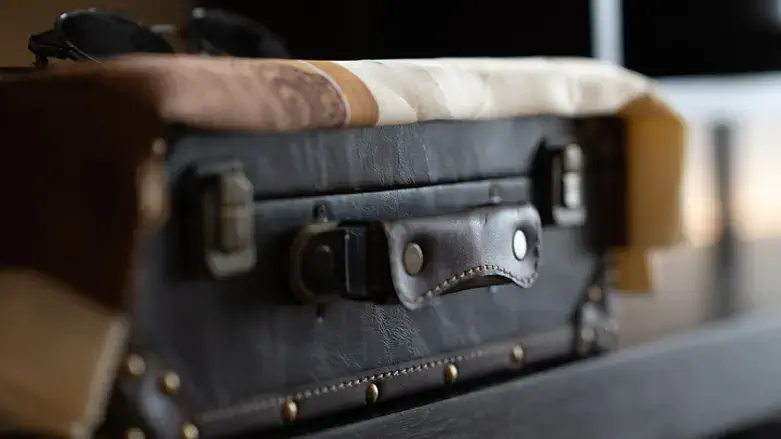
In 2009, following his father’s death, Antony Easton was sorting through the modest flat in Lymington, Hampshire, when he uncovered a small brown leather case hidden under hsi father's bed. Inside lay immaculate German banknotes, family photographs, and carefully labeled envelopes - along with a birth certificate that would upend everything he knew about his family.
Peter Roderick Easton, who had long prided himself on being thoroughly English, had in fact been born Peter Hans Rudolf Eisner - a member of one of Berlin’s wealthiest Jewish families. The discovery launched Antony on a decade-long quest that uncovered a lost fortune worth billions, a family devastated by the Holocaust, and a trail of artwork and property seized under Nazi rule.
The BBC reported that the suitcase’s contents revealed that Antony’s great-grandfather, Heinrich Eisner, was a pioneering industrialist who helped build Hahn’sche Werke into one of Germany’s largest steel companies. Around the turn of the 20th century, Heinrich’s factories in Germany, Poland, and Russia made tubular steel for railways and armaments - and brought him enormous wealth.
Photographs showed the Eisners’ grand lifestyle: stately homes in Berlin, servants, and a chauffeur-driven Mercedes. One family photo even captured a young Peter Eisner smiling as a Nazi flag fluttered in the background - a haunting image of what was to come.
When Heinrich died in 1918, his son Rudolf inherited both the family business and fortune. Although Hahn’sche Werke thrived during World War I, supplying steel to the German military, the years that followed brought growing instability and rising antisemitism.
By the 1930s, as Hitler rose to power, Jewish families like the Eisners became targets. Rudolf initially believed he could protect the company by making it indispensable to the regime, but by 1938, that illusion collapsed.
Under immense pressure, the Eisners were forced to sell Hahn’sche Werke to the Nazi-aligned conglomerate Mannesmann at a fraction of its value. Historian David de Jong, author of 'Nazi Billionaires', noted that the Eisners’ loss typified the massive theft of Jewish assets during the Third Reich. Decades later, parts of Mannesmann - including assets once belonging to Hahn’sche Werke - were absorbed into the British telecom giant Vodafone in a record-breaking £100 billion merger.
At the same time, Jews attempting to flee Germany were required to forfeit up to 92% of their remaining wealth under the 'Reichsfluchtsteuer' (Reich Flight Tax). Facing the loss of everything, Rudolf turned to a trusted acquaintance: an economist named Martin Hartig.
Hartig, who was not Jewish, appeared to offer a solution. The Eisners signed over their properties and assets to him in the hope he would safeguard them until after the war. Instead, he kept them for himself. German federal archives later confirmed that these were “forced sales,” a euphemism for the state-sanctioned looting of Jewish property.
By 1938, the Eisners had little choice but to flee. Train tickets, hotel receipts, and luggage tags found in the suitcase allowed Antony to retrace their path from Germany through Czechoslovakia and Poland, before they boarded one of the last ships bound for Britain in July 1939.
The family arrived penniless, their vast wealth lost. Rudolf was later interned by British authorities as an “enemy alien” and died in 1945. Most of the extended family who remained in Europe were murdered in Nazi concentration camps.
Peter, who had been 12 when they fled, grew up in England, changing his name and concealing his origins. He raised Antony without ever revealing the truth of his past.
Decades later, Antony’s search to uncover what had happened to his ancestors’ fortune led him back to Berlin. With the help of investigator Yana Slavova, he discovered that a painting mentioned in the suitcase - 'Eisenwalzwerk' (Iron Rolling Mill), a 1910 work by Hans Baluschek - had once hung in his family’s home. It now resided in Berlin’s Brohan Museum.
Archival evidence revealed that the artwork had been sold by an art dealer handling assets from a property seized by Martin Hartig in 1938. That link confirmed the painting’s origins as part of the Eisner estate.
When Antony and Yana met Hartig’s elderly daughter, she insisted her father had been a friend to the Eisners and had helped them flee Germany. She claimed he had even smuggled some of their paintings out by hiding them among clothes. However, other descendants of the Hartig family acknowledged that their wealth might have come from the Eisners’ misfortune.
Legal avenues for reclaiming the Eisners’ properties in Germany have long expired. Hildegard Eisner, Rudolf’s widow, tried to regain the family’s Berlin homes in the 1950s but was defeated in court. Yet for the family’s looted artworks, hope remains.
In early 2024, the Brohan Museum announced plans to return 'Eisenwalzwerk' to Heinrich Eisner’s descendants. Another painting was repatriated from the Israel Museum, and claims for additional works in Austria are ongoing.
For Antony, restitution is about more than wealth. “It’s not about objects and money and property - it’s about people,” he said. Through uncovering the truth, he has pieced together the lives of family members erased by war and silence.
This knowledge has now been passed on to a new generation. The Eisner name may have disappeared when Peter sailed to Britain in 1939, but it now lives again. Antony's great-nephew, Caspian, born in August 2024, was given the middle name of Eisner.
Antony says he was deeply moved by his niece's decision to honour their long-lost family.
"You know, as long as Caspian's around, that name will still be around with him," he says. "People will say, 'that's an interesting middle name - what's the story there?'"