
In the early stages of Israel’s counter-offensive following the October 2023 invasion from Gaza, Israeli Prime Minister Binyamin Netanyahu was asked about the civilian casualties that began to mount in Gaza.
I remember hearing his reply, which was along the lines of “no civilians need to die in Gaza. We are at war with Hamas. As long as the civilian population moves southward as we have instructed, they will be out of harm’s way.”
A similar line distinguishing between Hamas and the rest of the populace of Gaza was followed by many Jewish community spokesmen in the diaspora. At a communal gathering held in Australia a few days after 7 October, I heard Jewish leaders and their invited dignitaries repeatedly condemn Hamas. There was no mention of “Gazans” or “Palestinian Arabs” - the bogey man was only “Hamas”.
The problem here is that Hamas is not some unruly gang of terrorists holed up in a cave on a mountain. Hamas is the government and armed forces of what was effectively the unofficial Palestinian State of Gaza. The residents of Gaza gave it full support. What they all attempted to do is implement the goal of the ‘Palestine’ movement, which is the destruction of the Jewish State of Israel, including its populace, and its replacement by Arab/Islamic rule. Simple as that.
When the Allies declared war on Nazi Germany, they didn’t say “we are at war with the Nazi Party, but will do everything we can to make sure that no innocent German civilians are hurt”. It was clear that they were at war with Germany.
And more recently, when Russia invaded Ukraine, the Western world slammed boycotts and sanctions against everything Russian.
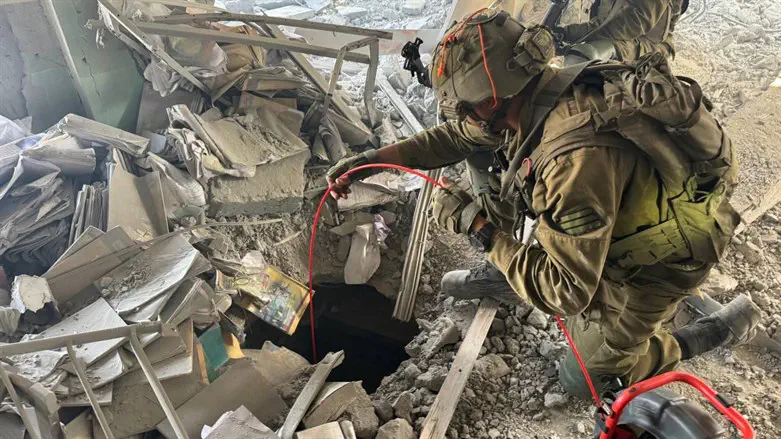
Historically, countries have waged war with other countries, not governments. This is true in a ‘normal’ war. How much more so does it apply in a place like Gaza, where military infrastructure is built in and under every school and every hospital, where Israeli soldiers reported that every second home had an armoury and an entrance shaft to the Gaza ‘metro’ tunnel network.
In Gaza, this integration of military and civilian society is not only within the physical infrastructure. Palestinian Arab society is permeated with anti-Jewish sentiment. Israeli actor and singer Idan Amedi (who served, and was injured in Gaza) reported that: “Every home in Gaza is filled with antisemitic, anti-Jewish propaganda. From images of ‘martyrs’ to stickers saying, ‘With blood and fire we will reach Jerusalem.’”
It's no wonder that Hamas has no problem finding new recruits, and that not one Gazan has found a way to provide information on the hostages - compare that to the German and Polish citizens who risked, and sometimes lost, their lives to hide Jews. True, they were few, but in Gaza they were non-existent.
Israel’s biggest mistake on the PR front is that it still thinks it’s fighting a war against terrorists, as I have written in this publication previously. However, what happened on 7th October was not simply a terrorist attack. It was a well-planned and executed invasion of the State of Israel by thousands of Gazan combatants and many "civilians".
As Israeli general Girora Eiland put it:
Gaza… resembles 1930s Germany, where an extremist party won elections, with the support of most of the people, and quickly unified the military and civil government into one entity.
In Gaza, with the support of perhaps 80% of the residents, Hamas has done much the same thing. It’s a de facto state, with all the characteristics of a state.
What happened on October 7 is that the State of Gaza went to war against the State of Israel. State against state.
Treating Hamas as a separate terrorist group, disconnected from the rest of Gaza, has been weaponised by our enemies who marketed the exaggerated suffering of Gaza’s population as a blood libel against Israel. While some paid lip service to Israel’s justified war against Hamas, they ignored the Hamas government's connection to the current state of suffering in Gaza.
Which brings us to the Palestinian Arab state.
World leaders from Paris to London to Canberra have called out Hamas for their inhumane practices while, from the other side of their mouths, expressed recognition for the "State of Palestine".
The knee-jerk reaction from Israel and its friends has been that this is “rewarding terrorism”. But if you compartmentalise the evils of Palestinian Arab violence and label it as “Hamas” as distinct from the “honourable” Palestinian Arab cause, you can say that it is not. Israel can then be expected to magically deal with Hamas and let the good Gazans (and other Palestinian Arabs) exercise their "right" to statehood. Not so.
Even some of our well-meaning friends are adopting this position. On the front page of an edition of the Australian Jewish News (15 August 2025), a sponsored message from Opposition Leader, Sussan Ley, appeared stating that “We will not support the recognition of a Palestinian state with Hamas still in control of Gaza.”
I’m sorry Sussan, but even if Hamas is no longer in control of Gaza, a Palestinian Arab state is a bad idea.
The horse has long bolted, but if we have any chance of reversing the diplomatic Tsunami heading Israel’s way, we need first to get our messaging clear, and at the very least explain that Hamas is not some aberration.
Hamas and the Palestinian Arabs give us pretty much the same thing.
The hundreds of thousands of “Pro-Palestine” marchers around the world yelling “from the river to the sea” make no distinction between Palestinian Arabs and Hamas. Why should we?
Mordechai Smith is a member of the Sydney Jewish community who has long held an interest in history and current political events and has written for the Australiaan Jewish News.