
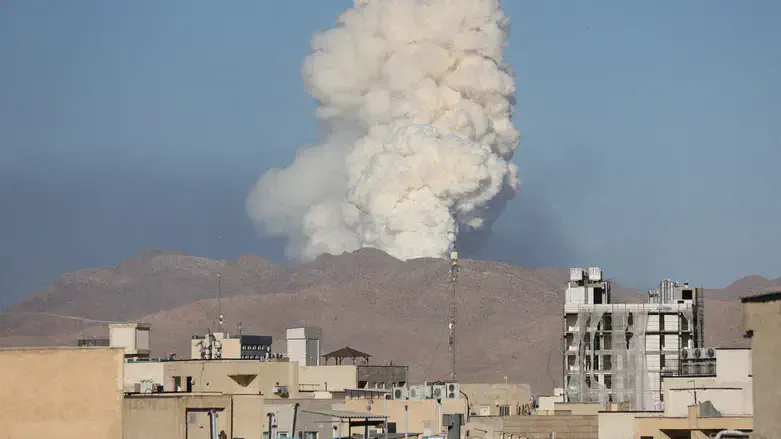
The United States executed Operation Midnight Hammer on June 22, 2025, employing roughly 125 aircraft, including seven B-2s, against Fordow, Natanz, and Isfahan-sites long assessed as the backbone of Iran’s enrichment enterprise [1][2][6]. Pentagon and administration statements characterized the strikes as highly successful, but open-source damage assessments and early intelligence leaks indicate disruption rather than destruction of Iran’s nuclear capability [3][12][25][37].
Publicly available technical reporting confirms first-ever combat use of the 30,000-lb GBU-57 Massive Ordnance Penetrator (MOP) against deeply buried targets; however, the translation of paper penetration performance into complex geology remains contested [4][7][18][21][35]. In my opinion, the best available open-source evidence supports the thesis that the strikes severely disrupted-but did not destroy-the program. The combination of possible pre-strike dispersal of enriched material, survivability of buried halls that cannot be verified from space, preserved expertise, and ongoing construction at deeper sites is more consistent with delay and degradation than with eradication [3][12][31][34][37][42][45][46].
Fordow’s enrichment halls lie under great overburden-often described as on the order of tens of meters of rock and reinforced concrete-which is precisely the archetype of target for which the MOP was designed, yet also among the hardest to neutralize with conventional means [18][21][22][49]. Maxar/Planet imagery, analyzed by major outlets, shows multiple craters and debris plumes concentrated around access points at Fordow and damage to surface support structures, but satellite pictures cannot conclusively reveal the condition of underground centrifuge galleries [23][24][25][29][50]. Preliminary assessments therefore converged on a mixed picture: significant surface and tunnel damage, severe impairment to power and conversion systems, and uncertainty about the status of buried cascades [3][12][25].
At Natanz, already damaged by Israel’s opening blows in mid-June, the United States added at least one MOP strike while cruise missiles and other munitions were used to finish off vulnerable above-ground elements; Isfahan’s conversion complex, by contrast, was reportedly hit by a salvo of Tomahawk land-attack missiles from a U.S. submarine, destroying numerous surface facilities tied to UF₆ conversion and uranium-metal work [2][6][8][28][29][30][47][48]. This pattern is consistent with target-system logic: use penetrators against deeply buried enrichment and standoff weapons against conversion, storage, and power infrastructure [18][28][30][47].
Iran’s counter-narrative emphasized pre-emptive evacuation and rapid continuity measures. In the days before the attack, unusual convoy activity and cargo traffic were observed near Fordow and Natanz, and Iranian officials later claimed critical materials had been removed, while intelligence assessments cautiously supported at least partial relocation of sensitive items [31][32][33]. If any portion of Iran’s 60 % enriched stock-about 408-410 kg as of mid-May 2025-survived via dispersal, the core of breakout potential remains intact because the jump from 60 % to weapons-grade (~90 %) requires comparatively modest additional separative work [14][15][19][31][33][43][44]. This, together with preserved intellectual capital among scientists and engineers, implies time-bound disruption rather than programmatic annihilation [12][16].
Subsequent weeks brought corroborating signs. The IAEA Director-General reiterated that attacks on nuclear facilities entail safety risks and noted the absence of radiological releases, aligning with open-source imagery that showed conventional-damage signatures rather than breached radiological containment [3][16]. Meanwhile, multiple monitoring groups and press analyses reported accelerated underground construction at the Kuh-e Kolang Gaz La (“Pickaxe Mountain”) complex south of Natanz-assessed to be both deep and expanding-consistent with Iranian efforts to increase survivability and strategic depth after the strikes [3][11][34][45][46]. The re-imposition (“snapback”) of U.N. sanctions by the E3, and Iran’s threatened further curbs on IAEA access, underscored the growing opacity around stockpiles and site status-an opacity that complicates confident claims of either total destruction or rapid restoration, but is wholly compatible with a robust residual reconstitution pathway [5][42].
Technically, Iran’s migration from IR-1 to IR-6 centrifuges multiplied effective SWU capacity by an order of magnitude, shortening timelines for any future ramp if cascades, spare rotors, or key subassemblies were preserved or can be re-manufactured; discipline in supply chains and underground siting magnifies this resilience [14][18][34]. Authoritative backgrounders concur that post-strike breakout remains a function of surviving material, machine availability, and access to power and feedstock lines, rather than a simple binary of “destroyed vs. intact” [2][6][12][18].
Strategically, the E3’s snapback and the U.N. Secretary-General’s warnings highlighted how unilateral military action, absent sustained inspections and diplomacy, can reduce transparency even as it imposes material costs, leaving a latent but harder-to-measure capability [5][8]. Regional and global commentary-across think-tanks, technical magazines, and OSINT outlets-has converged on a sober bottom line: the strikes likely set Iran back months, damaged key nodes, and forced costly repairs and redesigns, but they did not comprehensively eliminate Iran’s ability to enrich again if the political decision is taken [3][6][12][37].
- U.S. Department of Defense. “Defense Agency Contributed Toward Operation Midnight Hammer Success.” DOD News, July 10, 2025.
- Council on Foreign Relations (Ferragamo, M.). “U.S., Israel Attack Iranian Nuclear Targets-Assessing the Damage.” June 25, 2025.
- The Washington Post. “After U.S. Strikes, Iran Increases Work at Mysterious Underground Site.” Sept. 26, 2025.
- Béchard, D. E. “Why This Is the Only Bomb That Could Destroy Iran’s Nuclear Bunker.” Scientific American, June 18, 2025.
- Reuters. “‘Snapback’ Sends West Back to the Drawing Board on Iran’s Nuclear Programme.” Sept. 27, 2025.
- Financial Times. “Iran Hit with Reimposition of Sanctions over Its Nuclear Programme.” Sept. 27, 2025.
- Wikipedia. “GBU-57A/B MOP.” Updated 2025. (Background specs and chronology.)
- United Nations Press Office. “United States Bombing of Iran’s Nuclear Facilities Marks a ‘Perilous Turn’.” June 22, 2025.
- PIR Center (H. Linus). “Strikes on Iran Are Not the Victory Many Think.” 2025 (cites CFR damage assessment).
- CFR. “Iran’s Conflict with Israel and the United States (Tracker and Backgrounders).” June-Aug. 2025.
- Kurdistan24. “After U.S. Strikes, Iran Increases Work at Mysterious Underground Site.” Late Sept. 2025.
- Carnegie Endowment. “The Most Significant Long-Term Consequence of the U.S. Strikes on Iran: Monitoring and the IAEA.” June 26, 2025.
- U.S. Department of Defense. “Historically Successful Strike on Iranian Nuclear Site Was 15 Years in the Making.” June 26, 2025.
- CSIS. “Options for Targeting Iran’s Fordow Nuclear Facility.” June 18, 2025.
- ABC News. “Satellite Images Show Extent of U.S. Bombing Damage to Iran’s Nuclear Sites.” June 23, 2025.
- World Nuclear News. “IAEA’s Grossi ‘Deeply Concerned’ After Attack on Iran Nuclear Facilities.” June 13, 2025.
- Wikipedia. “United States Strikes on Iranian Nuclear Sites (2025).” (Roundup of public claims; use cautiously.)
- CSIS. “What Operation Midnight Hammer Means for the Future of Iran’s Nuclear Ambitions.” June 23, 2025.
- Al Jazeera. “Iran Increases Stockpile of Enriched Uranium by 50%-IAEA Says.” May 31, 2025.
- Reuters. “Iranian Commander Points to Potential Missile Range Increase.” Oct. 1, 2025. (Regional escalation context.)
- Scientific and defense press summarizing MOP penetration physics (see 4, 7, 18). (Consolidated technical background.)
- CSIS/technical briefs on cumulative/sequential aim-point tactics against hardened targets (integrated in 14 and 18).
- CBS News. “Satellite Photos Show Before and After U.S. Strikes on Iran’s Fordow Site.” June 22, 2025.
- General limitations of overhead/SAR imagery for subterranean damage assessment discussed across 2-3, 15-16 (synthesis).
- CFR (and follow-on briefings). “Assessing the Damage to Iran’s Nuclear Targets.” June 25-27, 2025 (revisions and caveats).
- Facility scale/context summaries for Natanz and Fordow drawn from CFR tracker and Al Jazeera explainer.
- DoD briefings aggregating B-2/MOP sorties and order of battle (1, 13).
- Washington Post synthesis noting Tomahawk strikes on the Isfahan complex. Sept. 26, 2025.
- ABC/Maxar detail on crater fields and access damage at Fordow. June 23, 2025.
- Defense-technology commentary on limits of cruise missiles vs. deeply buried targets (integrated in 18, 21).
- Media and OSINT references to pre-strike convoys/evacuations near Fordow and Natanz (CBS, CFR).
- Iranian state claims of prior evacuation covered in international press roundups (see 3, 17).
- CFR and allied reporting alluding to partial relocation of enriched material. June 2025.
- Washington Post / regional outlets on accelerated tunneling at Pickaxe Mountain, depth estimates (260-330 ft). Sept.-Oct. 2025.
- The Guardian and technical press discussing MOP’s first combat use and uncertainties (synthesized from 4, 7, 18). (Background consolidation.)
- Janes OSINT. “US Strikes Iranian Nuclear Infrastructure with GBU-57s and TLAMs.” June 23, 2025.
- CFR roundups citing early U.S. intel that delays may be measured in months, not years. June 25-29, 2025.
- DOD News: sortie composition and lack of Iranian SAM engagement during egress (as reported in 1).
- FDD / policy fora aggregations on prior testing of MOP and bunker-busting options (contextualized via 14, 18).
- Major-press commentary on uncertainty of underground effects notwithstanding visible surface ruin (e.g., WaPo/ABC; see 3, 15).
- CFR tracker updates on regime stability and strategic implications (June 2025).
- Reuters. “E3 ‘Snapback’ and Diminished Leverage Over Iran’s Program.” Sept. 27, 2025.
- Al Jazeera. “Is Iran ‘Very Close’ to a Bomb? Enrichment to 60% and Timelines.” June 18, 2025.
- Al Jazeera. “IAEA Chief: Iran Could Resume Enrichment Within Months.” June 29, 2025.
- Lorient-Le Jour. “Work Allegedly Underway at Mysterious Underground Site in Iran.” Late Sept. 2025.
- Iran International. “Iran Expands Secret Underground Site After Nuclear Strikes.” Sept. 2025.
- CSIS (Q&A format). “Facilities Targeted by Operation Midnight Hammer.” June 23, 2025.
- Janes (mission summary; first use of MOP). June 23, 2025.
- Al Jazeera explainer. “What Is Iran’s Fordow Facility and Could U.S. Weapons Destroy It?” June 19, 2025.
- ABC/Maxar and WaPo composites on “before/after” damage signatures and continued underground work (June-Sept. 2025).