

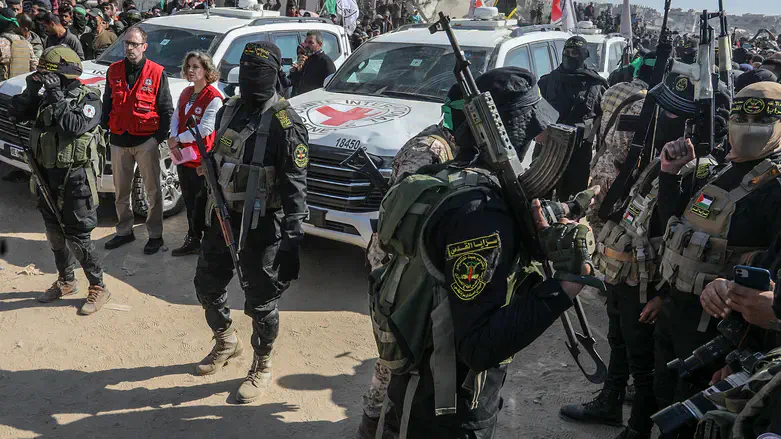
As Israel anxiously awaits the return of the bodies of twenty-eight hostages brutally murdered by Hamas, Yehuda Avidan, Director-General of the Ministry of Religious Services, spoke with Kan Reshet Bet about the extensive preparations underway to receive the bodies, honor the fallen, and support their bereaved families.
Avidan described the intricate and delicate process being conducted behind the scenes to ensure the dignified repatriation of the hostages’ remains.
“We are preparing to receive anywhere between one and twenty-eight bodies,” Avidan explained, clarifying that despite all estimates, the exact number remains uncertain. “We are acting with the utmost sensitivity and understanding, as we have throughout this war,” he added.
Fear of explosives until final identification
According to Avidan, the operation to receive the bodies is far from simple and involves significant security risks.
“We do not trust Hamas with anything,” he stressed, recalling previous instances in which bodies were booby-trapped with grenades or explosives. “Therefore, before any identification procedures begin, each body undergoes a comprehensive and meticulous inspection.”
The preliminary identification is conducted by the Red Cross before the bodies are transferred to the Institute of Forensic Medicine in Abu Kabir. “That is where the full and complex identification process begins,” Avidan explained. “It includes intelligence files compiled for every fallen hostage.”
He noted that most of the twenty-eight hostages have already been declared deceased by a special committee established for the first time in Israel, headed by Chief Rabbi Yitzhak Yosef. “There is no room for error,” he emphasized, adding that the committee’s decisions were based solely on unequivocal evidence-also to enable widows to remarry in accordance with Jewish law.
A second, yet painfully real, funeral
Avidan described an especially heart-wrenching reality: Some families have already completed the traditional *shiva* mourning period and even held symbolic burials, placing personal items in lieu of their loved ones. Now, with the return of the actual bodies, they face the agony of a second funeral.
“We are assisting each family with the arrangements and conducting a proper funeral for every fallen hostage,” said Avidan. “Our goal is to ensure that every family has the opportunity to bid a final farewell with dignity.”
The Ministry of Religious Services, together with the IDF, police, and other state agencies, remains in continuous contact with the families to accommodate their wishes regarding burial and memorial ceremonies. “We are doing everything possible to give each family the honor and respect they deserve,” Avidan concluded.
'My greatest fear'
When asked about his deepest concern, Avidan responded without hesitation: “Ron Arad.” He explained that his greatest fear is that Hamas may claim that some of the bodies were never recovered-leaving the families in an agonizing state of uncertainty.
“That is the most terrifying scenario,” he admitted, expressing hope that every last captive and fallen soldier will be brought home and that the war will end swiftly.
Avidan concluded with a heartfelt message: “May we only hear good news,” he said softly. “May we never again face such painful circumstances.”