
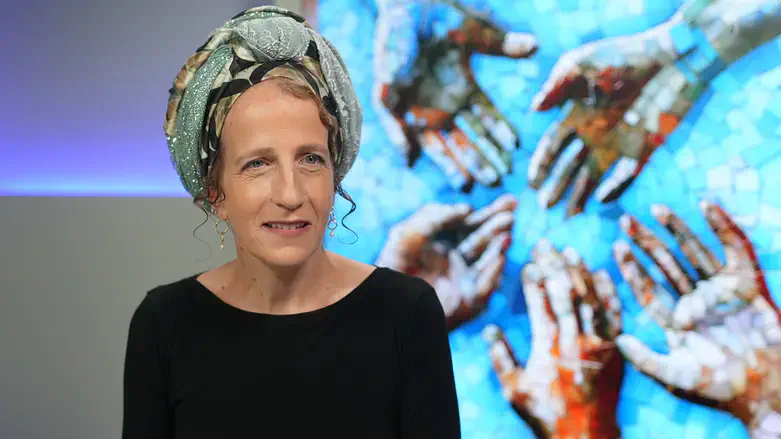
Ofra Lax is a well known Israeli journalist, who writes weekly columns for Makor Rishon and was formerly on the staff of the Besheva weekly newspaper. Her son Naveh,Hy"d, a soldier in the IDF's elite Sayeret Matkal, fell in the battle of Kibbutz Be'eri on October 7, 2023.
At the beginning of last week, after a drive in which I barely paid attention to the road, I began to wonder if I should put a sign on my rear car window - not one of those standard yellow signs commonly seen on Israeli cars warning of a “new driver” or “baby in the car,” but one that says “beware, yahrzeit coming” with an apologetic imogi. I don’t notice that the light has turned green, nor that I am driving like a snail in the left lane, even miss my exit because I am not sure which direction I should take.
The knowledge that the yahrzeit is about to take place is interspersed with the still-present atmosphere of the High Holy days, and together they take over every part of my body and soul, my legs and arms feel heavy, my eyes are constantly tearing, my lungs get insufficient oxygen, and my head is simply not functioning. Soon it will be two years since the invasion. Two years since the worst day Israel has experienced since its establishment. Two years since my beloved son Naveh, fell in battle at Kibbutz Be’eri as he and his friends fought to save their brothers from the hands of a cruel enemy.
Lots of things happen in two years. A two-year-old knows how to run, not just walk, he understands humor, can converse and stand up for what he wants. Within just two years he turns from a helpless, tiny infant to a small but interesting person. Two years is enough time to recover from an operation, get over a disease, for a scar to lighten. Two years is a long time to be bereaved. Months and hours and minutes of pain and lack and longing, a never-ending hope that he will open the gate, rush up the steps, throw down his backpack and wrap me in a bear hug while trying to explain that the whole thing was a mistake, a bad joke. These have been days too hard to bear, days in which time froze, nothing healed, nothing lightened, nothing got better. Part of me stopped still on that day.
Naveh and my husband, Noam, both loved to research the Yom Kippur War. They would delve into the surprise attack and how it was blocked, the battles and the memorials. With me, Naveh talked about books and poems. Those interests merged in a poem I wrote on our three-person WhatsApp chat, “Aba-Ima and Naveh.” Written by Avraham Balaban, the poem’s title is a date, “10.12.1973”:
“On the twelfth of October, nineteen seventy-eight/ in a Tel Aviv supermarket/ a bent and bowed-down woman/ writes the date 10.12.1973/on a check/ and the cashier says/ no ma’am, it’s 1978 not 1973/and he laughs/then freezes/then whispers:/What can we do, ma’am/What can we do…”
In my mind’s eyes, I still see the bodies strewn on the sides of Road 232, the chaos at the Reim parking lot after the massacre at the Nova rave, the smoking, wrecked homes of Kibbutz Be’eri, those at Nir Oz broken open - that is, before they were shut to respect the privacy of those murdered or taken hostage who once lived there. The story of the battles at the outposts, in Ofakim and Sderot are still going on inside me, and I don’t know if that Is because of the magnitude of the event or because Naveh is forever part of that story.
I thought naively that the Jewish People would never get over the shock, the sound and fury of that day. Not after those horrible deeds and their scope, not after our fighters described what they found in the homes in Gaza and certainly not after hearing the stories of the released hostages which prove that there are no innocent civilians in Gaza, no residents who are not willing partners in the barbaric struggle against us, the Jews. But it seems there are those who have already forgotten, who feel sorry for our bitter enemies, who accuse us of Hamas crimes, who believe the terrorists’ lying reports and statistics. Does one have to bear a personal scar from that day in order to be able to recall what really happened here?
You missed a stop
Sometimes I feel like an actress in a European movie, standing at a busy train station wearing a coat, looking at the trains passing and not understanding where everyone is travelling to, or more exactly, how they are travelling at all. They are skipping a stop that they are not allowed to miss, the stop called “Responsibility.”
I imagined that the day after the surprise attack, the entire army, Shabak, government and Knesset would hold meetings, publicly aired meetings that the entire nation could watch. And that one after another they would approach the podium - the head of the Shabak, the Commander in Chief and all the army and intelligence personnel connected to that days’ failures, including the has-beens and the MKs. Each in his turn would stand with wet eyes cast down, beg for forgiveness, add “I erred” and end with his resignation. Not that he had to leave his post at that moment, that was not possible. Those very same people had to turn the situation around, defeat Hamas and all the other fronts that opened since October 7, restore our security and then hand the reins to others.
I don’t see this as a political issue, but as a moral one. If the decision makers on all levels had an ounce of integrity, that would have happened long ago. Yes, we need an investigative committee that the public, not just the Opposition, has faith in, but the truth is that I don’t rely on its findings to begin with. I am still living that day and I still wait for them to accept their responsibility. I don’t have the luxury of cooling down or forgetting.
A great deal happened during the past two years. The IDF’s successes on many fronts are praiseworthy, the country is rebuilding and repairing, people have grown up, married and given birth to children. Our state and our people are moving forward. And as for me - along with the feeling of being rooted to the same spot, I feel that I am in motion as well, pushing forward and upward. In my daily and hourly work.
The source of inspiration for me are the bereaved families, all of them, the veteran and the new, those I meet at various opportunities. I don’t know most of their names, they have never appeared on stage or held a microphone, but they are worthy of being our mentors. They choose to continue to live each day, to influence everyone for the good - themselves, their family members, and sometimes, the nation in its entirety. And encircling all of them, myself included, is the great embrace of the People of Israel, its organizations, initiatives, family and friends - like a merciful Sukkah, warm, appreciative, encouraging, understanding, trying to follow the path of those who commanded us to live, those who don’t forget.
This article first appeared in the Makor Rishon weekly newspaper and was translated, with permission, by Rochel Sylvetsky.