

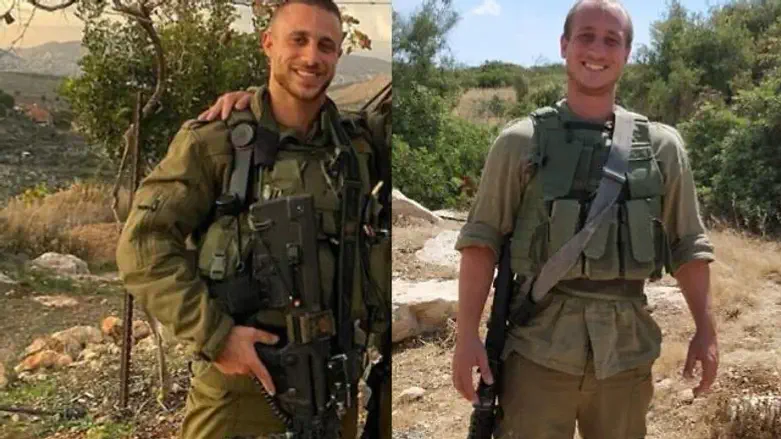
What gave rise to the level of courage we witnessed on October 7, 2023? What explains the unmatched phenomenon of two young men who rushed down south to fight before they were sent orders, and who were prepared to give up their lives without a moment’s hesitation to save their fellow Israelis in communities invaded by Nukhba terrorists?
Rabbi Avraham HaCohen Kook zts"l once said that there is a deep, inner power in Israel’s spirit, whose source is the soul of Am Yisrael.It is not just the result of being raised on idealism and sacrifice. It is something far deeper, a power found within the IDF soul. Perhaps the answer lies there.
The horrific initial success of Hamas’s barbaric surprise attack two years ago led to immeasurable heroism. Israelis rushed to the Gaza Envelope to help, some, like Noam and Yishai Slotki, armed only with handguns, paying with their lives. This was civilian heroism, on a level we cannot understand rationally because this war brought a new, higher level of Israeli courage and caring to the fore.
The Zionist enterprise revealed the scope of Jewish bravery once again, showed we are a nation of heroic fighters. The Patriarch Avraham was the first Hebrew fighter, then the Patriarch Jacob and Moshe Rabbeinu, then King Saul and King David, the Hasmoneans and the Great Rebellions, true heroes all.And IDF fighters are revealing that bravery anew.*
Yishai and Noam Slotki, closeknit brothers, loving young fathers and husbands, reached the Gaza Envelope by 9:40 in the morning, having rushed there together from their homes in Be’er Sheva with their personal firearms as soon as they heard of the terrorist invasion. Yishai had brought his wife and infant daughter to Noam’s home after he heard about it on a neighbor’s radio as they sheltered on the stairs from a siren, and since the two brothers were in the Shabak, they began hearing cries for help on the phone, but also knew how to use hand guns effectively.
Noam soon followed Yishai and the two met at the outskirts of the city, continuing south in one vehicle. They uncharacteristically did not obey their much-respected eldest brother Ori, who called at 9 from his army post up north telling them to turn back. The two jumped out of the car at Kibbutz Alumim, where it was later found, and rushed towards the fighting.
First Sergeant Noam Slotki (31) was a combat medic in the reserve infantry Karmeli Brigade, and Master Sergent Yishay Slotki (24), was a fighter in the reserve infantry Oded Brigade.
Their father, Major (res.) Rabbi Shmuel Slotki, says proudly, but longingly: “You can see them in the security cameras, rushing towards the terrorists’ location with guns drawn, focused on their goal. We know they saw a terrorist ambush, with tens of Nukhbas armed with long weapons and RPGs, then they hid in a wadi at the side of the road and began to fire their weapons. When they were found, the area around them was strewn with terrorist bodies. When they ran out of bullets, they grabbed the rifles of terrorists they had killed.They saved the entire Kibbutz, the army told us - the terrorists gave up and never managed to enter its gates, although they had cruelly murdered twenty foreign workers who lived in a nearby building outside the kibbutz. “
“All seven of our children are very close to one another," he continues, “and three of them, Noam, Yishai and Shifra, lived near each other in Be’er Sheva, ate Shabbat meals together, did things together and helped each other with the children. Noam and Yishai were always inseparable, although Noam was our second child and Yishai, slightly older than his twin brother, our fifth."
Noam was born on the 4th of Elul, September 9, 1992, to Tal and Shmuel Slotki, and spent his first two years in Gush Etzion as his father was learning at the Har Etzion Yeshiva located there. The family then spent 3 years in Cleveland as emissaries of Torah Mitzion, the World Movement which impacts Jewish communities by creating Torah study centers, encouraging youth leadership and bonding to the State of Israel, and then Rabbi Slotki was asked to serve as rabbi ofKibbutz Ein Hanetsiv in the beautiful Beit Shean Valley.
Kibbutz members remember Noamas a sweet, sociable, extremely sharp, bright and just as mischievous child who, as he grew up, felt he had better things to do than study.He stayed on the kibbutz when his parents moved to Jerusalem when he was a senior in high school, enlisted in Golani instead, first in the Egoz elite unit where disciplinary issues led to his becoming a medic, having volunteered for Magen David Adom at the kibbutz. (The kibbutz holds a soccer tournament in his memory every year now.) He continued his IDF service working for the Shabak and spoke fluent Arabic, but when he married his longtime girlfriend Adi in 2016, he took himself into hand, went back to school and achieved a B.A. in Middle Eastern Studies and History at Be’er Sheva U.
“All my dreams, all my aspirations and all the light in my life were always connected to our partnership and love,“ Adi says simply.
Feeling it was “in tune with the way the world is going," explains his maternal grandfather, leading Religious Zionist figure, Rabbi Eitan Eisman, “Noam switched to Economics, Cyber and Business Administration for his M.A. as well as actuarial science, and was soon hired as a Data Analyst at the multinational cyber security company, Check Point Software Technologies. He had a bright future ahead of him, a loving wife who is also a data analyst, and a one-year-old little boy Neta Yehuda, who looks just like him." Neta Yehuda is named for Noam’s uncle, Rabbi Eisman’s son, who fell during his IDF service over two decades ago.
Noam was promoted to the rank of Advanced Sergeant Major after his death.
Yishai was born erev Shavuot, May 19, 1999, before sunset and his twin Yonatan, after sunset. The two bright but rambunctious youngsters were together all day in the Kibbutz children’s quarters till 3rd grade, then attended the Noam school in Ramot, Jerusalem till the end of 6th grade, went on to Yeshivat Noam, but Yishai switched to the Ahavat Chaim yeshiva in Kochav Hashachar that could deal with his attention issues. He liked it, but it was too much frontal learning for him and at the end of the 11th grade he left, volunteered in Lev Binyamin in Ofra for children with special needs, putting his whole soul into being a caring mentor.He was also a successful Bnai Akiva counselor in Ramot Eshkol, walking close to an hour from Ramot Gimmel every Shabbat.
The pre army mechina in Dimona, where he was considered a natural leader, was where he finished his matriculation exams, later enlisting along with Yonatan in Golani’s reconnaissance unit, then fighting inBattalion 7006 as a reservist. He worked for the Defense Ministry after completing his service where co-workers said that “he always volunteered unquestioningly, his good heart shone through his modest and pleasant bearing, he was a true friend that could be counted on to raise everyone’s morale, someone with whom it was impossible to sustain an argument."
Aviya, Yishai’s wife, from Yad Binyamin, was doing her national service in Ofra when a friend introduced them. She says he would often suggest:“let’s live our lives instead of thinking about them." By October 7, Yishai had left the army and was planning to study, but didn’t make it.
Yishai’s body was identified during thechaotic days of attempting to distinguish between the many terrorist and Jewish bodies, because he wore a ring made by Aviya’s grandfather’s friend, burned by a grenade but identifiable. Their little girl, Be'eri, was just two months old when he fell.
Yishai was promoted to Master Sergeant after his death.
Aviya continued her studies with the family’s help and has just finished her degree in electrical engineering, one of the few women in the field.
It is illuminating to hear the Slotki parents’ educational philosophy from Hadassah Slotki, Noam and Yishai’s paternal grandmother (Disclosure: Hadassah is also a personal friend of many years and was a dedicated department head in Emunah Israel when I was CEO, whose late daughter was a well-known philosophy professor at Ben Gurion Univ., R.S.). She explained that both boys did not like to study, but their parents calmly told the anxious grandmother that when they were ready, their talents would shine.
They were full of life and everyone loved them because of their happy personalities. The two would go sit at the shores of the Kinneret, and had to be persuaded to do their bagrut (matriculation) exams, but still, their parents, with infinite patience and love, said to let them be.And that is just what happened.They finished school, became respected officers inculcated with the right values, succeeded in their budding careers.
“And", she says sadly, “they were the ‘boys who put their fingers in the dike,’ saving so many lives with their unflinching courage. It’s hard to live a life of national values, but they didn’t think twice."
Family friend, poet and choir leader Richard Shavei-Tzion adds in a JPost memorial article in 2023, “the Slotki offspring grew up on a diet of Zionism, deep commitment to land, nation and family. The assumption of responsibility for people in distress was embedded in them as deep as DNA. Both parents are role models. Talia is a senior and veteran nurse at Jerusalem’s Shaare Zedek Medical Center, currently serving as the hospital’s pain management coordinator… Rabbi Shmuel is a revered communal rabbi with a quiet charisma and the ability to deliver complex sermons with profound insight, a judge in an army conversion court and CEO of the Organization of Orthodox Synagogues…"
Rabbi Slotki, who also served in the Rabbinate unit identifying October 7th victims at Shura army base, eulogized his sons: “My beloved Noam and Yishai, it is with great sadness we bring you to your eternal rest, but also with great pride and our heads raised high at the way you decided to act last Shabbat, the way you showed your characters and personalities. We miss you unbearably, a large hole is in our hearts, but we are grateful for the years we had together, the good you left behind and what will grow because of you. Your deeds are your heritage, along with the values of unity, love of man and mutual responsibility that we must adopt in Israeli society."
Rabbi Eisman said: “Twenty one years ago I stood at the military cemetery on Mount Herzl [to burymy son] and I am here again today to bury my two grandsons. I recall the biblical verse (said by Matriarch Rebecca, R.S.) ‘Why am I losing my two sons on one day?’. It is not normal. It is not real. It is an impossible scenario. Yet the great willingness to sacrifice existing within our holy people and being revealed now is the best of our nation."
Yishai’s battalion commander said: “Today Israel has lost two of its best sons. ‘Beloved and pleasant in their lives and unseparated in their deaths (David’s elegy for Saul and Jonathan, R.S.)’. Noam, always first to volunteer. Yishai, a brave fighter, always ready to be first on every mission. You were both willing to volunteer without anyone requesting it. Be proud of Noam and Yishai, dear Slotki family."
And the family has managed to turn their bottomless grief into well-deserved pride. A podcast in the “Making History" series tells the story of the two heroes on that fateful day. Noam and Yishai were posthumously awarded the President’s Award for Civilian Heroism. Caps and stickers in their memory say "A hero is someone who cannot stand by passively." An outpost is dedicated to Yishai.
The family works tirelessly and in many other ways to inculcate their heritage of mutual responsibility and unity, among them: libraries andstudy corners, a matchmaking site and one encouraging naming children for fallen soldiers - all bearing the names of Yishai and Noam.
May their memories be blessed.
Source:
*Based on the words of Rabbi Aharon Eisenthal, a hero of the Yom Kippur war, in a recent interview.