
Rabbi Shlomo Aviner heads Ateret Cohanim Yeshiva in the Old City of Jerusalem.
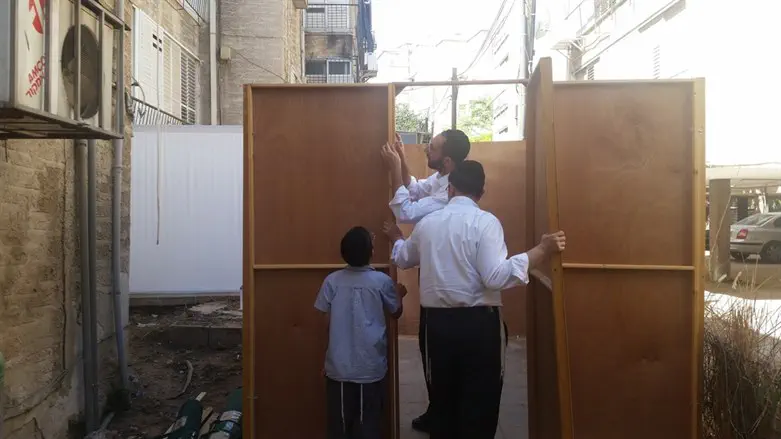
Our Sages have noted that the mitzva of sukkah is unique in that it is performed with the whole body. One walks into the mitzvah of sukkah fully clothed, down to the mud on one’s boots. In this way, the mitzvah of sukkah is similar to the mitzvah of building Eretz Yisrael. There is even a source for this parallel in Tehillim: “And His sukkah was in Shalem, and His dwelling place in Zion”; sukkah is equated with Zion.
The Vilna Gaon notes another similarity: just as one is commanded to construct one’s own sukkah (“ta’aseh ve’lo min ha’asui”), so is one commanded to be personally involved in the mitzvah of building Eretz Yisrael. These are acts which are blessed by God.
Moreover, one can even perform the mitzvah of sukkah while asleep. Halakha considers it more important to sleep in a sukkah than to eat in it. This indicates that there are mitzvot which, by their very nature, a Jew performs unconsciously - a sign of the unique quality of the Jewish soul. Likewise, the mitzvah of living in Eretz Yisrael is also fulfilled while asleep.
On Sukkot, we demonstrate that we are in love with life in this world; with our whole being, we immerse ourselves in the mitzvah. We fulfill the mitzvah with our bodies, even when our intellect and consciousness are asleep.
In contrast, on Yom Kippur, we minimize our ties with the physical world, in imitation of the angels. As soon as the fast of Yom Kippur ends, we begin to build our sukkot, emphasizing the connection between these two seemingly opposite mitzvot, which together demonstrate the distinctive nature of the Jewish soul.
Sukkot does not signify a spiritual decline from Yom Kippur. On the contrary, the “other-worldly” sanctity of Yom Kippur is absorbed in the “this-worldly,” tangible mitzvah of sukkah.
Our Sages debated which type of shofar is preferable - straight or bent - and finally ruled that a shofar should be bent. The reason for this is that during the High Holidays, we emphasize the spiritual, and the material must bow down before it. However, after this period of spiritual purification, we return to the physical, material world with the lulav in our hands. A kosher lulav, in contrast to the shofar, has to be straight. If it is bent or bowed, it is disqualified, for the lulav must stand upright in its sacredness.
What does Sukkot commemorate?
What it is that we commemorate on Sukkot. R. Eliezer claims that the huts in which we dwell on Sukkot represent the actual huts in which Am Yisrael dwelt in the desert. R. Akiva maintains that the huts symbolize the Clouds of Glory which hovered over Am Yisrael in the desert.
The forty years that Am Yisrael spent in the desert after leaving Egypt were a difficult test indeed. The men, women and children were threatened by snakes and scorpions, and had to cope with insufficient water, unbearable heat during the day and biting frost at night. Meanwhile, they hungered for real bread as opposed to manna.
These forty years of trials were God’s way of educating Am Yisrael to appreciate the good and overcome the bad, to be satisfied with their lot, and to view life with a balanced perspective. Commemorating that period of challenge and growth equips us with the ability to come to terms with the positive and the negative that we experience. The forty years of hardship in the desert were part of God’s plan to educate His nation. Causing us to stay so long in the hostile desert was designed to teach us to appreciate the good in life and to be grateful for what we have been given.
Difficult trials strengthen character, as opposed to “the good life” which, in excess, spoils people and weakens their ability to cope. The suffering in the desert was for our own good, as the verse says, “In order to try you and to test you, to benefit you at the end.” These tests prepared us and nurtured within us the strength of character that enabled us to fight during the conquering of Eretz Yisrael and during the other struggles that have been our lot over the years. One could argue: We, the descendants of that generation, weren’t in the desert and weren’t tested with those difficulties. What relevance and benefit do their challenges have for us today? Just as a person can go through a powerful experience that has a great impact upon him or her, and will remain indelibly imprinted memory on a personal level, so, too, are there experiences that are forever engraved in our national psyche, so that subsequent generations and individuals still perceive them and feel their influence.
Clouds of Glory
The Divine Clouds of Glory surrounded and guided us through all the years we spent in the desert, as it says, “According to God’s word they encamped, and according to God’s word they traveled.” All our comings and goings were mandated by the Clouds of Glory.
But were they really necessary? Isn’t the whole world a witness to the Creator? It is true that all of creation proclaims God’s glory, but there are varying degrees in the revelation of God’s grandeur in creation. Mankind created in God’s image manifests a more refined level of God’s glory than does the rest of creation, but the pinnacle of God’s revelation in the world is through Am Yisrael.
God’s presence was revealed through us in the desert, hovering over us in all our nomadic wanderings. He did not abandon us to drift in the desert; rather, the traveling was part and parcel of Divine Providence, as it says, “According to God’s word they encamped, and according to God’s word they traveled.” The Clouds of Glory were the means by which God led us, watched over us and protected us. This is so despite all our sins during those forty years in the desert: the Golden Calf, the Sin of the Spies, the complaining, the promiscuity with the daughters of Moab, and so on.
We have to know that notwithstanding our transgressions, God is always with us, as it says, “Who dwells with them amidst their impurity.” Whether we realize it or not, Divine Providence continually guides us and watches over us. Just as the Clouds of Glory were manifest yet also hazy, unclear, hidden and incomprehensible, so is it hard for us today to discern the Hand of God in everything that happens. There is much that we don’t understand. The Torah itself was given in fog. Just as the Torah contains some passages that we understand and others that are shrouded in cloudiness, so too, at times it is clear that God’s Hand is guiding our history, and at other times His Presence is hidden. At times, the Divine handwriting is clear upon the wall; at others, it is hazy and illegible.
Who can fathom the Holocaust? Even with all the books, articles and explanations proffered, we are incapable of comprehending the facts, let alone the reasons behind it. On the one hand we see in our days Divine Guidance clearly revealed in the return to Zion, the building up of the Land, the establishment of the State and the miraculous military victories over our foes. But on the other hand, we are faced with threats from our enemies without, devastating tragedies like the savage pogrom on Simchat Torah, and even deep internal strife. Additionally, many Jews are estranged from a life of Torah and mitzvot, and we often wonder if this is what we have prayed for throughout the generations.
However, we need not worry; even these situations are part of God’s carefully determined plan. Though the secrets of Divine Providence are hard to grasp, we are not exempt from making an effort to perceive God’s Hand in the world. Ultimately, we must realize that the Clouds of Glory are always surrounding us, even in times of sin and suffering, whether we clearly see the Hand of God or not.
A time to rejoice.
The holiday of Sukkot is also known as a time of rejoicing and happiness. Our forty years in the desert taught us to be happy with our portion in life and to overcome difficulty. We learned how to put into perspective the challenges, the difficulties, and the suffering in our lives, and how to accept our lot without being weakened or broken by it. We are capable of withstanding the test: every year we leave the comfort and security of our homes to live in huts for a week - with no complaint. We realize that God’s Clouds of Glory envelop us and that the Master of the World is always with us, and this knowledge keeps us from becoming disheartened and pessimistic.
Our forty difficult years of living in huts in the desert strengthened us. With this historic memory indelibly engraved in our national psyche, no difficulty can deter us. We are confident that only good will come from the challenges we face. We are happy and optimistic. Today, too, our faith in God and confidence in His beneficial Providence colors our outlook on life. We have seen Am Yisrael reborn in our lifetime.
Clearly, we have military, economic, political, ethical, and spiritual challenges - but these are only fragments of a bigger picture. We must look at the course of history over the past century. Our rebirth is a continuous process. It began over a century ago, and may take many more centuries, but one thing is certain: it is the process of the Redemption of Am Yisrael.