
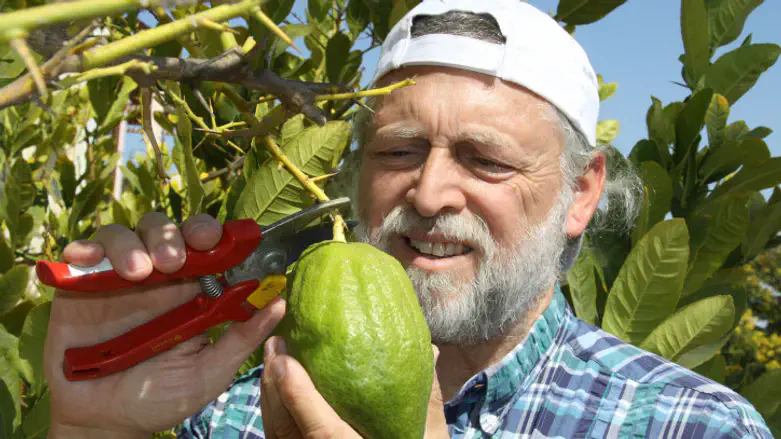
If it did it would die. Just the way the Diaspora is destined to die. The etrog tree doesn’t belong in Brooklyn. The climate isn’t right for it. It’s the same with the lulav, hadasim, and aravot. The four species which we are commanded to take for ourselves on the Festival of Sukkot are indigenous to Eretz Yisrael, just as the Torah is indigenous to Eretz Yisrael, and the Jewish People are indigenous to Eretz Yisrael.
We belong in Eretz Yisrael. All of the holidays are intrinsically connected to Eretz Yisrael. The Torah was designed and fashioned by the Almighty to be observed in Eretz Yisrael.
How wonderful to be in the Land of Israel where you hear hammers pounding away the week before the Sukkot holiday and see sukkah booths literally wherever you look!
And although there might be some rain, there will be no snow as there often is in other countries.
I remember living in New York City and walking the length and width of the city on the holiday of Sukkot and not seeing even one sukkah on the street. Finally I found a mini sukkah, the size of a telephone booth, in the back alley of a kosher dairy restaurant. Recently someone told me that Chabad is constructing a big succah in Manhattan outside the New York Public Library - a milestone in Jewish History! And good luck with that as the pro-Palestinian protestors go by.
This week in Israel, in whatever direction you look, chances are you will see a succah booth. On front lawns, in driveways, in parking lots, on restaurant sidewalks, on the terraces of buildings, and on rooftops.
In the Diaspora, the opposite is true. Unless you happen to be in one of the 5 or 6 Orthodox neighborhoods scattered around the globe, chances are you won’t see a succah booth at all. Take a walk from one end of Chicago to the other and there won’t be a succah in sight. In Paris and London, you would never know that there is a Jewish Festival about to begin. Diaspora succahs, if they exist, are hidden away on back lawns, or in back alleyways, so that the goyim won’t shoot flaming arrows at them and ignite them in a blaze of smoke. In the villas of wealthy Jews, you might discover a succah inside the house under a pull-back roof, so that the neighbors don’t have to know that Orthodox Jews live inside.
That’s the sad state of affairs when you are a secret Jew living amongst the goyim.
Yes, we have many problems in Israel, but we don’t have to hide our succot in the back of our homes. We can proudly construct them in our driveways and front lawns without worrying about protestors, vandals, burglars, South Florida alligators or gentile police. In the Diaspora, a front lawn succah sticks out like the gaudy statues that Beverly-Hills Arabs like to put on their lawns. In Israel, no one takes a second look. Succahs are natural in Israel. They are a part of the landscape. People can dine in them in peace, and sleep comfortably in them all night without the slightest disturbance.
The reknowned Torah scholar, the Gaon of Vilna, emphasized that only two mitzvot are performed with all of one’s body - the mitzvah of dwelling in the succah and the mitzvah of living in Eretz Yisrael.
How wonderful to be in the Land of Israel where you don’t have to be embarrassed or afraid to sit in your sukkah out on the street!
-Where many apartment buildings are built with terraces especially designed for the Sukkot holiday!
-Where the Kotel and the place of the Temple are a short walk or car ride away!
-Where there are sukkah booths outside of every restaurant!
-Where Sukkot is a national holiday with school vacation, and not some weird, mumbo-jumbo practice of the Jews.
How wonderful to be in the Land of Israel where you can be proud to be a Jew!
Hag sameach!
Tzvi Fishman was awarded the Israel Ministry of Education Prize for Jewish Culture and Creativity. Before making Aliyah to Israel in 1984, he was a successful Hollywood screenwriter. He has co-authored 4 books with Rabbi David Samson, based on the teachings of Rabbis A. Y. Kook and T. Y. Kook. His other books include: "The Kuzari For Young Readers" and "Tuvia in the Promised Land". His books are available on Amazon. Recently, he directed the movie, "Stories of Rebbe Nachman."