

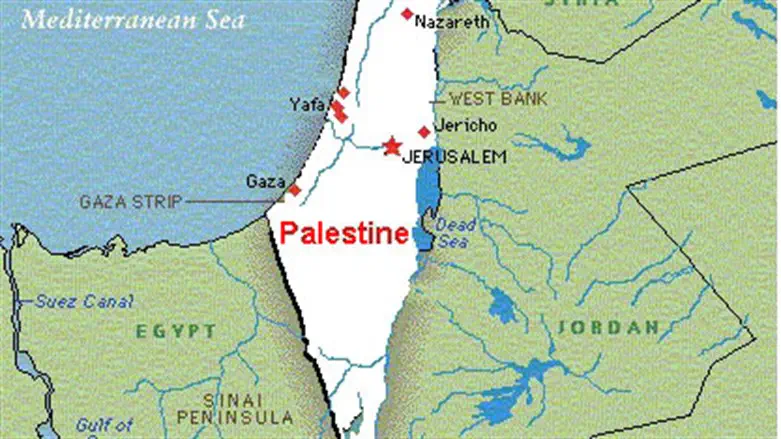
Though 157 UN member states have now recognized a "State of Palestine,” their actions do not confer legal sovereignty. Under international law, statehood is “independent of recognition by the other states.”
Juridical statehood is based on four explicit treaty requirements:
(a) a permanent population;
(b) a defined territory;
(c) a government; and
(d) the capacity to enter into relations with other states.
These requirements are codified at the Convention on the Rights and Duties of States (Montevideo Convention; 1933).
Regarding the specific interests of Israel, recognizing a Palestinian Arab state contradicts both the Oslo Accords and the Arafat-Rabin agreements not to alter legal status of pertinent territories prior to formal accession by Jerusalem. On its face, any such wrongful recognition is simultaneously at odds with (1) EU obligations incurred as organizational witness to the Oslo Accords; and (2) endorsements of these Accords as expressed in assorted UN resolutions.
For the security record, the existing State of Israel is less than half the size of America’s Lake Michigan.
There is more. Multiplying recognitions of “Palestine” pay no attention to the Jewish State’s lack of strategic depth and its continuous exposure to exterminatory enemies. Ironically, these acts of recognition prejudge the outcome of negotiations that were never completed precisely because of unrelenting Palestinian Arab terrorism.
Inter alia, such acts openly ignore the Natural Law origins of international law. Recalling William Blackstone's Commentaries (Book IV, "Of Pubic Wrongs," Chapter V): "All law results from those principles of natural justice in which all the learned of every nation agree...."
All declared recognitions of “Palestine” fail to meet even a single one of the Montevideo Convention requirements. Whatever their motives, national governments that support sovereignty for “Palestine” are welcoming a self-declared aggressor state[1] into the community of nations. As evidenced by unhidden Palestinian intentions, this terror-state[2] would become an existential hazard for Israel, directly or in collaboration with other irredentist states. Ipso facto, it would also undermine international law more generally.
In world politics, law is indispensable.[3] Accordingly, even as leaders of a “nonmember observer state,”[4] Palestinian leaders of every ideological stripe have displayed persistently “criminal intent” (mens rea) toward Israel. But could this lawless behavior be reduced or controlled in a Palestinian state? And what if the new Arab sovereignty were “demilitarized?”[5]
There is a clear and conspicuous answer to this question: A fully sovereign state of “Palestine” could evade any pre-independence security promises made to Israel, including those made in alleged good-faith.[6] Because treaties are binding only on states, any agreement between a non-state Palestinian authority and a sovereign State of Israel would have no foreseeable effectiveness.[7] This is the case even if a “government of Palestine” were somehow willing to consider itself bound by its pre-state assurances.
There is much more to consider. Even in such presumptively favorable circumstances, the "government of Palestine" could retain law-based grounds for agreement termination. For example, it could withdraw from the pact on account of a supposed “material breach.” In all likelihood, such withdrawal would stem from a supposed violation by Israel that had “undermined the object and/or purpose of the agreement.”[8]
Multiple opportunities for Palestinian Arab manipulation would arise. Palestinian Arab decision-makers could point toward what international law calls a "fundamental change of circumstances" (rebus sic stantibus). If a falsely-called "Palestinian" state were to declare itself vulnerable to previously unforeseen dangers, perhaps even to forces of other Arab armies or jihadist insurgencies, it could lawfully end its commitment to remain demilitarized. A faux "state of Palestine" could also point to “errors of fact” or “duress” as allegedly permissible grounds for agreement termination.
On its face, any treaty or treaty-like agreement is void if, at the time of entry into force, it conflicts with a "peremptory" rule of general international law - a “jus cogens” rule accepted and recognized by the international community of states as one from which "no derogation is permitted.” Because the right of sovereign states to maintain military forces essential to self-defense is precisely such a rule, “Palestine” could credibly argue its right to abrogate any arrangements that had “forced its demilitarization.”
In the 18th century, Thomas Jefferson, an American president, wrote knowledgably about obligation and international law.[9] While affirming that "Compacts between nation and nation are obligatory upon them by the same moral law which obliges individuals to observe their compacts...," he simultaneously declared "There are circumstances which sometimes excuse the nonperformance of contracts between man and man; so are there also between nation and nation." Specifically, Jefferson continued, if performance of contractual obligation becomes "self-destructive" to a party, "...the law of self-preservation overrules the law of obligation to others."
Conceivably, a presumptive "Palestinian state" could “lawfully” abrogate any pre-independence commitments to Israel to demilitarize.
Nonetheless, cascading declarations of recognition by a majority of existing states have no legal bearing on the creation of such a state. These declarations directly undermine the authority of law-based international relations.
In response to a growing number of ill-conceived declarations, Jerusalem will need to assess the existential threat of Palestinian statehood as part of a larger strategic whole - in tandem with the intersecting perils of conventional and unconventional war. This points to a comprehensive analytic focus on potential synergies between enemy state aggressions[10] and Israel’s nuclear doctrine.[11] Already, recent victories over Iran, Hamas and Hezbollah notwithstanding, Israeli leaders need to plan variously incremental shifts from “deliberate nuclear ambiguity” to “selective nuclear disclosure.” Though all recent declarations of national support for Palestinian statehood ignore authoritative international law, even a faux “State of Palestine” would be intolerable.
International law is not a suicide pact.[12] Israel has no legal obligation to carve a new enemy state aggressor from its own still-living body. Despite their expression in tones of high moral authority, the accumulating recognitions of “Palestine” avoid much larger justice issues altogether.
Assigning formal statehood to violence-centered entities that seek an existing state’s elimination violates both justice and logic. In the case of Israel and the Palestinian Arabs, such assignment is wrongheaded on several levels and signals an evident contradiction in terms. Instead of accepting ad hoc policy prescriptions drawn from non-legal sources, the community of states needs to display “good faith” (a basic expectation of the Vienna Convention on the Law of Treaties) by upholding law-based rules.
Under the British Mandate, in confirmation of decisions made at the San Remo peace conference of April 1920, all of Palestine was reserved for establishment of a “Jewish national home.”
In 1922, though no part of mandatory Palestine had ever been designated for the creation of another Arab state, Britain illegally carved Transjordan out of 78% of its mandatory territory. Transjordan became Jordan in 1949, just one year after declaration of the State of Israel. On May 15, 1948, one day after the State of Israel was declared by David Ben-Gurion ion Tel-Aviv, Azzam Pasha, Secretary General of the Arab League, forecast the war being planned by combined Arab forces: “This will be a war of extermination and a momentous massacre.”
The later UN partition resolution (1947) included only 22% of the lands originally pledged to establish a Jewish national home. In the interests of a peaceful start, Jewish national authorities accepted the lawlessly reduced land mass (essentially half of the residual one-fifth) in exchange for establishing a Jewish state.
There is one final observation. In view of continuing misinformation alleging Israeli displacement of a pre-existing Arab state, all current issues concerning "Palestinian statehood" and disposition of Gaza should be understood in correct historical context:
At no time in history has there been a Palestinian state.
If current UN member states want to establish the first Palestinian state, they will first have to honor the listed expectations of both Montevideo (1933) and Vienna (1969) conventions.
Prof. Louis René Beres was born in Zurich at the end of WWII, educated at Princeton (Ph.D., 1971), is Professor (emer.) at Purdue and author of many books and scholarly articles dealing with Israel and international law. Chair of Project Daniel (PM Sharon, 2004), his writings have appeared in Israel Defense; Bulletin of the Atomic Scientists; JURIST; The New York Times; American Journal of International Law; Yale Global Online; Harvard National Security Journal (Harvard Law School); Modern Diplomacy; The Atlantic; JNS; U.S. News & World Report; Los Angeles Times; Oxford University Press; The Hill; Israel National News; International Security (Harvard); BESA (Israel); Princeton Political Review; World Politics (Princeton); INSS Strategic Assessment (Israel); Herzliya Conference Papers (Israel); Parameters (Pentagon); Air-Space Operations Review (USAF); The War Room (Pentagon); and Modern War Institute (Pentagon/West Point). Dr. Beres' twelfth book, Surviving Amid Chaos: Israel's Nuclear Strategy, was published by Rowman & Littlefield in 2016.
Sources:
[1] Punishment of aggression is a longstanding expectation of international criminal law. The peremptory principle of Nullum Crimen sine poena, "No crime without a punishment," has its origins in the Code of Hammurabi (c. 1728 - 1686 B.C.E.); the Laws of Eshnunna (c. 2000 B.C.E.); the even-earlier Code of Ur-Nammu (c. 2100 B.C.E.) and the law of exact retaliation, or Lex Talionis, presented in three separate passages of Torah.
[2] Under international law, all terror actors and actions are criminal per se. Terrorist movements are always hostes humani generis, or "common enemies of mankind." See: Research in International Law: Draft Convention on Jurisdiction with Respect to Crime, 29 AM J. INT'L L. (Supp. 1935) 435, 566 (quoting King V. Marsh (1615), 3 Bulstr. 27, 81 Eng. Rep 23 (1615) ("a pirate est hostes humani generis")).
[3] The origins of modern international law lie in the Peace of Westphalia (1648), the agreement that ended the Thirty Years’ War. See: Treaty of Peace of Munster, Oct. 1648, 1 Consol. T.S. 271; and Treaty of Peace of Osnabruck, Oct. 1648, 1., Consol. T.S. 119. Together, these two treaties comprise the Peace of Westphalia.
[4] This status was conferred by UN General Assembly resolution in 2012. It offers “Palestine” certain rights of deliberation in pertinent UN organs, but no corresponding voting rights.
[5] For earlier assessments of this question see: Louis René Beres and (Ambassador) Zalman Shoval, "Why a Demilitarized Palestinian State Would Not Remain Demilitarized: A View Under International Law," Temple International and Comparative Law Journal, Winter 1998, pp. 347-363; and Louis René Beres and Ambassador Shoval, "On Demilitarizing a Palestinian `Entity' and the Golan Heights: An International Law Perspective," Vanderbilt Journal of Transnational Law, Vo. 28., No.5., November 1995, pp. 959-972. Zalman Shoval was twice Israel’s ambassador to the United States.
[6] Under international law, issues of “good faith” fall under the principle of pacta sunt servanda: “Every treaty in force is binding upon the parties to it and must be performed by them in good faith.” See Vienna Convention on the Law of Treaties, May 23, 1969, art. 26, 1155 U.N.T.S. 344; reprinted in 8 I.L.M. 679 (1969).
[7] Regarding relevant obligations of a sub-state Palestinian Authority, Israel should remain wary about all such asymmetrical legal agreements. In this connection, several well-known U.S. federal court decisions affirm that legal agreements between sub-state and state parties may sometime impose unequal compliance expectations. In the prominent case of Tel-Oren v. Libyan Arab Republic, a 1981 civil suit in U.S. federal court wherein the plaintiffs were Israeli survivors and representatives of persons murdered in a terrorist bus attack in Israel in 1978, Circuit Judge Harry T. Edwards opined: "...I do not believe the law of nations imposes the same responsibility or liability on non-state actors, such as the PLO, as it does on states and persons acting under color of state law."
[8] See Vienna Convention on the Law of Treaties (1969).
[9] From the beginning, even from the time of the American Revolution, international law has been part of US domestic law. In exact words used by the U.S. Supreme Court in The Paquete Habana, "International law is part of our law, and must be ascertained by the courts of justice of appropriate jurisdiction, as often as questions of right depending upon it are duly presented for their determination. For this purpose, where there is no treaty, and no controlling executive or legislative act or judicial decision, resort must be had to the customs and usages of civilized nations." See The Paquete Habana, 175 U.S. 677, 678-79 (1900). See also: The Lola, 175 U.S. 677 (1900); Tel-Oren v. Libyan Arab Republic, 726 F. 2d 774, 781, 788 (D.C. Cir. 1984) (per curiam) (Edwards, J. concurring) (dismissing the action, but making several references to domestic jurisdiction over extraterritorial offenses), cert. denied, 470 U.S. 1003 (1985) ("concept of extraordinary judicial jurisdiction over acts in violation of significant
[10]For the crime of aggression under international law, see: Resolution on the Definition of Aggression, adopted by the UN General Assembly, Dec. 14, 1974. U.N.G.A. Res. 3314 (XXIX), 29 UN GAOR, Supp. (No. 31), 142, UN Doc A/9631 (1975) reprinted in 13 I.L.M., 710 (1974).
[11] Regarding the prospective impact of Israeli nuclear doctrine on United States security, see monograph (Israel/Tel Aviv University) by Professor Louis René Beres, postscript by General (USA/ret.) Barry R. McCaffrey
https://sectech.tau.ac.il/sites/sectech.tau.ac.il/files/PalmBeachBook.pdf
[12] Though international law may allow certain imperiled states a resort to carefully measured preemptions, an act of “preemptive” self-defense (or “anticipatory self-defense) is never the same as one of “preventive” self-defense. Preemption is a military strategy of striking an enemy first in the expectation that the only alternative is to be struck first oneself. A preemptive attack is launched by a state that believes enemy forces are about to attack. A preventive attack is launched not out of genuine concern for "imminent" hostilities, but rather for fear of longer-term deterioration in a particular military balance. In a preemptive attack, the length of time by which the enemy's action is anticipated is very short, while in a preventive strike the interval is considerably longer. A problem for Israel, in this regard, is not only the practical difficulty of determining “imminence,” but also that delaying a defensive strike could prove fatal.