

President Donald J. Trump has introduced a sweeping new proposal aimed at bringing an immediate end to the ongoing conflict in Gaza, while laying the foundation for long-term stability and prosperity in the region.
Under the plan, Gaza would be transformed into a deradicalized and terror-free zone. The comprehensive agreement includes provisions for a complete cessation of hostilities, the release of hostages, extensive humanitarian aid, and the redevelopment of Gaza under international oversight.
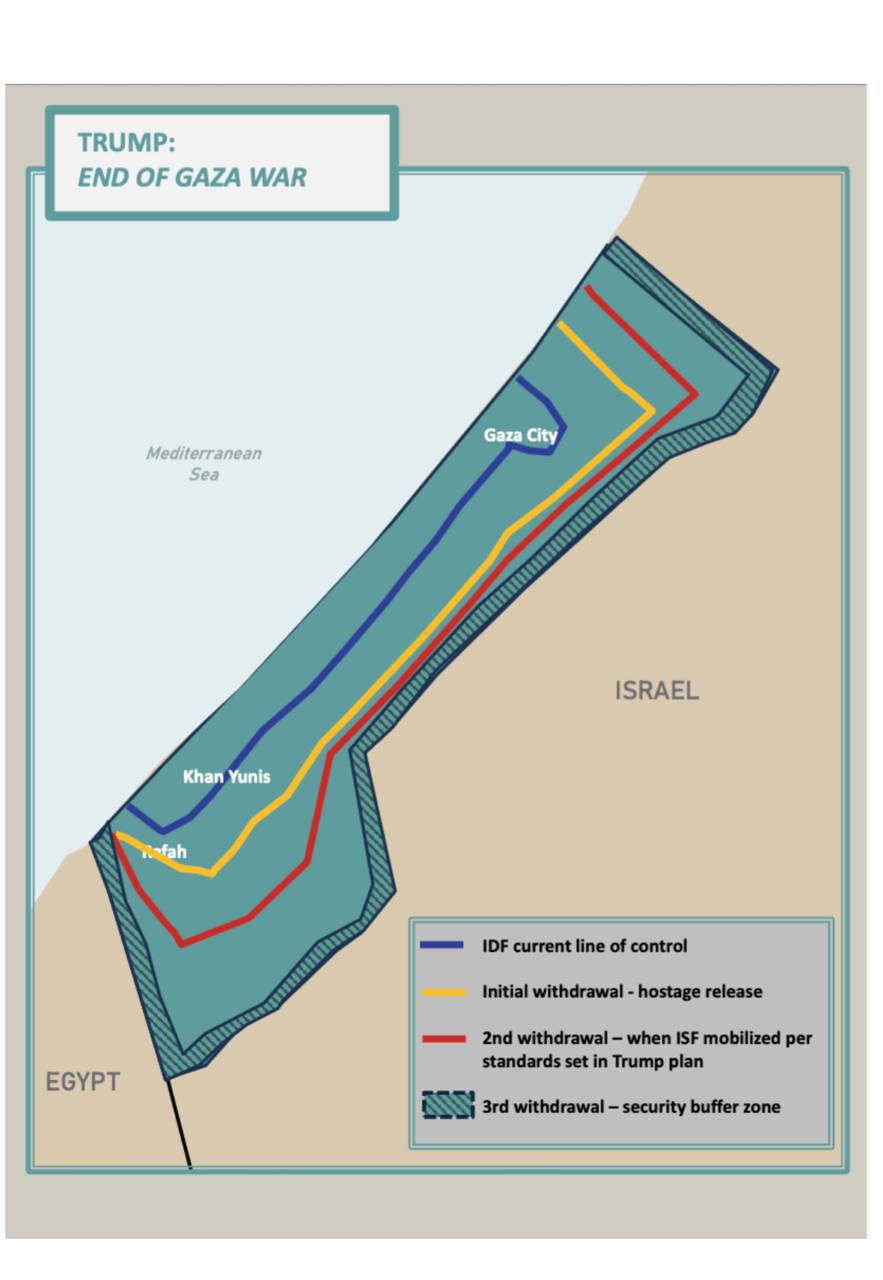
If both sides agree to the terms, Israeli forces will withdraw to an agreed-upon line and prepare for the release of hostages. During this stage, all military operations, including aerial and artillery strikes, will be suspended. Within 72 hours of Israel publicly accepting the agreement, all hostages—both alive and deceased—are to be returned.
Following the return of hostages, Israel will release 250 prisoners serving life sentences and 1,700 Gazans detained after October 7, 2023. This includes all women and children detained since that date. Additionally, for every Israeli hostage whose remains are returned, the remains of 15 Gazans will be released.
The plan offers amnesty to Hamas members who renounce violence and agree to decommission their weapons. Those wishing to leave Gaza will be provided safe passage to receiving countries.
Upon acceptance, a robust aid operation will commence, mirroring the scale of the January 19, 2025 agreement. This includes infrastructure repair, medical and food supply support, and equipment to clear rubble and reopen roads. Aid will be administered through neutral international bodies including the UN, Red Crescent, and others.
A temporary technocratic Palestinian committee will govern Gaza, tasked with providing essential public services. Oversight will be provided by a newly established international body, the "Board of Peace," chaired by President Trump. Former UK Prime Minister Tony Blair is among those expected to join. This body will oversee funding and redevelopment until the Palestinian Authority completes its reform process and is prepared to assume control.
The plan includes the creation of a special economic zone with favorable tariffs and access, aiming to attract investment and create jobs. An expert panel will be assembled to design an economic blueprint modeled on successful development projects in the Middle East.
According to the plan, Hamas and other factions will agree to play no role in Gaza's future governance. All terror and military infrastructure will be dismantled, and a demilitarization process, supervised by independent monitors, will be implemented.
To ensure compliance and stability, an International Stabilization Force (ISF) will be deployed. Composed of international and regional partners, the ISF will train Palestinian police forces and coordinate with Egypt and Jordan. The ISF will also help secure Gaza's borders and facilitate humanitarian aid.
Israel will not occupy or annex Gaza. As the ISF gains control, the IDF will conduct a phased withdrawal, maintaining only a security perimeter until Gaza is deemed secure.
Should Hamas reject the agreement, all provisions—including aid and demilitarization—will proceed in areas handed over to the ISF.
The plan also envisions an interfaith dialogue to promote mutual understanding and peaceful coexistence between Palestinians and Israelis. President Trump emphasized that successful implementation of PA reforms could ultimately pave the way for Palestinian self-determination and statehood.
The United States will initiate a political dialogue between Israel and the Palestinians to explore a lasting solution based on coexistence and mutual prosperity.