

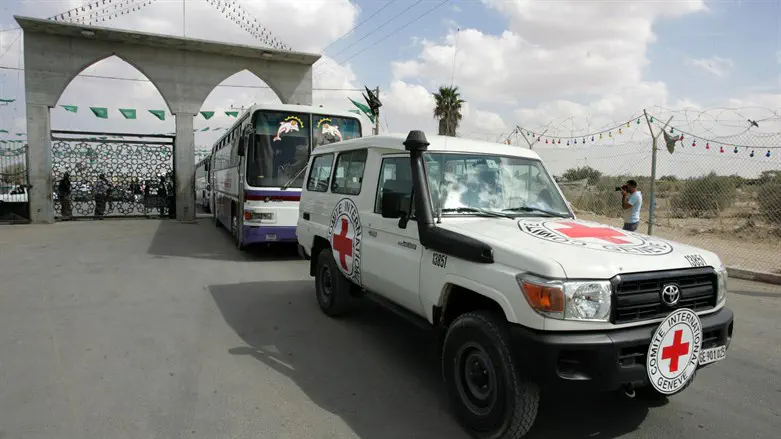
The National Security Committee convened today (Tuesday) to discuss the prevention of visits by the International Committee of the Red Cross (ICRC) to prisons, to formulate recommendations for government ministries on how to proceed in dealings with the organization, and the committee’s position on the matter.
Committee Chair MK Tzvika Foghel (Otzma Yehudit) stated: The Red Cross received a special mandate to visit prisoners, especially prisoners of war and security prisoners. However, this mandate is one-sided, and I do not see it making any effort with Hamas regarding our hostages, like it pressures us. I think this is totally invalid, and the mutuality must be maintained, and the same conditions must be upheld. I will do everything for the Red Cross to visit the hostages, and until that happens, I will stand at the prison gates and prevent the Red Cross from visiting."
MK Ariel Kalner (Likud) said that "there were occasions where the Red Cross harmed national security and used its visitation rights to transfer information. This entire asymmetric game, where the state is obligated to norms with a barbaric terror organization, is abused, so our citizens pay the price. Allowing visits to those murderers is a delusional request. It is not fair, not just, and not acceptable."
MK Limor Son-Har Melech (Otzma Yehudit) added: "The Red Cross, which is an antisemitic organization, works in an unbalanced fashion with our hostages when compared to the 'prisoners,' as they call them, as opposed to terrorists who raped and murdered and committed horrific crimes. This is a biased terminology that permits and covers up the world's antisemitism, Jew hatred, and hypocrisy. First and foremost, we must look out for the good and security of the country's citizens and the prison staff."
MK Tzvi Succot (Religious Zionists) added: "It's symbolic that there's an international law that they don't follow. We have to treat it like an enemy; that's the only way they'll understand. We have to be more ruthless than those who come to murder us. That's the only way to bring peace."
Yizhar Lifshitz, the son of Oded Lifshitz, who was abducted and murdered by Hamas, said during the meeting: "The hostages are the mirror of the prisoners. When you say that you are making it worse for the prisoners, we are torturing the hostages more, and it puts us in a dilemma. We tried to send food and visitors through the Red Cross, but we didn't succeed; Hamas did not agree. It is a terror organization, and we are a state. “If we speak in the language of a terrorist organization, then they’ve managed to insert yet another burden into our system of values. I'm trying to think differently after 710 days and after 42 hostages were murdered. Anything that would bring the hostage back."
Hana Cohen, the aunt of Inbar Hayman, whose body is being held by Hamas, stated: "Our daughter was abducted by those who are sitting in prison and ask for Red Cross visits. In a normal country, they should have been executed. I don't know where our daughter is. The law requires the Red Cross to find the girl. My family is being tortured. The state is merciful and humanitarian because we accept all these troubles."
Attorney Ohad Buzi Segev, Legal Advisor for Intelligence and Operations at the Israel Prison Service (IPS), explained that there is a pending case before the Supreme Court on this matter. “In principle, since the beginning of the war, the IPS position has been that the Red Cross will not enter the prisons. This position is based on a professional assessment by the IPS Intelligence Division, which determined that the entry of the Red Cross into prisons could endanger prison security and the safety of correctional officers.”
His colleague in the organization, Chief Superintendent Netanel Shimshon, head of counterterrorism, added: “We have information indicating that the Red Cross’s entry could harm the security of the prisons and possibly also national security. There are two main issues: the safety of correctional officers and the increasing friction inside prisons, including the coordination of protest actions and the accumulation of improvised cold weapons. Another issue concerns national security — I won’t go into details, but the entry of foreign actors into the prison system raises the potential, deliberately, for the transfer of hostile messages.”
Concluding the discussion, MK Foghel recalled the many humanitarian steps Israel has taken in recent years and addressed the Prime Minister and ministers, saying: “Don’t be confused — there are measures we must prevent. We must act like a state with a backbone. The Cabinet must decide that there will be no Red Cross visits until information about our hostages is received.”