

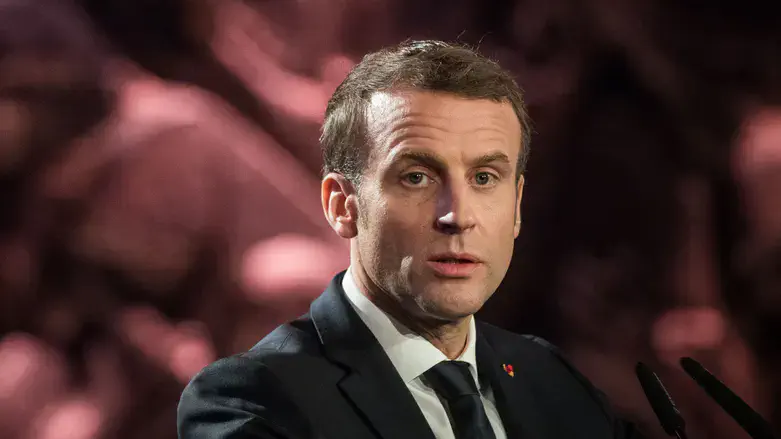
The political crisis in France deepened this week as yet another prime minister was forced to resign following a failed no-confidence vote, paralyzing the country’s leadership.
Dr. Emmanuel Navon, an international relations expert at Tel Aviv University, told Israel National News - Arutz Sheva that French President Emmanuel Macron is caught in a spiral with no clear exit.
“The French parliament is divided into three blocs - the far-right, the far-left, and Macron’s centrist faction - without the ability to form a stable coalition,” he explained. “The result is a destructive cycle: Macron appoints a prime minister, but without a parliamentary majority, the government collapses in the first no-confidence vote, and the process repeats.”
According to Dr. Navon, Macron’s political weakness has directly influenced his recent stance toward Israel.
“His domestic vulnerability pushed him to focus more on foreign policy issues, particularly ones that resonate with the left and with Muslim voters in France. His tough statements and diplomatic gestures against Israel, including threats to recognize a Palestinian state, are not ideological but rather a desperate bid to shore up political support. But this strategy won’t help him - appealing to the left will not provide the majority he desperately needs.”
A similar picture, he noted, is emerging in Spain, where the far-left government has adopted an aggressively hostile line toward Israel, even threatening sanctions.
“This will end badly for Spain,” Dr. Navon warned. “The country is currently led by a far-left coalition attacking Israel for purely political reasons, headed by a prime minister deeply entangled in serious corruption scandals.”
Unlike in France, however, he believes Spain has a clearer path forward. “If and when the right returns to power in Spain, the situation will change dramatically, because the Spanish right is strongly pro-Israel. It’s only a matter of time, as this government will not last long.”
Despite the hostile rhetoric from Paris and Madrid, Dr. Navon emphasized that public opinion in both countries tells a different story.
“Most polls show there is a silent majority that supports Israel, because they understand that Israel’s struggle is also their struggle. The problem is that current leaders are focused only on political survival and are adopting anti-Israel positions as part of that effort.”
Within this complex reality, he praised Israel’s current diplomatic approach led by Foreign Minister Gideon Sa’ar.
“I think Gideon Sa’ar is correct not to allow these governments to lash out at Israel for political reasons. His strong responses are justified.”
At the same time, Navon noted, Israel is deepening alliances with more friendly nations.
“Sa’ar is also working to strengthen ties and alliances with countries that are more supportive of Israel, particularly in Eastern Europe.”