

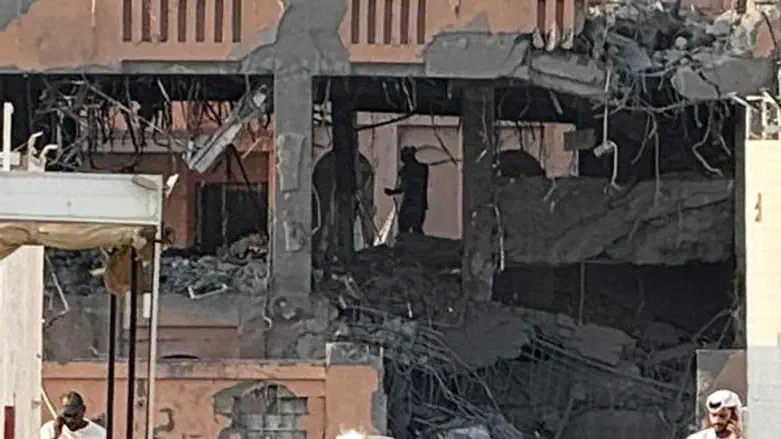
As time passes, suspicions grow that Operation "Summit of Fire," aimed at eliminating Hamas leadership in Doha, may not have been the success initially presented. In a column written for Arutz Sheva in Hebrew, Israeli author and journalist Haggai Huberman discusses the report that the failure likely stemmed from the US allegedly warning Qatari authorities just minutes before Israeli Air Force planes were set to strike. The Qataris, in turn, alerted Hamas commanders, who dispersed quickly, evading what could have been a decisive Israeli blow.
If accurate, Huberman argues, this would represent a disgraceful American act—yet one that is not without precedent. He notes that Israeli military operations have been compromised before due to similar leaks from the United States. One historical example, he recalls, is Operation Karameh, carried out on March 21, 1968. This was the IDF’s first large-scale counterterror mission after the Six-Day War, and it ended with significant Israeli losses and a controversial outcome.
Operation Karameh was triggered by a deadly terror incident only days earlier. A school bus carrying students from the Herzliya Hebrew Gymnasium struck a mine near Be’er Ora in the Arava, leading to the deaths of two parents accompanying the students and wounding many of the young passengers. The attack shocked the Israeli public and created immense pressure on the government to respond forcefully against Palestinian terrorist bases operating from across the Jordanian border.
Then Prime Minister Levi Eshkol, however, faced a dilemma. On one hand, the Israeli public and military leadership were demanding decisive action; on the other hand, he received explicit messages from Washington against it. The administration of President Lyndon B. Johnson strongly opposed Israeli action against Jordan, which at the time was a close American ally. Eshkol feared harming the critical relationship with the United States, and as a result, convened his government twice before eventually authorizing the operation. Most ministers supported military action, with only a few, such as Moshe Haim Shapira of the National Religious Party, expressing opposition.
When the operation was finally approved, the IDF mobilized a large force. The target was the town of Karameh in the Jordan Valley, which housed Fatah headquarters under the leadership of Yasser Arafat. It was also a base for launching terror raids into Israel. The operation involved tanks, paratroopers, and the Air Force in a wide assault on Jordanian soil. The scale of the mission made it the first comprehensive IDF operation after the Six-Day War, intended not only to strike Fatah but also to send a message to neighboring states about Israel’s military reach.
Yet, as later accounts revealed, the element of surprise had already been lost. American intelligence had informed Jordanian intelligence services of Israel’s imminent attack. The Jordanians, in turn, relayed this information to senior Fatah leaders, including Arafat’s deputy, Abu Iyad. With prior knowledge, the terrorists were able to prepare, and the Jordanians themselves could position forces to meet the Israeli assault.
Abu Iyad recounted in his memoirs that days before the battle, a senior Jordanian intelligence officer passed on details reportedly originating from the CIA. This official even urged the Fatah leadership to withdraw to avoid confrontation with Israel. Although Fatah did not entirely evacuate, they managed to secure their leaders and prepare defenses, blunting Israel’s strategic advantage. Huberman notes that this early warning robbed the IDF of one of its most important tools—surprise—and shifted the balance in favor of the defenders.
The results were harsh for Israel. By the end of the day, the IDF had sustained 33 fatalities, 161 wounded, and the loss of dozens of tanks, armored vehicles, and other equipment. In addition, an Israeli Air Force jet was shot down by Jordanian anti-aircraft fire. Several damaged tanks and vehicles were left behind on the battlefield, becoming prized trophies for Jordanian forces. Meanwhile, Yasser Arafat narrowly escaped capture, fleeing on a motorcycle. His survival and subsequent declaration of victory significantly boosted the prestige of the PLO, paving the way for its expanded operations against Israel in the following years.
The long-term consequences of Karameh were profound. Rather than deterring terror, the operation elevated Arafat and emboldened Palestinian Arab groups. Terror attacks from Jordan increased in frequency and severity, and later, Arafat would expand his campaign from Lebanon and, following the Oslo Accords, from within Judea and Samaria itself. Huberman draws a direct line from that moment in 1968 to the decades of bloodshed that followed.
Huberman underscores the parallel with today. Just as American leaks in 1968 shielded enemy leaders and undermined Israeli military efforts, so too, he argues, did American actions in the case of Operation "Summit of Fire." In both instances, crucial opportunities to deal decisive blows against terrorist leadership were squandered, and in both, Washington’s reliability as a strategic ally comes into question.
Huberman concludes that while Israel has long depended on American support, the recurring pattern of intelligence leaks and political interference highlights a dangerous vulnerability. For Israel, he warns, history is repeating itself, with American betrayal once again protecting those responsible for terror against the Jewish state.