
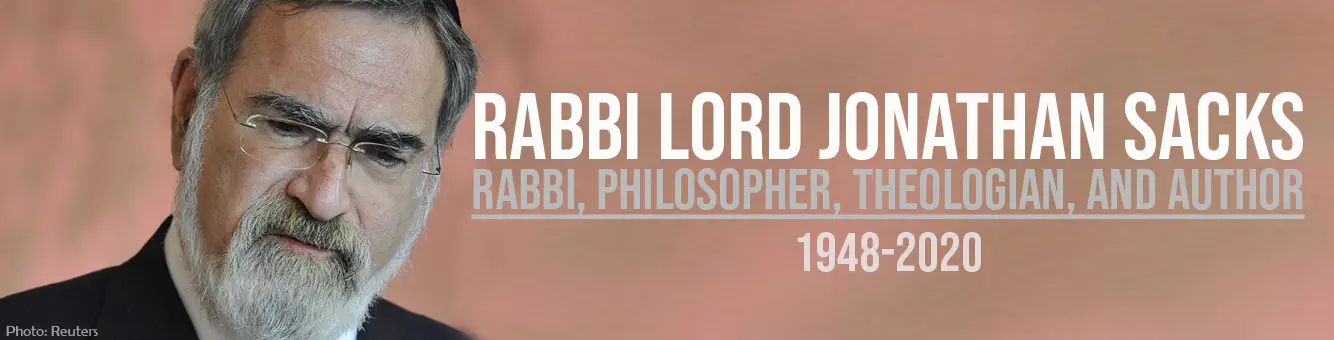
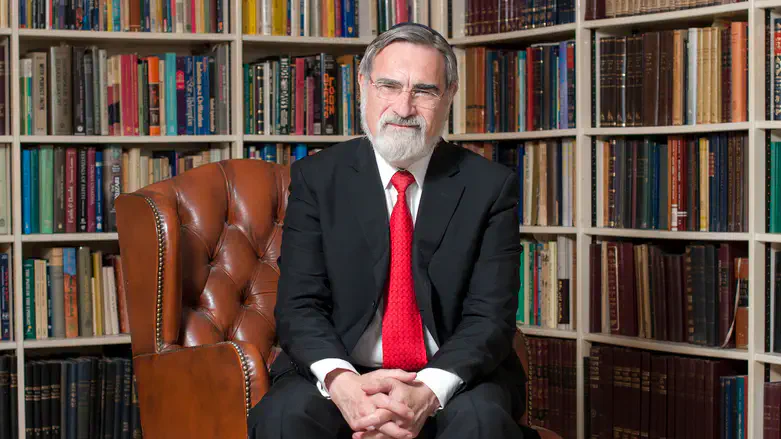
In a moment that resonates deeply across the Jewish world, Koren Jerusalem has announced the release of the Koren Sacks Humash, a landmark volume that unites Rabbi Lord Jonathan Sacks’ zt’l, complete English translation and commentary on the Five Books of the Torah with the classical voices of Rashi and Targum Onkelos.
More than four decades in the making, the project represents the culmination of Rabbi Sacks’ scholarship, teaching, and philosophy—Torah that speaks with intellectual rigor, spiritual depth, and contemporary relevance.
According to Koren, thousands of copies have already been pre-ordered or donated to synagogues across the globe, ensuring that Rabbi Sacks’ zt’l voice will accompany Torah readings in communities from London to New York, from Jerusalem to Johannesburg. The edition, supported by an extensive bibliography, is designed not only for public worship but also for sustained individual and communal study.
Torah for a Global Age
At the heart of the Koren Sacks Humash lies a bold but faithful vision: Torah commentary that bridges the ancient and the modern, speaking to the dilemmas of contemporary life while remaining deeply rooted in tradition. Rabbi Sacks zt’l, who served as Chief Rabbi of the United Hebrew Congregations of the Commonwealth from 1991 to 2013, devoted his life to showing how Judaism could converse with Western philosophy, politics, and ethics without compromising its authenticity.
As Matthew Miller, Publisher at Koren Jerusalem, explained, “Rabbi Sacks created Torah commentary for our generation - deeply rooted in tradition yet fully engaged with the modern world. This Humash reflects that vision, bringing his insights to the heart of Jewish study and synagogue life, and ensuring his voice continues to inspire future generations.”
For Rabbi Sacks, this bridging of worlds was not an abstract exercise. His translations and commentaries sought to illuminate the Torah as a living text—one that speaks to questions of identity, responsibility, community, and moral purpose in an era marked by uncertainty and fragmentation.
A Lifelong Dream Fulfilled
The Koren Sacks Humash also fulfills a personal aspiration long cherished by Rabbi Sacks himself. As Joanna Benarroch, President of The Rabbi Sacks Legacy, noted, “This Humash is the fulfillment of one of Rabbi Sacks’ lifelong dreams and the culmination of his life’s work. It brings together his translation and commentary in a way that makes his thought accessible to every reader, and we are proud to see it now in the hands of communities around the world.”
Lady Elaine Sacks, his widow, spoke movingly of the release: “I find it very special to see how many people, in so many parts of the world, are already using the Koren Sacks Humash. To know that my husband’s voice will continue to guide future generations is deeply moving for myself and my family.”
Her remarks reflect the unique position Rabbi Sacks zt’l occupied in Jewish life: at once a traditionalist steeped in the yeshiva world and a global statesman of moral ideas whose eloquence touched religious and secular audiences alike.
Rabbi Sacks’ Enduring Influence
Since his passing in November 2020, Rabbi Sacks’ zt’l reputation has only grown. In Britain, King Charles III eulogized him as “a light unto our nation.” In Israel, he has become a bestselling rabbinic author, his Hebrew translations widely read. Across the globe, his works have been translated into 15 languages, finding audiences far beyond the Jewish community.
Through dozens of books, countless lectures, and his presence in the media, Rabbi Sacks zt’l influenced hundreds of thousands. His moral clarity and intellectual breadth allowed him to speak credibly about issues as diverse as religious extremism, the challenges of multiculturalism, the ethics of markets, and the centrality of family life.
As The Jerusalem Post once observed in a retrospective on his career, Rabbi Sacks was unique in his ability to speak the language of philosophers while retaining the cadence of a preacher. The Koren Sacks Humash now places that voice in the most sacred context of all: the weekly reading of Torah.
The Commentary: Ancient Sources and Modern Insight
The structure of the new Humash reflects Rabbi Sacks’ methodological brilliance. His translation of the Torah accompanies the Hebrew text, while his commentary is interwoven with that of Rashi—the medieval sage whose commentary has shaped Jewish learning for centuries—and Targum Onkelos, the Aramaic rendering that anchored Torah study for millennia.
This tri-layered approach allows readers to appreciate continuity: the Torah itself, the traditional interpretations that have guided Jewish thought, and Sacks’ own voice, which situates those traditions in the modern world. The effect, Koren explains, is not to diminish classical sources but to place them in conversation with today’s pressing ethical and spiritual questions.
In the commentary, Sacks frequently turns to themes that animated his career: covenant and responsibility, faith and doubt, the dignity of difference, and the idea of Torah as the constitution of a moral community. His insights are accessible to readers who may lack traditional learning yet are rich enough to challenge scholars.
For Individuals and Communities
The reception of the Koren Sacks Humash calls attention to its dual purpose. For individuals, it provides a guide to study that connects timeless wisdom with modern concerns—family, purpose, justice, and human dignity. For communities, it represents a resource for synagogue life that elevates the Torah reading, offering congregants commentary that is both deeply Jewish and universally resonant.
In this sense, the project exemplifies what Rabbi Sacks zt’l often called “Torah vehokhmah”—Torah in dialogue with wisdom. By situating the ancient text within the horizons of today’s ethical discourse, he sought to demonstrate that Judaism has something profound to say not only to Jews but to the world.
A Voice for the Future
The release of the Koren Sacks Humash comes at a time when many Jewish communities are grappling with generational shifts in identity and practice. The accessibility of Rabbi Sacks’ commentary—neither simplistic nor overly academic—offers a bridge for younger Jews seeking meaning and relevance in tradition.
It also arrives in a world that Rabbi Sacks zt’l often described as fractured, plagued by polarization, radicalism, and a loss of shared moral purpose. In such a climate, his insistence on a Judaism that engages rather than retreats from the world may prove even more vital.
As one rabbi in London remarked after receiving the volume, “This is not just a commentary. It is a moral compass for a generation searching for its bearings.”
A Legacy in Print
The Koren Sacks Humash is more than a book; it is the realization of Rabbi Jonathan Sacks’ zt’l enduring vision: that Torah can speak with equal force to the synagogue pew and the university lecture hall, to the yeshiva student and the secular seeker. It enshrines his belief that Judaism, when lived authentically, can inspire both the Jewish people and the broader world.
In his lifetime, Rabbi Sacks zt’l reminded audiences that Judaism’s mission was to be “a light unto the nations.” With the release of this volume, his light continues to shine—illuminating the words of Torah with wisdom, clarity, and hope.