
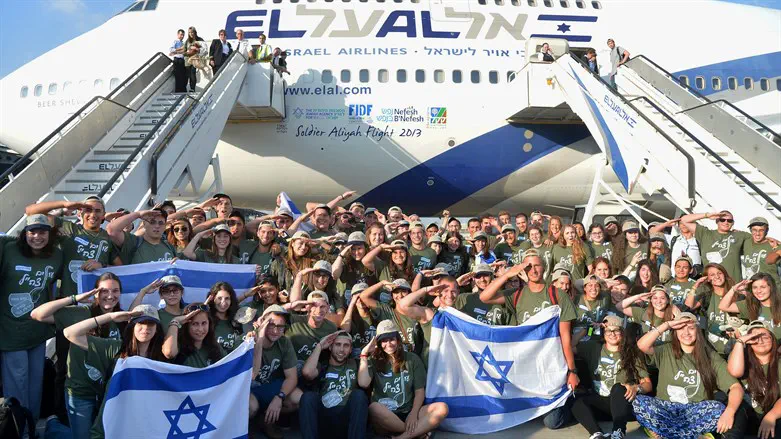
New immigrants to Israel, who come filled with great expectation, are often met with seemingly unsurmountable difficulties. Rabbi Tzvi Yisrael Tau, Head of the Har HaMor Yeshiva in Jerusalem, teaches that the challenges and turmoil which new olim face are a necessary and Divinely-orchestrated part of the Aliyah process:
About two hundred years ago, Jewish settlement in the Land of Israel began with the immigration of the disciples of the Baal Shem Tov, led by Rabbi Menachem Mendel of Vitebsk. These were select individuals, righteous men and Hasidim, who ascended to the Land with noble and lofty intentions They came to complete and perfect their holiness through the holiness of the Land of Israel, the place of the Divine Presence. In the book of Rabbi. Menachem Mendel, Pri Ha’aretz (“Fruit of the Land”), letters are printed by his contemporary, “the greatest among his brothers,” Rabbi Avraham of Kalisk, which contain guidance for his disciples and followers abroad.
In one of these letters, Rabbi Avraham finds it necessary to warn those desiring to follow him to the Land, informing them of the unique character of the Land and the many difficulties of absorption involved in Aliyah, precisely because of the greatness and uniqueness of the Land. Although the subject of the letter is the hardships that befall an individual ascending to the Land of Israel, especially individuals of lofty spiritual motivation, the principle expressed is a general and fundamental matter relevant to all olim. From this, we can learn about the difficulties of integration which the entire nation faces in the Land of Israel, when hundreds of thousands of Jews, after long and difficult years of exile, return to settle in their eternal Homeland.
In our time, when the light of Redemption secretly shines within the soul of the generation, motivating multitudes of Jews from the four corners of the earth to return and take root in their Land, the words written I the etter take on doubled force. They can illuminate and clarify the difficulties and crises that we are undergoing today. Rabbi Avraham writes:
“From my heart, I reply with honor to anyone who asks and seeks to dwell in honor in the Holy Land: come and learn what this Land is.”
First we must know the deeper essence of Eretz Yisrael. Not in the sense of geography, botany, or entomology, but knowledge of the Land in its inner meaning and value to the Jewish People, its spiritual qualities, and its holiness. From this comes understanding of our connection with the Land and the different transformations we must undergo until we truly become “children of the palace of the Holy King” - owners of the Land, true “Eretz-Yisraelites.”
The story of the Jewish People’s return to the Land of Israel cannot be told only in political, economic, or social terms. It is, above all, a spiritual drama, rooted in the profound mystery of what it means for the People of Israel to live again in the Land chosen for them. The sages and righteous leaders of previous generations already recognized that stepping into the Land of Israel is not a simple change of geography, but an upheaval of the soul, a rebirth of the nation, and a testing of ideas and ideals. The words of Rabbi Avraham of Kalisk, later expanded by Rabbi Kook, provide a lens through which to understand not only the struggles of individuals who ascend to Israel, but also the crises of the Jewish People and even of Zionism itself.
When a Jew first arrives in the Land, he often comes with expectations formed in exile: images of a land flowing with milk and honey, or of a holy resting place of the Divine Presence where life will become easier, loftier, more harmonious. But the reality that greets him is often harsher: stones, dust, ruins, material difficulties, demographic and cultural tensions, and spiritual confusion. This clash between dream and reality can create deep disappointment. Sometimes the new immigrant even comes to resent the Land. Yet, just as a seed must first decay before sprouting, so too must the person undergo a breaking down of his former worldview, a shedding of his old identity and ego, before he can truly become bound to the Land. Over time, he learns to love the stones and dust, to cherish the ruins more than the palaces of exile, to prefer the simplest crust of bread eaten in the Land of Israel over all the delicacies of foreign lands.
The sages explained that the Land of Israel is unlike any other place. A Midrash on the verse in Psalms, “You have favored, O Lord, Your Land; You have returned the captivity of Yaacov” (see the Midrash Shocher Tov on Tehillim 85:2) teaches that God’s supervision over the Land of Israel involves a process of dynamic transformation. The Creator gazes upon it and scrutinizes it until it becomes pleasing in His eyes. The understanding of “until it becomes pleasing in His eyes” refers to the people in the Land. Eretz Yisrael and Am Yisrael are bonded together. The Land itself is bound up with the destiny of Israel’s Redemption, and every return to it involves divine processes of trial and purification. Just as the psalmist prays, “You have borne away the iniquity of Your people… Restore us, O God of our salvation,” so too the Midrash emphasizes that it is the Land itself that bears Israel’s sins and demands their correction. The Land, in other words, is not passive ground but an active spiritual reality that presses its inhabitants toward holiness, forcing them to grow into who they truly are.
This pressing demand explains why entry into the Land is never easy. Rabbi Avraham warned his disciples that even if they had reached spiritual heights abroad, when they set foot in Israel they would find themselves thrown into confusion, stripped of their familiar sense of piety and accomplishment. They might lose their confidence, feel unworthy, and struggle to find stability. Because of the upheavals, some new arrivals might even come to despise the Land and leave it, Heaven forbid. But this feeling of breakdown was not failure - it was the necessary preparation for renewal on a higher level. The Land gives forth, not what one expects, but what one needs: not comfort but transformation.
Rabi Avraham of Kalisk notes: “And the race is not to the swift; not one day or two, not a month or a year, but only over many years, until the days of absorption pass.” Like a seed sown in the soil, which first decays and only then grows, so too a person who comes to be absorbed in the Land must first see that all the concepts and worldviews that were the foundation of his life until now are nullified - even those rooted in holiness and fear of Heaven - and only then renewed. Rabbi Zeira, when he ascended to the Land of Israel, fasted one hundred fasts to forget the Babylonian Talmud he had learned” (Baba Metzia 85A). There, in the Land, his Torah certainly returned and flourished, but in an entirely new form.
Rabbi Kook expanded this teaching further: a Jew who comes to the Land does not merely undergo an inner crisis; he actually receives a new soul which elevates him to a new level of life (see also “Chesed L’Avraham” by Rabbi Avraham Azuli, the Third Spring, Spring of the Land, River 12). In exile, he lived with a private, individual soul, limited to his personal experiences. In Israel, however, he is endowed with the neshama clallit, the collective soul of the entire Nation of Israel. This soul cannot dwell in exile. It belongs to the Land itself. Whether or not he wishes it, whether or not he even recognizes it, the new arrival is transformed by the Land. Much like the “extra soul” that descends upon every Jew on Shabbat, regardless of his observance, the collective soul enters every Jew who sets foot in the Holy Land. But here too, awareness and preparation make all the difference. The one who opens himself to this new dimension, who aligns his thoughts, desires, and deeds with the greatness now beating within him, experiences light, holiness, joy, and strength. The one who resists or remains unaware is thrown into turmoil, as the Divine force within him demands to be revealed and he prevents it by resisting the change.
What applies to the individual applies even more to the nation. After two-thousand years of exile, humiliation, and persecution, the Jewish People’s return to its Homeland is necessarily accompanied by upheavals. National rebirth cannot occur in a moment; it unfolds through long processes of trial, contradiction, and gradual adjustment. The people returning to its Land must relearn who it is, shed the crippling habits of exile, and embrace the holiness that has always been its essence. As the prophet Isaiah exclaimed: “Shall a land be born in one day? Shall a nation be brought forth at once? For as soon as Zion travailed, she brought forth her children” (Isaiah 66, 8-10) Rebirth involves labor pains, and national rebirth all the more so.
The crises of modern Israel are therefore not signs of failure but signs of growth. Political conflict, cultural strife, spiritual confusion, these are not random problems but stages in the maturation of a nation adjusting to a new soul. Rabbi Kook insisted that the apparent contradictions between Israel’s inner greatness and its external realities must be understood as part of the Divine Process of Redemption. The inner being of the nation, holy and radiant, demands expression, while the external structures of thought, will, and society struggle to catch up. This tension produces suffering, but it also propels the nation toward its true destiny.
Even the Zionist idea itself is not immune. Born in exile, Zionism was often shaped by secular motives: a quest for safety from antisemitism, or the desire for Israel to be “a nation like all others.” These were limited, sometimes even distorted visions, possible only in the polluted air of exile. They were enough to ignite the first sparks of national revival, but they could never carry the full power of eternal life. Once transplanted into Israel, even these secular ideas are infused with new light. They too undergo crises, doubts, and contradictions, but through this process they are refined and ultimately joined to the eternal spiritual sources of the nation. Only then do the sparks of revival find their completion, becoming part of the great torch of Israel’s holiness, shining from Zion to illuminate the path of national renewal.
Spies in the Wilderness
The Torah’s story of the spies reflects the same principle. They were righteous men when they left on their mission, leaders of Israel. But upon stepping into the Land, they fell from their previous spiritual level. Confused and shaken, they misinterpreted their own descent as proof that the Land was unconquerable: “for it is stronger than us.” In truth, they were experiencing what every Jew undergoes upon entering the Land, the breaking down of the old self to make room for the new. Joshua and Caleb succeeded because they prepared their hearts, understanding that the Land transforms those who enter it. The Spies failed because they mistook descent for defeat, rather than for the necessary beginning of ascent.
The same danger exists today. When Jews come to the Land, whether as individuals or as a nation, they may feel at times that the holiness has departed, that they have lost their earlier levels, that the promises of Redemption have not yet been fulfilled. But this too is part of the process. Just as therapeutic waters first draw out the inner impurities before healing the body, so too the Land first brings out the hidden flaws before lifting the soul to a higher plane. The task is not to despair but to persevere. “Hope in the Lord, be strong and of good courage, do not despair of mercy and salvation, and then the Lord will send you help from His holy place.”
The message, then, is one of profound encouragement. The crises of absorption, the struggles of immigrants, the national tensions, the ideological confusions, all these are not signs of failure, but part of a divinely-guided rebirth. The Land of Israel does not allow its inhabitants to remain who they were in exile. It presses them, sometimes painfully, to become who they truly are. The descent is for the sake of ascent, the suffering for the sake of renewal. And as the process continues, the individual, the nation, and even the Zionist idea itself will rise to levels greater than ever imagined.
To see the trials of our time only as obstacles is to miss their meaning. They are birth pangs, necessary struggles, guided by Providence. The more we recognize the greatness within us, the less we will need suffering to remind us, and the sooner we will merit to see “a new light shine upon Zion.”
[Translated, adapted, and condensed from Rabbi Tau’s18 volume series, “L’Emunat Etaynu,” Vol.2, Ch.4).