
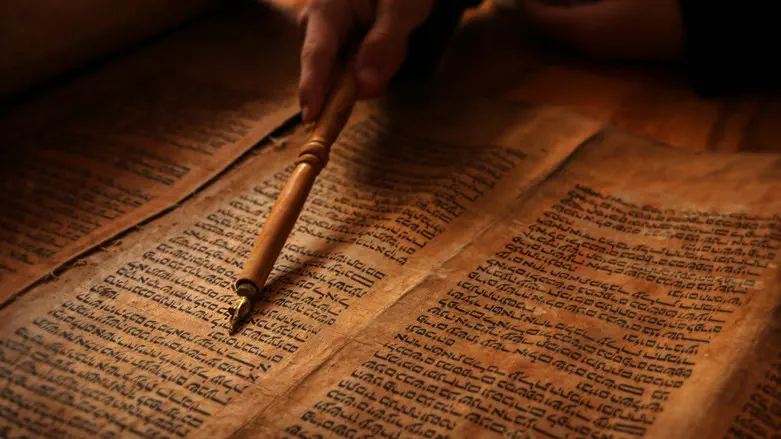
Most religions of the world determine their adherents on the basis of their choice. Thus, anyone who wishes can decide to become a Christian or a Muslim, and he is welcomed into the fold. In some cases, the religion regards those who are born to its members as automatically partaking of that religion’s identity without any need to decide of their own accord.
Jewish identity is determined by birth. Orthodox Judaism regards anyone born to a Jewish mother as Jewish. If the mother is gentile then even if the father is Jewish the child is regarded as gentile. This is known as Matrilineal Descent. However, Jewishness is not limited only to those who are born into the religion. We also have mechanisms for the acceptance of converts.
The Unique Nature of Jewish Conversion
Judaism is unique in its attitude to the matter of conversion. We do not seek out or engage in any type of recruitment of those who might be candidates for Giyur (conversion). Unlike most religions, we do not believe that “only Jews go to heaven.” Judaism maintains that all mankind is commanded by Hashem to observe the Seven Laws of Noach. According to the Rambam (Maimonides) a gentile who accepts these Laws as commanded by Hashem and observes them scrupulously, is one of the “pious of the nations of the world” and merits a place in the World to Come.
Thus, our initial reaction to the would-be convert is somewhat discouraging, in order to test out the degree of their sincerity and commitment. We don’t want people to convert for the wrong reasons and to thereby become bound to the system of Mitzvot which they will end up violating. If that happens, then their conversion will have become a stumbling block which caused them to suffer for transgressions they did not have to be responsible for in the first place.
One who becomes Jewish “by choice” i.e., because they were attracted to the righteousness of our religion and our special relationship to the Creator, is regarded as being on the highest possible level and is to be fully respected and praised. In general, converts are free to marry anyone they choose within Klal Yisrael (the Congregation of Israel) (although there are certain minimal exceptions).
Hakarat HaTov: The Virtue of Gratitude in Jewish Law
This week’s Parsha, Ki Teitzei, lists certain categories of converts who while fully Jewish are restricted in terms of whom they can marry.
[Note: It should be mentioned that even certain born Jews may not marry into the Klal Yisrael. Thus, a Mamzer i.e., one who is the child of a severely prohibited union such as an incestuous or adulterous one may not marry an ordinary Jew.]
The verse states:
“An Ammonite and a Moabite may not enter Hashem’s Congregation; even their tenth generation may not enter Hashem’s Congregation forever” (Devarim 23:4).
What is the reason for this harsh limitation?
“It is because they did not greet you with food and water, on your way out from Egypt; and because he (Balak) hired Bilam son of Be’or, of Petor, Aram-Naharayim, to curse you.” (Devarim 23:5)
At first glance, the reason for the distancing of these groups is not clear. What was the sin of failing to greet Bnei Yisrael (the Children of Israel) with refreshments on their journey from the enslavement of Egypt? The Ramban (Nachmanides) explains that the tribes of Ammon and Moab, who were descendants of Lot, had a special obligation to be gracious to Bnei Yisrael. This is because these two tribes owed a debt of gratitude to Bnei Yisrael, whose forefather, Avraham was the uncle of Lot. Lot was saved from the destruction of Sedom and Amorrah only due to the merit of Avraham.
Therefore, Lot’s descendants owed their very existence to the righteousness of the Forefather of those who had suffered from the oppression of Egypt and who now were on the road to freedom. The Ammonites and Moabites should have had a sense of appreciation for Avraham’s great virtues. They should have felt a natural affinity for his children, who were seeking to perpetuate the religious ideals he had lived for.
This Parsha (Torah portion) indicates the supreme importance of the virtue of Hakarat HaTov (appreciation of the good) and the moral degradation of ingratitude. The need to be appreciative to those who were kind to us is further illustrated in the law pertaining to the status of Egyptian converts. One would have thought that they would have been permanently banished from marriage into the Klal Yisrael because of the horrible treatment they meted out to the Jews. But surprisingly that is not the case. While the first and second generations of Egyptian converts are excluded from marrying into the Congregation the third generation may marry into the community.
As the Verse states:
“You shall not reject an Edomite, for he is your brother; you shall not reject an Egyptian, for you were a sojourner in his land. Children who are born to them in the third generation; may enter the Congregation of Hashem.” (Devarim 23:8-9).
The case of Egypt seems to be counter-intuitive. Most would naturally feel that this People, although originally kind to Bnei Yisrael, lost all claim to our gratitude when they subsequently turned against us ferociously and subjected us to a lengthy and cruel enslavement. Yet that is not the case and this is a reminder that moral questions cannot be determined by our feelings about what is right, but rather, by the dictates of Hashem.
Moral Obligations in Forgiveness and Relationships
The Rambam explains this principle:
“The Torah teaches this virtue most eloquently—one must care for one’s kin and favor blood relations, even if they have wronged or crossed us. Even if they are rotten as can be, one must regard them protectively. As [Hashem] says, Scorn not the Edomite, for he is thy brother. ([Devarim] 23:8) By the same token, whoever you have relied on, whose help you have sought and gotten in your time of need, even though he later aggrieved you, still deserves credit for past favors: Scorn not the Egyptian, for thou wast a stranger in his land ([Devarim] 23:8). Everyone knows how badly the Egyptians later treated us.” (Lenn E. Goodman translation, Guide to the Perplexed, Pt. 3, Ch. 43)
Lessons from Ki Teitzei for Teshuva in Elul
This lesson has great relevance for us, especially in the Month of Elul, as we prepare ourselves for the Days of Awe and Judgment that are coming. The requirement of Teshuva (repentance) extends to the infractions that were committed against our fellow man. The Rambam teaches that these sins cannot be atoned for unless we first rectify the wrong we have perpetrated and acquire the forgiveness of the one we have offended. Only then can we come before Hashem and engage in Teshuva, for the sinful aspect of our behavior.
Thus, we should carefully review our behavior and summon the courage to humbly apologize to all who we may have mistreated, even if only with words.
There is, however, another side to this coin, and that is the manner in which we must respond to those who have insulted us and now seek our forgiveness. Frequently, people have difficulty letting go of grievances and displaying friendship to former “enemies”. The Rambam emphatically declares that if the offending party has done all they are required to do in making amends, we are obligated to forgive them and if we don’t, then we now become the sinner.
We should therefore recall the teaching of our Parsha that if someone was at one time beneficent to us, we have an obligation of Hakarat HaTov even if he has subsequently misbehaved toward us. We should always strive to remember the good things people have done, even if they also have some negative behaviors on their record. Hopefully, this might provide additional incentive to be kind to this person and graciously accept his apology for any wrongdoing he may have inflicted on us.
At this time we must ameliorate our behaviors in matters pertaining exclusively to Hashem as well as those which involve our fellow humans. Let us pay careful attention to and remember the words of Mishlei (3:17): “Her (The Torah’s) ways are ways of pleasantness; and all her pathways are peace”.
May Hashem assist us in our endeavor to atone for our sins and achieve a new level of peace and Achdut (unity) in Klal Yisrael.
Shabbat Shalom.
Questions? Comments?
Please reach out to Rabbi Mann on WhatsApp at 050-709-2372 or by email at rebmann21@aol.com.
Alternatively, contact Mitch Rosner on WhatsApp at 054-426-3419 or by email at mitchrosner@gmail.com.
Dear Friends,
My books on the weekly Torah reading can be found on Amazon.com:
Eternally Your's - Genesis - https://amzn.to/3UyTMsx
Eternally Your's - Exodus - https://amzn.to/45pk46L
Eternally Your's - Leviticus - https://amzn.to/4m8EEP3
Eternally Your's - Numbers - https://amzn.to/4o8AhVd
Eternally Your's - Deuteronomy - https://amzn.to/3NBewg7
I hope that my essays will enhance your reading and Torah study, and I’d be grateful for your feedback in a brief Amazon review.
For those in Eretz Yisrael, my books are available at David Linden’s Bookstore, Emek Refaim 21, Jerusalem, and at Pomeranz Bookstore, Be’eri 5, Jerusalem.
Additionally, I have a series of YouTube videos called “Rabbi Reuven Mann Torah Thoughts.” You can find them here: https://bit.ly/49N8hyX.