
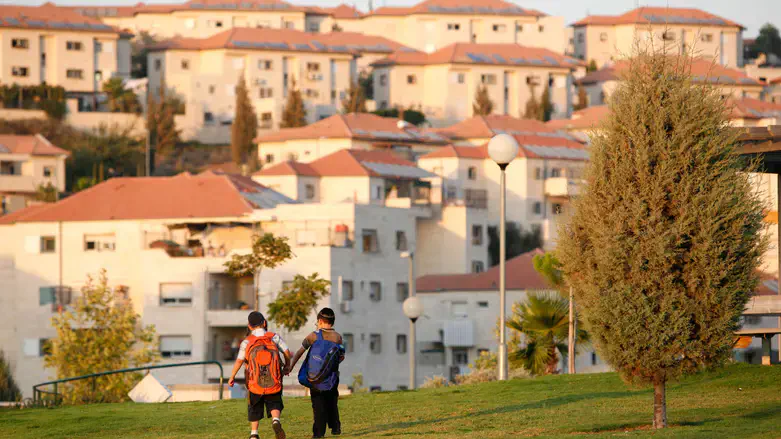
This letter is primarily addressed to my fellow haredi Jews living in Israel. You are steadfast guardians of our sacred Torah, unyielding keepers of our faith who live with uncompromising devotion to Hashem’s commandments. Our yeshivas are fortresses of learning, our homes are sanctuaries of mitzvot and our commitment to every detail of halakha is a testament to your love for the Divine.
Yet, as I gaze upon the hills of Judea and Samaria, the biblical heartland of our people, I am struck by a troubling absence. Where are you, my haredi brethren, in the sacred task of settling our Land? We flock to these regions for vacations, visiting the holy sites of Hebron, the springs of Gush Etzion, the vineyards of Shilo, the deserts of the Judean Desert, the graves of Yosef Hatziddik and Yehoshua Bin Nun—but when it comes to building our lives there, to planting roots in the soil of our forefathers, our presence is painfully sparse.
Yes, the towns of Beitar Illit and Modiin Illit stand as towering achievements, the two largest communities in Judea and Samaria are home to thriving haredi communities. But let us be honest: while there are hundreds of Jewish communities, yishuvim, dotting these hills, fewer than ten are haredi. Why do so few of us claim our inheritance?
Judea and Samaria are not just a collection of hills and valleys; they are the cradle of our covenant with Hashem, the land promised to Avraham, conquered by Yehoshua, sung of by David. Yet, while Beitar Illit and Modiin Illit shine as beacons of haredi life, the broader landscape of Jewish settlement remains largely the domain of the national-religious and secular. The prominent haredi yishuvim can be counted on two hands- amongst them Maale Amos, Meitzad, Immanuel, Tel Tzion, Givat Zeev, Beitar, Kiryat Sefer- a stark contrast to the hundreds of communities built by others. This is not for lack of love for the Land, nor for lack of faith. So what holds us back?
Is it the shadow of doubt, the fear of the unknown, or simply the comfort of familiar urban enclaves like Bnei Brak, Jerusalem, or Beit Shemesh, where our communities have long flourished?
Consider the practical realities. The housing crisis in our strongholds is no secret. Apartments are shrinking, prices are soaring, and our growing families are squeezed into spaces that strain both spirit and sanity. Across the Green Line, however, lies opportunity: spacious land, affordable homes, and the chance to build communities that reflect your values—yeshivas, mikvahs, and kollels included.
The breathtaking views are a bonus, a daily reminder of the beauty of Hashem’s creation. And safety? The thriving settlements of Beitar Illit and Modiin Illit stand as proof that Jews can flourish and live safely where faith meets determination. This is not a pipe dream; it is a practical solution to a pressing problem.
Moreover, the haredim are uniquely suited to this mission. Our entire existence is a bold defiance of the world’s norms. We live according to Torah, heedless of the scorn of secular media or the disapproval of international bodies like the United Nations. When the world labels us “outcasts” for our commitment to long term kollel study, large family sizes, our modest dress, our unwavering commitment to halakha, we shrug and carry on, because our allegiance is to Hashem, not to fleeting global opinion.
So why should the disparaging label “settler” faze us? It should feel like second nature. We are already a people apart, living with courage and conviction in a world that often misunderstands us. To settle Judea and Samaria, to build communities in the face of criticism, is simply an extension of who we are: a people who choose principle over popularity, who choose Hashem's Will over public opinion.
The timing could not be more providential. The Gedolim of our era, following the legacy of Rav Shach, zt”l, no longer oppose living beyond the Green Line. The ideological barriers of the past have faded, replaced by a quiet consensus that supports Jewish presence in our biblical heartland. Politically, the stars have aligned: Israel’s right-wing government champions new communities in Yehuda and Shomron, and even the American administration offers rare support for this cause.
This is not just an opportunity—it is a divine call, a moment when history and destiny converge. To wait for others to act, to leave this mitzvah to the Religious Zionists alone, is to shirk a responsibility that is as much ours as it is theirs.
The mitzvah of settling the Holy Land, yishuv ha’aretz, is a cornerstone of our covenant, as vital as any other command in our Torah. So, I call upon you, my haredi brothers and sisters, to rise to this challenge. Let us build more communities in Judea and Samaria, beyond the shining examples of Beitar Illit and Modiin Illit, communities that shine with the light of Torah, where the sound of Gemara study echoes through the hills, where Shabbat candles illuminate the night, and where your children can grow with space to thrive.
This is not a task for tomorrow—it is a mission for today. And to my English-speaking haredi brethren, you olim from Brooklyn, London, and Lakewood, I extend a special invitation: join me in founding a new haredi yishuv, a community that marries your unwavering faith with the sacred soil of our Land.
If your heart stirs at this call, reach out to me. Together, with G-d’s help, we will find opportunities to join pre-existing communities that are looking to expand or start a new community. The opportunities are there for those who are looking to find them.
I can be reached at avrumshusteris@gmail.com