
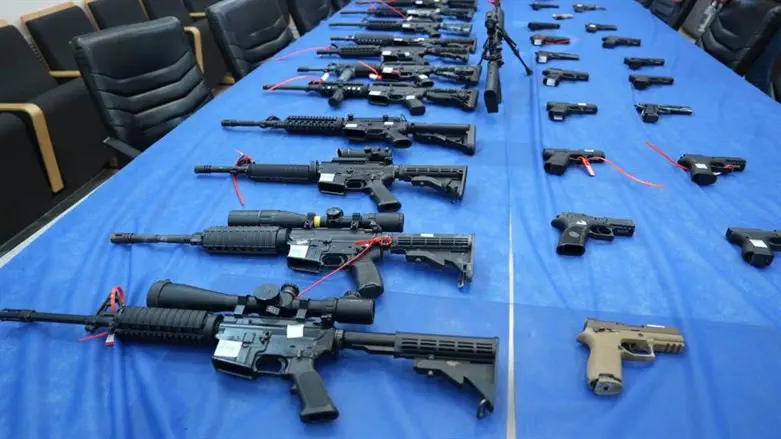
Hagai Reznik, director of the Rifman Institute for the Development of the Negev, has issued an urgent call to the government to promote new legislation aimed at combating the epidemic of illegal weapons in Arab society. In a letter addressed to the prime minister and senior ministers, and in a detailed conversation with Channel 7, Reznik outlined the scope of the problem, its national implications, and his legislative proposal for addressing it.
Reznik highlighted the staggering estimates: some 400,000 illegal weapons are believed to be circulating in Israel, of which approximately 100,000 are concentrated in the Negev. Despite the police’s ongoing operations, even on their most successful days authorities manage to seize only 50-60 weapons—an effort Reznik likens to “emptying the sea with a spoon.” He warned that while Arab communities are currently the first victims of this wave of violence, the uncontrolled proliferation of arms inevitably threatens Israeli society at large and could spark a major national security crisis.
The root of the enforcement problem, Reznik explained, lies in current legal restrictions. At present, police must obtain a focused judicial order for each individual home search, which requires substantial evidence directly linking that home to hidden weapons. This procedure, while protective of civil liberties, severely hampers police effectiveness and prevents wide-scale disarmament efforts.
Reznik’s proposal therefore calls for legislative reform that would allow administrative searches and, where necessary, administrative detentions, with judicial oversight but without the need for narrowly tailored warrants. He suggests dividing the country into geographic “cells.” When intelligence indicates that weapons are hidden in a particular cell, police would be authorized to raid homes and conduct searches across that zone, making arrests if necessary. This approach, he argues, would provide the necessary flexibility to break up arms networks and prevent weapons from spilling unchecked into the streets.
Acknowledging potential objections about human rights, Reznik insists that the right to life outweighs other considerations. The cell-based model, he adds, avoids targeting any one ethnic or social group, since enforcement would be tied to geography rather than identity. It would also empower local residents to provide intelligence without fear of reprisal, as information could be acted upon without exposing the identity of informants.
A particularly alarming aspect of the crisis is the emergence of a flourishing rental market for weapons. Reznik reports that residents of the Bedouin diaspora describe a system in which guns, ammunition, and even accessories such as magazines can be rented for a few hours or days at fixed prices. Assault rifles and long guns are often offered for short-term use, making firearms accessible even to those who cannot afford to purchase them outright. Social media is rife with videos of young men flaunting their rented weapons, riding ATVs with belts of ammunition slung across their chests, and firing into the air as if in celebration. According to Reznik, this market demonstrates just how normalized and entrenched illegal weapons culture has become in the Negev.
The threat is not abstract. Residents of the diaspora, as well as Reznik’s own institute staff, have been threatened for their efforts to raise awareness of the issue. Locals increasingly warn that the danger is not looming in the future but already unfolding daily: “The catastrophe is not ahead of us, it is already here,” Reznik said.
In advance of his letter, Reznik met with MK Tzvika Fogel, chair of the Knesset’s National Security Committee. Fogel expressed support for raising the matter formally and promised that a special discussion of the proposed legislative outline will be held at the very opening of the next Knesset session. Reznik stresses that action cannot be delayed, warning that without immediate steps, the epidemic of illegal weapons will continue to spiral beyond control.