
The international media has long held a flattering view of itself. Journalists imagine they are doing important and sacred work. Yet they are not the protected species they imagine themselves to be.
Nowhere has this delusion been more visible than in coverage of the Israel-Hamas War in Gaza.
Ever since Israel entered Gaza to destroy the jihadist Hamas terror group after it carried out the October 7 massacre in 2023 - the worst slaughter of Jews since the Holocaust - international media has lamented the deaths of “journalists” in Gaza, demanding they be treated as if they had diplomatic immunity.
They have painted reporters’ deaths as evidence of Israeli war crimes, as if the laws of war impose on Israel a unique obligation to avoid people wearing press badges regardless of circumstance.
The implication is that journalists are somehow more innocent than the civilians around them, more valuable than the soldiers who risk their lives, more irreplaceable than the hostages Hamas still holds underground.
This is morally obscene nonsense.
Journalists are civilians, yes, so they are entitled to the same protection under the laws of war as any other noncombatant. They are not more than civilians. There is no “journalist privilege” in international law granting reporters greater protection than a teacher, farmer, or child. Journalists’ lives are not worth more.
I am not belittling journalists’ work or the risks they take to report news. I was a foreign correspondent on the streets of Jakarta in 1998 when a mass protest movement overthrew the 32-year dictatorship, sparking a four-day orgy of violence in which more than 800 people, mostly ethnic Chinese, were killed, often gruesomely.
I was targeted and chased by a machete-wielding mob. I escaped by running and climbing up the outside fire escape of Jakarta’s World Trade Centre, from which I jumped across a wall to safety while the mob bayed below me. I do not mind telling you that I was a tad rattled. This and other incidents are seared into my brain.
Yet, I never imagined that my story was more important than anyone else’s in Jakarta. I was hardly alone. I know a photographer who was shot in the foot that day and another reporter who was beaten up. None of these events made the news, and nor should they have. It was not about us.
The myth of the sacred journalist is exactly that. It began in the second half of the 20th century, when Western news organizations began romanticizing their war correspondents.
Vietnam produced the archetype of brave correspondents, flak jackets open, notebooks in hand, “speaking truth to power” as their crews filmed jungle ambushes or reported from Saigon bars. War had never been beamed into people’s living rooms before so the impact was powerful.
Hollywood enshrined the image in films such as The Killing Fields and The Year of Living Dangerously. From then on, journalists cultivated the fantasy that they were indispensable actors on the global stage, as if without them civilization would lapse into darkness.
War reporting is important, but it does not confer a priestly status upon war correspondents. Journalists convinced themselves, and each other, that to harm a journalist was sacrilege. No one else got the memo.
This self-importance spawned the idea among journalists that they deserved a special legal status, as if they were a “protected class.”
Some even imagine that governments have a duty to protect journalists, which is a bizarre notion given there is no such duty to protect any other particular profession.
The war in Gaza has exposed how corrupt and cynical this mythology has become. Western outlets weep over the death of “journalists” in Gaza without mentioning that many of them were Hamas propagandists and terrorists.
Foreign journalists do not have access to Gaza, which is something they protest about even as they claim to know what is happening there. The “press corps” in Gaza comprises people whose salaries are paid by Hamas-run ministries, whose photographs glorify Hamas terrorists, and whose “reporting” is indistinguishable from jihadist agitprop. (and whose every word is checked by Hamas, ed.)
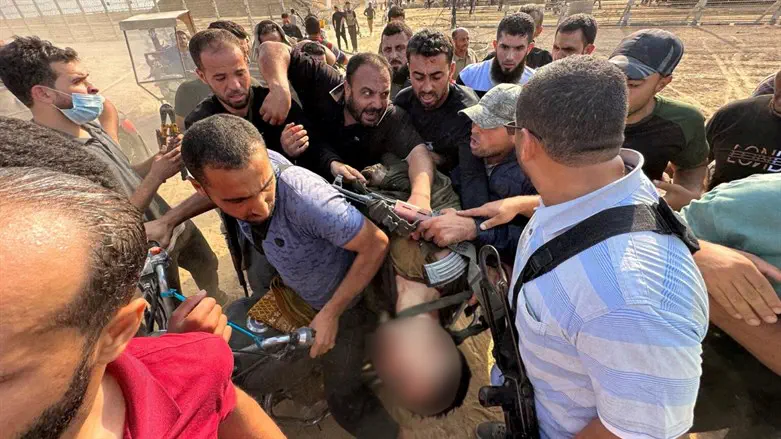
Consider the so-called journalists who rushed to the Israel-Gaza border on October 7 to film the massacre. They were there not by accident but by coordination. The Associated Press and Reuters had to explain why they were publishing photographs taken by men who tagged along with Hamas killers as they stormed kibbutzim, slaughtered civilians, raped women, took hostages, and burned families alive. These news agencies failed to provide any credible or satisfactory answer.
These “journalists” were not neutral witnesses; they were there to spread the terror. Yet, when some of them were later killed in Israeli strikes, the Western press held them up as martyrs of journalism.
If a Hamas fighter puts down his rifle, picks up a camera, and files photos to a wire service, is he then immune from attack? If an operative uses his status as “press” to travel safely and transmit information to Hamas command, is he untouchable?
The laws of war do not create such absurdities. They recognize that in war zones the distinction between civilian and combatant can collapse, especially when terrorists such as Hamas intentionally blur it.
International Humanitarian Law is clear that civilians should not be directly targeted. Journalists are civilians. That is the beginning and the end of their legal status. They do not rank higher in the hierarchy of humanity.
The Geneva Conventions make no mention of the press as a special category. Protocol I, Additional Article 79, says only that journalists are civilians, and thus “shall be protected as such.” In other words, journalists are the same as everyone else.
Journalists knowingly assume risk when they report from a war zone and it is obvious that if they embed with the combatants, then they risk being treated as combatants.
If they participate in hostilities, whether by transmitting targeting data, by carrying weapons, or by coordinating with combatants, they lose civilian protection. This is black-letter law, and it has been upheld in countless conflicts.
The outrage that erupts whenever a “journalist” is killed in Gaza is just propaganda, not even a legal or sound moral claim. The goal is not to uphold the laws of war but to elevate journalists above it.
Journalists push their own mythology, partly out of vanity and partly for political convenience. Vanity is a human trait that we must suffer, but convenience is more sinister. In declaring themselves “protected,” journalists are trying to avoid any accountability.
If they enjoyed such a status, they would be free to enter war zones, spread propaganda, and embed with terrorists, all while claiming immunity from any consequences.
The irony that they claim to be holding the warring parties to account while avoiding any accountability themselves is wasted on them.
Western outlets routinely publish Hamas talking points under the guise of “local reporting,” confident that any Israeli strike which kills their stringers will be presented as an attack on journalism itself. The propaganda value is immense.
Hamas understands this, which is why it hands out press vests and has its propagandists pose as independent reporters. A Hamas fighter with a Kalashnikov is a legitimate target. A Hamas propagandist with a press badge is a human shield, and a powerful one, because Western editors will cry foul when he is killed.
This has a corrosive affect on laws of war. It makes some deaths count for more than others, which is evidently what the international media thinks given the way they report some deaths and events but not others. It incentivizes terrorist groups to masquerade as journalists, further eroding the distinction between combatant and civilian at the cost of civilian safety.
It feeds a dangerous culture of blackmail against democratic states. An army that kills a journalist, either accidentally or because they were serving the enemy, will be accused of crimes.
Israel faces this blackmail constantly. Every time it bombs a Hamas command center, it risks killing propagandists. When it raids a terrorist safe house, it risks detaining “journalists” who are really intelligence assets. Every time such things happen, the anti-Israel Western press screams that Israel is waging war on the media.
This is nonsense. Israel is waging war on Hamas. If Hamas uses journalists as shields, or if it employs journalists as agents, then the blood is on Hamas’ hands, not on Israel’s.
A medicinal dose of clear thinking is needed. Journalists have no special status. To the extent that they behave like civilians, they deserve the protection of civilians. To the extent that they behave like combatants, they share combatants’ fate.
The laws of war exist to protect civilians, not to provide privileges for one profession. War reporters have chosen dangerous work. I am not being heartless. Many do their jobs with courage and integrity. I have lost two friends who died covering wars.
Yet journalists are not more valuable than the civilians who grow food, treat the wounded, or teach children. They are not entitled to greater protection than the grandmother in Sderot or the child in Ashkelon.
When journalists die in war, it is tragic, as is every civilian death. But it is not a war crime in itself and it is not sacrilege. The press must show some humility, abandon this mythology and accept that no one is immune to war’s horrors.
Perhaps if they faced that reality, their reporting would be less sentimental, less self-righteous, more serious and, above all, more honest.
Nachum Kaplan has decades of international experience as a journalist, commentator, speaker, and C-suite media strategist to Fortune 500 companies.
Reposted from the Moral Clarity: Truths in Politics and Culture substack.