
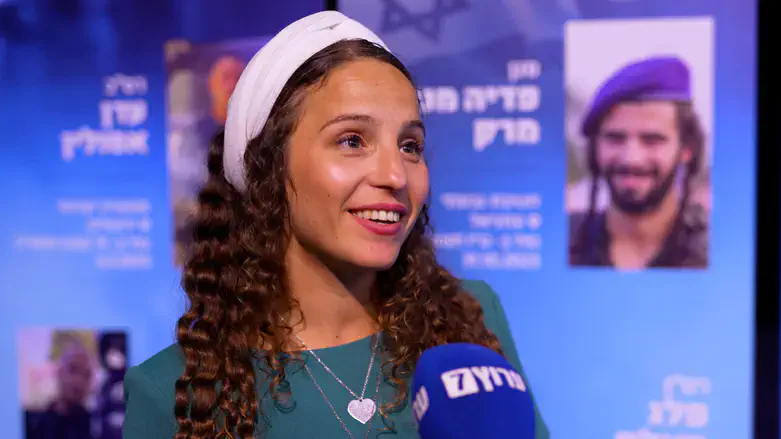
Thousands gathered on Sunday at the International Convention Center (ICC) in Jerusalem for a moving conference marking 90 years since the passing of Rabbi Avraham Yitzchak HaCohen Kook. Among the voices that gave the evening its spirit was Orit Mark Ettinger, who not only hosted the event but also carried into it her own story of loss and hope.
For Ettinger, the timing of the gathering could not have been more fitting.
“Elul for me is music,” she said with a smile touched by emotion. “The songs of Elul, the melodies of the Days of Awe - I start listening weeks before. It helps me enter the atmosphere. In these complex times, especially the last two years, to come into such a moment - it feels deeply right.”
Just a few steps away from the stage stood a powerful memorial: a wall of faces of the fallen from the Iron Swords War. Among them, the picture of her brother, Pedaia Menachem OBM. Orit’s eyes rested on his photo.
“This is the first time I’ve seen such a display of all the fallen,” she said quietly. “It shakes you. You see familiar faces - my brother, my friends, people I sat with during shiva [the Jewish week of mourning]. So many faces. It’s overwhelming to be here.”
Yet the evening was not only about grief. Around her, music played, families embraced, and children laughed. That contrast struck her deeply.
“There’s life here too. People came from all over Israel, many of them bereaved families. Almost no one is untouched - either they lost someone, or they have a loved one still serving in reserves, like my husband. And still, here we are - remembering, and also singing and dancing together. That’s exactly the verse: ‘In their death, they commanded us to live.’”
Ettinger sees in that balance a reflection of Rabbi Kook’s vision.
“I don’t always quote ‘Rabbi Kook said,’” she admitted, “but his way is a way of life. To learn Torah and also to be active in the world - to volunteer, to contribute, to serve in the army. Today, with all the debate around enlistment, that’s the root. That’s Rabbi Kook.”
Referring to the spirit of Rabbi Kook, she said: "I don't always say 'Rabbi Kook said,' but his way is a way of life. It's exactly ‘in their death they commanded us to live' - knowing how to continue, to sit in Torah lessons on the one hand, and on the other hand to also be present in the world of action, even on television. Different worlds, and still a jungle between them: to study, to volunteer, to contribute to society, to serve in the army. Today, with all the talk around conscription - this is the basis, this is the root, this is Rabbi Kook."
Looking once more at her brother’s portrait, his long peyot [sideburns] unmistakable, she spoke with pride.
“People point and ask: ‘Who is this with the peyot?’ And I say: that’s my brother. I’m so proud of him. Yes, it’s heartbreaking to see how many from the religious Zionist community have fallen. But I don’t want to see it only through that lens - we are one people.”
As the month of Elul calls for self-reflection, Orit carried the message into something personal - and universal.
“Each of us has to ask: what am I doing to make this country better? To remember that we must live better lives, for them. Even in small things - if I feel like cursing someone in the street, I hold back, because they gave their lives so that we could live here together.”
For her, that was the essence of the evening, and perhaps of Elul itself: “That each of us will do our part - as individuals, as a community, as a nation - to be better. That is how we honor them. That is how we live.”