
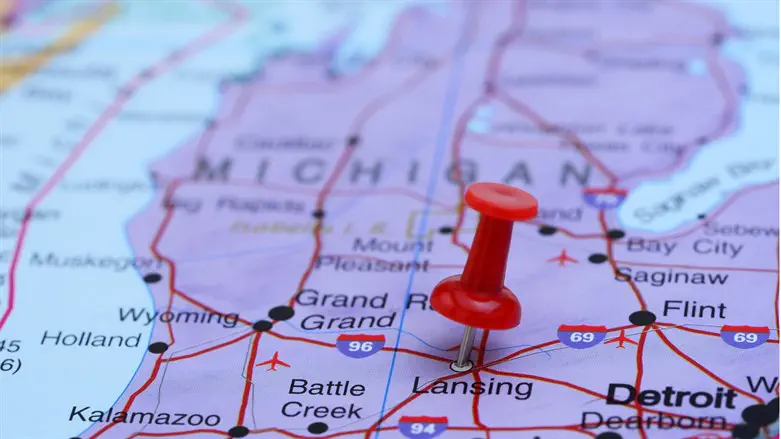
A large-scale Arbaeen procession was held in Dearborn, Michigan, over the weekend, with the participation of about 40,000 people.
Arbaeen is a Shiite holiday marking the end of forty days of mourning for the death of Imam Hussein, the grandson of Muhammad, who was killed in the Battle of Karbala.
The city of Dearborn, a major hub for the Arab and Shiite communities in the US, has become the venue for the largest religious event of its kind in the country. According to reports on the Shafaqna website, this year’s turnout was the highest to date.
Dearborn, a suburb of Detroit, has been home to tens of thousands of Lebanese immigrants and descendants of immigrants for decades, many of whom are Shiite Muslims. The community was formed in waves of immigration that began in the early 20th century with the development of Ford factories in the area, and intensified following the Lebanese civil war. The high concentration of Shiites in the city means that religious events, including the Arbaeen procession, are held on an extraordinary scale, even in comparison to other Shiite communities in the West.
The event was accompanied by increased security from the city police and local authorities, led by Mayor Abdullah Hammoud. According to a report on CBS News Detroit, a man was arrested during the procession after threatening to harm participants, but the event remained under complete control and ended without casualties. Local authorities emphasized that they take a zero-tolerance approach to violence, along with a commitment to maintaining freedom of worship.
Beyond the religious dimension, the procession in Dearborn also received public and political resonance. Local media in the US focused mainly on security aspects and public order management, but national media outlets presented the event as an expression of the strength and identity struggle of the Arab and Shiite communities in the US.
At the same time, media outlets affiliated with Iran and Hezbollah, including the Al Mayadeen channel, highlighted the event as evidence of the global resilience of the Shiite community and described it as a symbol of the "axis of resistance" taking root in the heart of America.
The event also occupied a prominent place on social media. Thousands of videos and photographs were distributed on platforms such as X, Instagram, and YouTube, documenting the singing, chanting, and speeches during the march. Many in Shiite communities around the world viewed the procession as proof of the community's ability to preserve its religious and cultural identity even far from the Middle East.