
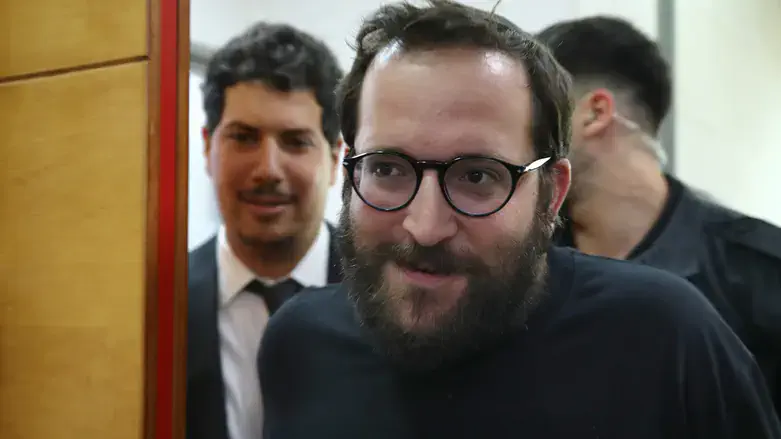
The President of the Magistrate’s Court, Judge Menachem Mizrahi, has rejected an appeal filed by the police to lift the restrictive conditions imposed on Yonatan Urich, a former advisor to Prime Minister Benjamin Netanyahu. Another hearing in the case is scheduled for tomorrow (Tuesday).
Attorney Eyal Basarglik, a criminal law specialist, commented on the decision, sharply criticizing the conduct of the police and the prosecution. He described their actions as “highly irregular,” noting that they initially refused to provide the court with the case evidence. “When it comes to an arresting judge—who is required to decide whether to detain a person, the most severe measure available—it is inconceivable that the prosecution and the police would withhold the material from him. In 22 years of practice as a criminal lawyer, I have never encountered such conduct,” Basarglik stated.
Judge Mizrahi ruled that he could not make a decision without reviewing the material. Following prolonged arguments, the investigators were compelled to submit the evidence, which revealed that Prime Minister Netanyahu himself does not regard Qatar as an enemy state and expressed no objection to maintaining relations with it. This disclosure directly undermined the police’s central claim that Urich posed a security risk.
Basarglik further asserted that the police and the prosecution pursued extreme measures—employing Shin Bet interrogations, arrests, and accusations of treason and espionage—without any substantive basis. “Judge Mizrahi, known as one of the strictest judges, told them unequivocally that they had no case. Instead of accepting this, they leaked accusations that he was a bad judge. If in every case where he extends detention he is considered excellent, why only here is he suddenly unqualified? Is this simply a matter of political positioning?” he asked.
According to Basarglik, the proceedings appeared designed to exert pressure on Urich and Yonatan Feldstein in order to turn them into state witnesses against Netanyahu. “The approach seems to be: apply maximum pressure because the system has failed so far to incriminate Netanyahu. Yet according to the judge’s rulings, there is no basis even for detention until the end of the proceedings, let alone for an indictment,” he said.
When asked whether Urich could pursue legal action against the state for damages, Basarglik responded that such a possibility exists, but in his view complaints to the Police Investigation Department or the Attorney General’s Office are rarely handled effectively. “At present, there is no authority that genuinely supervises the police, the prosecution, or the Attorney General,” he claimed. Nonetheless, he argued that a civil lawsuit should be considered once proceedings are concluded. “Although many prefer to return to personal peace rather than confront the system, in cases such as this it is appropriate to challenge it,” he concluded.