
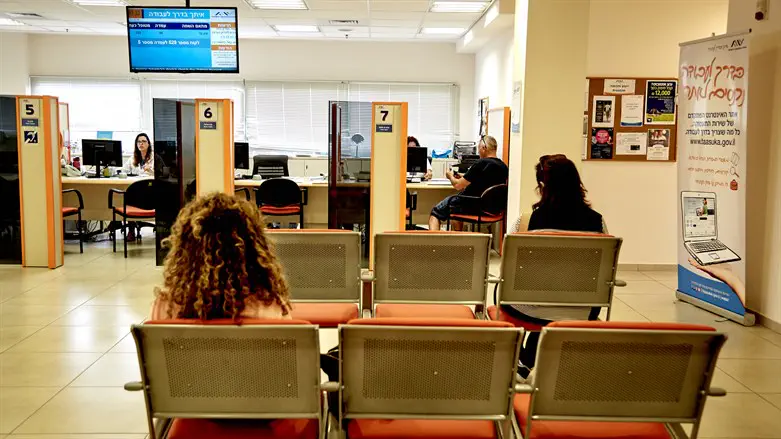
The Israel Employment Service announced today (Sunday) that the number of jobseekers in July fell to approximately 212,000, marking a 12.5% decrease compared to June. However, officials clarified that around 25,000 of these individuals are workers who went on unpaid leave during Operation Rising Lion, and only had their unemployment benefits approved in July. Adjusting for this, the actual number of active jobseekers stands at around 187,000.
Meanwhile, the number of people receiving income support remained below 40,000.
The data revealed an average 13.5% decline in jobseekers across most Israeli cities. The southern resort city of Eilat showed the sharpest drop at 27.7%. In contrast, cities such as Umm al-Fahm and Rahat experienced an increase in the number of jobseekers.
Unemployment benefit claims fell by 14.3% in July compared to June, while income support claims saw only a modest 2.2% decline.
Among young jobseekers (ages 18-34), the number dropped to 31.4%.
However, there was a rise in jobseekers among middle-aged (35-54) and older workers (55+).
By gender, the drop was more significant among women (17,600) compared to men (12,700), though women now make up 58.8% of all jobseekers — a 3.8% increase from July 2024.
Analysis by socioeconomic clusters shows:
- A decline in jobseekers from higher-income areas
- Stability in middle-income groups
- A rise in lower-income clusters
Interestingly, compared to the same period last year, the pattern was reversed, highlighting an ongoing diversification in the labor market.
By sector, jobseeker numbers have increased across nearly all fields over the past two months — likely due to seasonal layoffs and the aftermath of Operation Rising Lion. The most impacted professions include:
- Gardeners and crop growers (+182.5%)
- Sports and fitness workers (+144.6%)
- Childcare workers and teacher’s aides (+143%)
- High school teachers (+83%)
In large cities (populations over 40,000), the highest rates of jobseekers are found in Modi'in Illit and Beitar Illit, while Ra’anana, Kfar Saba, and Ramat HaSharon reported the lowest.
Adv. Inbal Mashash, Director-General of the Employment Service, stated:
“Once again, the Israeli labor market has shown resilience and adaptability in the face of emergencies and their aftermath. However, two concerning trends stand out: seasonal layoffs that undermine workers’ rights and stability, and a changing profile of jobseekers that signals potential weakening among traditionally strong workforce groups. This may be an early indication of how artificial intelligence is beginning to reshape the labor market.”