

“To serve G-d with all you heart and with all soul” (Deuteronomy 11:13).
How does one serve G-d with one’s heart? By praying, says the Gemara (Taanis 2a).
Most of us think of davening as an activity in which we pour our hearts out to G-d. Not so, says Rav Samson Raphael Hirsch. Davening “is not an overflowing from within but a renewed intake and penetration of truth from without.” When we daven, we remind ourselves of “facts and truths that need to be awakened, reanimated, and kept ever afresh in us.”
That’s why the Hebrew verb hitpallel (to pray), is reflexive. (Other examples of reflexive verbs are hitkarer [to grow cold] and hitkale’ach [to shower oneself].) When we pray, we do something to ourselves.
According to Rav Hirsch, hitpallel comes from palel, which means to judge. “[A judge] brings justice and right - Divine truth - into a matter, makes it penetrate every aspect of the case, and thus brings about a harmonious unity where there was division and conflict. Hitpallel means to perform this same task on ourselves: to make G-d’s truth penetrate every aspect and condition of our lives and thereby attain the harmonious unity of our existence in G-d. In short, it means to penetrate oneself with godly thoughts.”
Rav Hirsch notes that if davening were an emotional subjective experience, halakha couldn’t possibly command us to daven using a particular text three times of day. “For it cannot be assumed that, at the word of a command, at some fixed moment, everyone will have the same thoughts and feelings and have the urge to put them into words.”
But davening is “the very opposite of what is generally called ‘prayer,’” writes Rav Hirsch. “It is not an overflowing from within, an expression of that with which the heart is already filled (for that we have expressions like techinah and si’ach).” Rather, as Rav Hirsch writes in The Nineteen Letters, it is “the purification, enlightenment, and uplifting of our inner selves to the recognition of the Divine truth.” The “activity is not from within outwards but from without inwards.”
In fact: “One can truly say that the less we feel inclined to pray, the greater the necessity to do so. For when we pray, we correct our judgment, we become clear on our obligations and our relationships to things in general.”
Three times a day, we go to shul - the German word for school - to relearn what we’re supposed to be thinking.
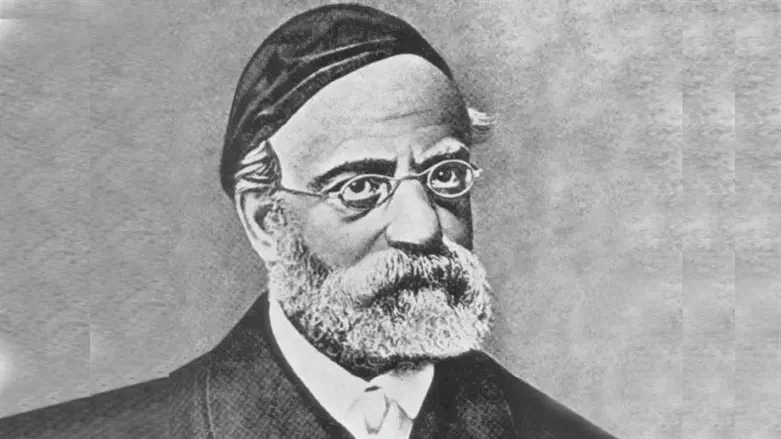
Rav Samson Raphael Hirsch (1808-1888) - head of the Jewish community in Frankfurt, Germany for over 35 years - was a prolific writer whose ideas, passion, and brilliance helped save German Jewry from the onslaught of modernity.
Elliot Resnick, PhD, is the host of “The Elliot Resnick Show” and the editor of “The Rav Samson Raphael Hirsch Dictionary.”