

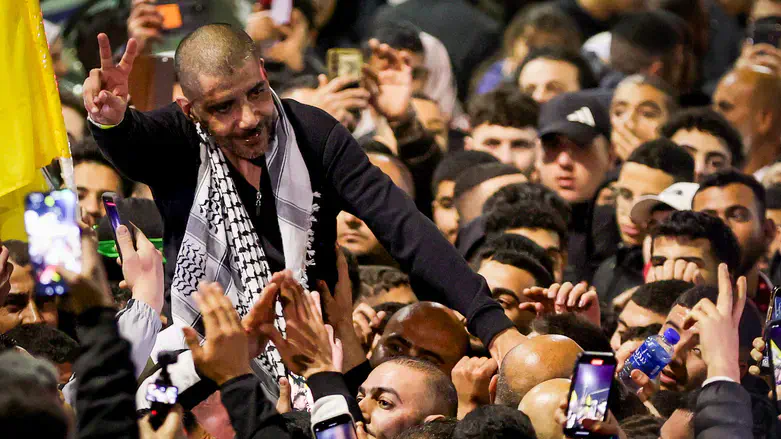
Zakaria Zubeidi, the notorious leader of the Fatah-affiliated Al Aqsa Martyrs Brigade in Jenin during the Second Intifada, has admitted in an interview with The New York Times that decades of violence, militancy, and political activism have failed to bring about a Palestinian state.
Zubeidi, 49, was freed from Israeli prison in February as part of a hostage deal. Convicted of multiple violent offenses and accused of ordering deadly attacks on Israeli civilians, he is viewed by many in Israel as a dangerous terrorist who should never have been released. Bella Avraham, whose husband was killed in one of the attacks he allegedly ordered, told Israeli media after his release: “I expect the state to hunt him down until his last day.”
According to the New York Times profile, in the early 2000s, Zubeidi rose to prominence during the wave of suicide bombings and shootings that killed roughly 1,000 Israelis. Leading the Jenin branch of the Al Aqsa Martyrs Brigade, he was accused of directing shooting attacks, including one on a political party office that killed several people. Although he denied involvement in murders, Israeli authorities charged him with 24 offenses related to violence. “I’d never give myself up,” he once boasted in a scene documented in the press, adding, “I’d rather die.”
In 2007, Zubeidi accepted an Israeli amnesty in exchange for laying down arms, co-founding the Freedom Theater in Jenin with foreign activists. Yet he insisted to The New York Times that his cultural work was never a renunciation of violence. “The media said Zakaria moved from armed struggle to cultural struggle,” he said. “But it’s not about being one thing or another. How did I open the theater door? I broke it with my rifle.”
Rearrested in 2019, Zubeidi escaped prison in 2021 through a tunnel but was recaptured within days. His jailbreak, celebrated in Palestinian media, resulted in harsher conditions for all security prisoners. Reflecting on the escape, he said in the interview: “The prisoner who does not think about escaping prison does not deserve freedom.” Yet he admitted it ultimately achieved nothing: “I always knew it would end in death or recapture.”
Now, months after his release, Zubeidi concedes that both violent and non-violent strategies have failed. “We have to reconsider our tools,” he said. “We tried the rifle, we tried shooting. There’s no solution.” He also dismissed the results of cultural resistance: “We founded a theater, and we tried cultural resistance — what did that do?”
Despite his admission, Zubeidi continues to reject Israel’s legitimacy. “There is no peaceful solution and there is no military solution,” he claimed. “Why? Because the Israelis don’t want to give us anything. It’s impossible to uproot us from here, and we don’t have any tools to uproot them.”
The New York Times reports that since his release, Zubeidi has begun a Ph.D. in “Israel studies” at Birzeit University. He says the research will help him “better understand the complexities of the conflict,” though his past statements suggest his opposition to Israel remains unchanged.