
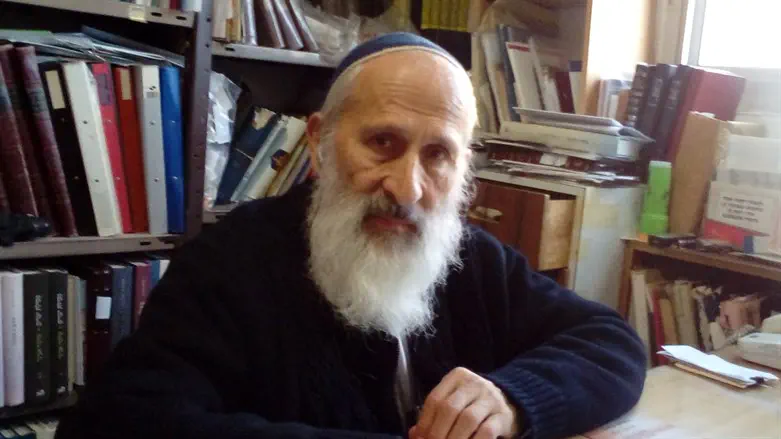
HaRav Shlomo Aviner is Head of Yeshivat Ateret Yerushalayim
Once, the wicked Roman rulers passed a law forbidding Jews to bring logs for the altar in the Beit HaMikdash. They stationed guards at checkpoints along the main roads, just as the Kingdom of Israel’s Yerovam ben Nevat had done, to prevent Jews from coming to the Holy Temple.
What did the devout men of that generation do? They made ladders out of the logs, and carried them on their shoulders. When the guards asked them, “Where are you going?” they answered, “To bring down birds from the birdhouse down the road, using the ladders on our shoulders.”
As soon as they passed the checkpoint, they dismantled the ladders and brought the logs up to Jerusalem. In our sacred literature, these people are remembered as “tzaddikim of blessed memory.” Even under threat and persecution, we remained faithful to Jerusalem and to the Beit HaMikdash.
All of the six incidents which took place on Tu B’Av relate to unity; on this day, different segments of Am Yisrael were united and showed their commitment to Eretz Yisrael and the Beit HaMikdash;
-Jews of different tribes were permitted to marry one another;
he tribe of Binyamin was once again allowed to marry women of other tribes, thus saving them from extinction, despite the grave sin they had committed;
-the Generation of the Desert ceased to die, and the Sin of the Spies, of rejecting Eretz Yisrael, was forgiven;
-the border policemen preventing Jews of the Kingdom of Israel from coming to Jerusalem were sent away. As a result, the ties between the Kingdom of Israel on the one hand and the Kingdom of Judah and Beit HaMikdash on the other were reestablished.
-Also, the corpses of Beitar were brought to burial, honoring the memory of those freedom fighters who gave their lives to establish a sovereign State with the freedom to worship God as they chose;
-trees were no longer cut down to be burnt on the holy altar. This has significance since the custom of donating logs affords another opportunity to illustrate the dedication shown by Am Yisrael to uphold the service in Beit HaMikdash, even during times of persecution.
Domestic harmony within the nation, and harmony between the nation and its Land, are really one and the same, for Eretz Yisrael is the factor which unites Am Yisrael. In Eretz Yisrael we become one nation. As the prophet Shmuel says, “Who can compare to your people, Israel, one nation in the Land.”
Tu B’Av, which this year fell on this past Shabbat, is the opposite of Tisha B’Av: In contrast to the baseless hatred that brought about the destruction of the Beit HaMikdash and the exile of our nation, the events commemorated on Tu B’Av reflect love and unity within our people, and our deep connection to Eretz Yisrael and the Beit HaMikdash.
Why did R. Shimon ben Gamliel say that there were no days more joyous than Tu B’Av and Yom Kippur? Because Tu B’Av is a day of renewal of ties among Jews, and likewise Yom Kippur is a day of renewal of our ties to God.
Yom Kippur is considered the wedding between Am Yisrael and God. This is the time when God’s wrath over the sin of the Golden Calf was appeased and Moshe Rabbeinu brought down the second Tablets to Am Yisrael. On this day we ask for forgiveness and “make peace” with God. We start afresh; our slate is clean.
There is a famous story about the Ba’al Shem Tov who sent his disciples to learn how to repent by following the example of a very simple man. They saw him standing in prayer, holding two notebooks, and speaking to God: “Master of the Universe, in this notebook I have recorded the many sins which I have committed this past year. And in the other notebook, I have recorded all the suffering and troubles You have brought upon me. I will forgive You for all the suffering You have brought on me, if You forgive me for all my sins!” He then threw both notebooks into the fire.
This should serve as a model for all our relationships - with our friends, our spouses, and so on. We must learn to throw all the notebooks into the fire, and begin anew. Yom Kippur and Tu B’Av are, therefore, days of connection: between God and Am Yisrael; between Jews; and between Jews, Eretz Yisrael and the Beit HaMikdash.
It is, therefore, fitting that on these days of spiritual unity, individual Jews should be married. We are now able to understand that, “Israel has had no holidays more joyous than Tu B’Av and Yom Kippur, when the young women of Jerusalem would go out…and dance in the vineyards and choose their spouses.”