
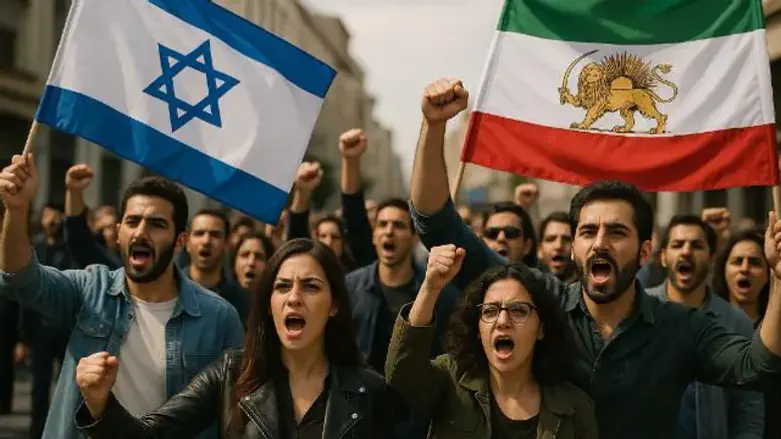
The Islamic Republic of Iran, now in its fifth decade of rule, persists not through legitimacy or consent, but through fear, repression, and ideological rigidity. Born out of the 1979 revolution, the regime has institutionalized clerical absolutism at the expense of constitutionalism, enforced religious orthodoxy over civic pluralism, and prioritized regional belligerence over national welfare. It has systematically stifled dissent, marginalized minorities, and squandered Iran’s vast natural and human resources. Abroad, it has destabilized the Middle East under the pretense of exporting revolution.
As such, if Iran is ever to emerge as a peaceful, democratic, and respected nation, the Islamic Republic must ultimately be dismantled.
Yet the question is not simply whether the regime should fall—it is how. The pathway to a post-Islamist Iran must be carefully charted. A reckless collapse could plunge the country into chaos, with devastating consequences for both its citizens and the wider region. Removing a deeply entrenched regime without a viable and inclusive alternative risks igniting sectarian violence, triggering humanitarian catastrophe, and fueling broader regional conflict. Therefore, the goal must not be regime change at any cost, but a carefully managed transition toward a stable, democratic political order that can endure.
The first and most urgent concern is to prevent mass civilian casualties. The Islamic Republic has repeatedly demonstrated its willingness to deploy lethal force against its own people. Combined with the threat of external military strikes—from Israel, the United States, or other actors—this raises the specter of large-scale violence. Iran’s long-suffering population, particularly its women, youth, and minorities, must not be made to pay the ultimate price for the regime’s downfall. A transition must be envisioned in a way that protects the dignity, safety, and agency of ordinary Iranians. Without this moral clarity, any resulting system would lack legitimacy and risk reproducing the very forms of repression it seeks to abolish.
Closely tied to this is the need to preserve Iran’s national unity. With its complex ethnic mosaic—including Persians, Kurds, Azeris, Arabs, Baluchis, and others—Iran is uniquely vulnerable to fragmentation if centralized authority disintegrates too rapidly. Foreign powers with nefarious agendas could exploit internal divisions, pushing the country toward Balkanization. The collapse of Iraq, Libya, and Syria offers grim precedents of what happens when authoritarian regimes fall without a plan for national cohesion. To avoid repeating these tragedies, the Iranian transition must be guided by a vision of inclusive democracy—one that guarantees cultural rights, equitable development, and full political representation for all the people within a united Iran.
Furthermore, any serious plan for transition must address the regime’s capacity to retaliate beyond its borders. Tehran has spent decades building a web of proxy militias across the Middle East—Hezbollah in Lebanon, Shiite militias in Iraq, the Houthis in Yemen, and others. These groups have been weakened following a series of targeted Israeli attacks, yet they still retain the potential to wreak havoc. Should the regime face existential threat, it may activate these forces to provoke instability, sabotage peace efforts, or even start a regional war. This threat cannot be dismissed as mere bluster; it must be anticipated and neutralized through a comprehensive strategy involving intelligence cooperation, regional coordination, and targeted diplomatic pressure. Any roadmap that overlooks this transnational dimension risks unleashing further conflict in an already volatile region.
The key:
The key to avoiding these peril lies in empowering Iran’s civil society—the most authentic and enduring force for democratic change. Unlike foreign interventions, grassroots movements draw their legitimacy from the people themselves.
The nationwide uprising triggered by the 2022 murder of Mahsa Amini stands as a testament to the power of civil resistance. Women, students, workers, and intellectuals took to the streets, defying brutal crackdowns to demand dignity, freedom, and a secular democratic future. Though the regime ultimately survived, it was profoundly shaken. That moment marked a turning point—a declaration by the people that clerical authoritarianism no longer commands their consent.
Civil disobedience has already achieved tangible victories. The most symbolic is the widespread rejection of the mandatory hijab. Despite its legal status, enforcement has collapsed in many cities. Women now walk unveiled in public spaces, reclaiming bodily autonomy in defiance of the regime. This act of everyday resistance—nonviolent, visible, and persistent—has proven more powerful than years of international sanctions. It demonstrates that the people, when organized and unafraid, can erode the pillars of tyranny from within. This momentum must be sustained. It must be protected. And it must be supported by the democratic world.
The role of the West:
Western governments and international institutions have a vital role to play—not as liberators, but as enablers of democratic agency. In all diplomatic engagements with Tehran, they must prioritize human rights over any kind of short-sighted expediency. This means pressing for concrete reforms: freedom of speech, freedom of assembly, women’s rights, and unfiltered internet access.
Beyond diplomacy, they should invest in long-term civic development. Programs that support independent media, democratic education, legal reform, and digital infrastructure can create the conditions necessary for a post-theocratic political culture to take root.
Even if military measure is unavoidable against the regime, it must be tightly coordinated with internal democratic forces. External intervention alone, without the consent and participation of the Iranian people, would almost certainly backfire. The bitter lessons of Afghanistan, Iraq, Libya, and Syria should be fresh in our minds: military victories unmoored from social legitimacy breed only instability. Sustainable change must grow from within, even if it needs international intervention and support to succeed.
In the end, the road to a democratic Iran will be neither swift nor simple. But it is essential—for the Iranian people, for the region, and for the world. The Islamic Republic has proven itself irredeemable: violent at home, belligerent abroad, and fundamentally incompatible with the aspirations of a modern nation. The task ahead is not merely to oppose the regime, but to envision and build what comes next: an Iran that honors its cultural richness, upholds human dignity, and stands as a responsible actor on the world stage.
That future is possible—but only if we begin planning for it with foresight and strategy today.
Dr. Reza Parchizadeh is a political theorist, security analyst, and international affairs specialist. His research and commentary have been widely featured in leading international media and institutions such as Al Arabiya, BBC, Fox News, Gulf International Forum, Middle East Forum, The Jamestown Foundation, and Voice of America.
A different version of this article was presented by Israel Law Center to the government of Israel.