
Shabbat Nachamu Concert! Shabbat Nachamu Getaway! Tu B’av Shidduch Program! The advertisements grab our attention from all directions, but the stark question remains. Is this what Shabbat Nachamu is all about? Is this what Tu B’av - the happiest day of the year - is here to teach us?
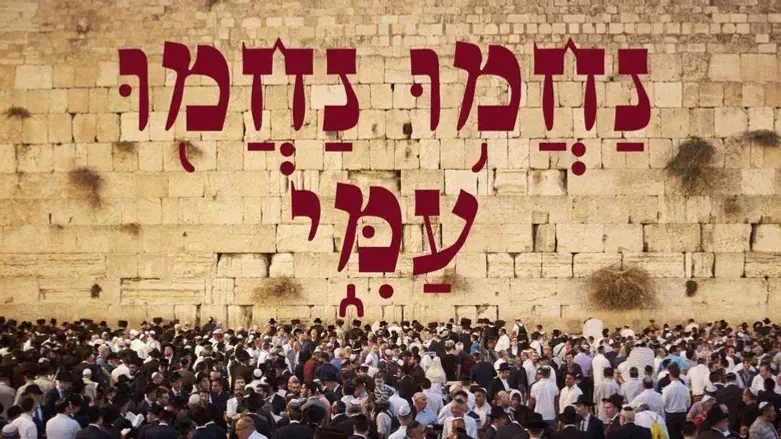
It is well known that the Shabbat immediately after Tisha B'av is called Shabbat Nachamu, based on the opening words of the haftorah, "Nachamu, Nachamu Ami!" Despite Klal Yisroel’s suffering throughout the galus that we relived on Tisha B’av, on Shabbat Nachamu we are reassured that Hashem's love for us is everlasting and that He will ultimately comfort us with the final redemption.
The Maharil, in his Minhagim on Shiva Asar B’Tamuz and Tisha B’av (27), teaches that Shabbat Nachamu is a time for celebration. It is a time when we renew our trust and anticipation for the Geulah. The Talmid Harashba explains that Shabbat Nachamu is like Yom Tov. The Ritva, at the end of Masechet Taanit, says that the seudah of Shabbat Nachamu is the seudah of Tu B'av, indicating that the two days are connected.

What is the celebration of Tu B’av, and what is its message for us on Shabbat Nachamu?
Although some identify Tu B’av as a day for shidduchim (based on Masechet Taanit), Rabbi Moshe Shapiro zt”l, taught that Tu B'av's central message is that it is a day of Tefilla (Afikei Mayim on Yemai Hamitzarim).
Following the Cheit HaMeraglim, which took place on Tishah B’av, every year afterward, on the night of Tishah B’av, Moshe Rabbeinu instructed all men between the ages of 20 and 60 to dig a grave and sleep in it. As a consequence of the Cheit HaMeraglim, this group of people was destined to die in the midbar, and their passing would take place on the night of Tishah B’av. Each year, on the morning of Tishah B’av, 15,000 from this group of men would not wake up.
In the final year in the midbar, when the last 15,000 men lay in their graves, the morning arrived, and yet no one died. Klal Yisroel assumed they had miscalculated the date and repeated the procedure the following night, the next night, and the next night. When Tu B’av arrived, and they saw the full moon, they knew with certainty that Tishah B’av had passed. To their great joy, they realized they would live and enter the Land of Israel.
Why was this so?
Indeed, all of the men lying in their graves each year on the night of Tishah B’av prayed that they be granted another year of life. Yet, in this final year, all the men lying in their graves realized that they were the ones who were going to be taken. There was no question in their minds. They pleaded and begged with heartfelt and desperate prayers to be granted life, and Hashem accepted all of their tefillot and allowed them to live.
Thus, Tu B’av teaches us the power of prayer—that heartfelt prayers can overturn even an explicit decree—and that message remains with us forever.
Parshas Vaetchanan is always read on Shabbat Nachamu, and it, too, teaches us about the Koach of Tefillah. The parsha begins with Moshe Rabbeinu recounting how he pleaded with Hashem to allow him to enter the Land of Israel. Moshe davened 515 prayers, the gematria of the word Vaetchanan. The word tefillah is also equal to 515. The obvious question is if Moshe’s tefillot weren’t answered, where do we see the power of tefillah from Parshas Vaetchanan?
The first answer is that Hashem hears, accepts, and responds to all of our prayers. We do not always understand His answers, but we know that no prayer is ever lost, and no prayer is ever in vain. Do we see the effect of Moshe’s many prayers? The Slonimer Rebbe teaches in Netivot Shalom, that Moshe’s pleading to enter the Land of Israel created an eternal impact on the Jewish people. Moshe’s 515 prayers - not answered with his being allowed to enter the Land of Israel - nevertheless were answered in that it imbued the Jewish people with a love and connection to Eretz Yisrael for all time.
A second understanding of how we see the power of tefillah from Moshe’s 515 tefillot, is in Hashem’s response to Moshe. Rabbi Reuven Katz zt”l in Dudaei Reuven notes that Hashem commanded Moshe to stop praying to be able to enter Eretz Yisrael. Rabbi Katz asks why Hashem needed to command Moshe not to pray anymore. Just as Hashem didn't allow Moshe to enter following the 515 earlier prayers, Hashem could have continued to refuse all future prayers.
Rabbi Katz answers that the Torah is teaching us how powerful prayer is! Hashem forbade Moshe to continue praying because if Moshe had prayed just one more time, Hashem would have allowed him to enter Eretz Yisroel. Yet Hashem, in His infinite wisdom, knew it was best for the Jewish people not to have Moshe lead them into Eretz Yisrael. To ensure that this did not happen, he commanded Moshe to stop praying. Such is the power of prayer!
A third point based on the Sfat Emet. The Midrash (Devarim Rabbah 7:10) says that Moshe Rabbeinu rebuked Klal Yisroel, saying that ‘one person (Moshe) was able to save 600,000 people (when he prayed for them after cheit haeigel), yet 600,000 people couldn’t save one person!’ What was Moshe Rabbeinu’s message? He was rebuking the Jewish people for not praying for him! He had invested himself entirely in prayers to save the nation, yet when the time came for the Jewish people to help Moshe by praying that he be allowed to lead them into Eretz Yisrael, they didn’t pray adequately. Had they davened just one more tefillah with kavannah, Moshe would have been allowed to enter Eretz Yisrael. Yet, they didn’t realize what they could have accomplished with their tefillot.
A fourth idea from the Pnei Yehoshua on Masechet Berachot 32a. He writes that calculating the number of Shemoneh Esreis said from Tu B’av until Zayin Adar (excluding Shabbat and Yom Tov when one cannot make personal bakashos) adds up to … 515! He says that it is his feeling that Moshe Rabbeinu wanted to tap into the power of davening on Tu B’av, and that is when he began his earnest prayers to be allowed to enter Eretz Yisroel.
He prayed three times on Tu B’av, three times the next day, and the next, until his final day on Zayin Adar, when he prayed his final - 515th - prayer.
In 2006, Prime Minister Ariel Sharon suffered a massive stroke. The doctors performed complex surgeries and used all medical means at their disposal, yet his prognosis was grim. In an unusual turn of events, Sharon’s family found out that there was one Jew in Israel, Rabbi Pinchas Ritter, who had suffered a similar stroke, and yet he recovered completely. The family traveled to this man's home to find out what they could learn from him to bring about Prime Minister Sharon’s recovery.
Rabbi Ritter met with them and apologized that he didn’t think he could help them. He said they had probably done all they could medically, certainly above and beyond the treatment he himself had received. That which had brought about his own salvation was not something they could duplicate.
They pleaded with him to reveal the secret, reassuring him that they were willing to go to any lengths to heal their father. But Rabbi Ritter just shook his head. He told them that he had recuperated because his children, grandchildren, and great-grandchildren prayed heartfelt prayers on his behalf every day and that his miraculous recuperation was undoubtedly due to their prayers.
To sum up, how are Shabbat Nachamu, Tu B’av, and Parshas Vaetchanan all intertwined?
It is all about the power of prayer.
Tefillah can bring about miraculous recuperation as Rabbi Ritter taught. It was tefillah that saved the Jews of the Midbar from the decree of death. It was Moshe’s message to the Jewish people with Parshas Vaetchanan - to keep on praying. And it is our key to the geula.
This Shabbat Nachamu - which is also Tu B’av - realize the importance of the day, that it is a day of tefillah. Take the time to daven slower and invest yourself in the words of tefillah. Grab hold of the opportunity that this day gives us to connect to the power of sincere and heartfelt prayer. And may we, too, see our prayers answered with the fulfillment of the haftara of Shabbat Nachamu.
(An earlier version of this article was published in Hamodia Prime Magazine.)
Rabbi Menachem Levine is the CEO of JDBY-YTT, the largest Jewish school in the Midwest. He served as Rabbi of Congregation Am Echad in San Jose, CA, from 2007 to 2020. He is a popular speaker and writes for numerous publications.