
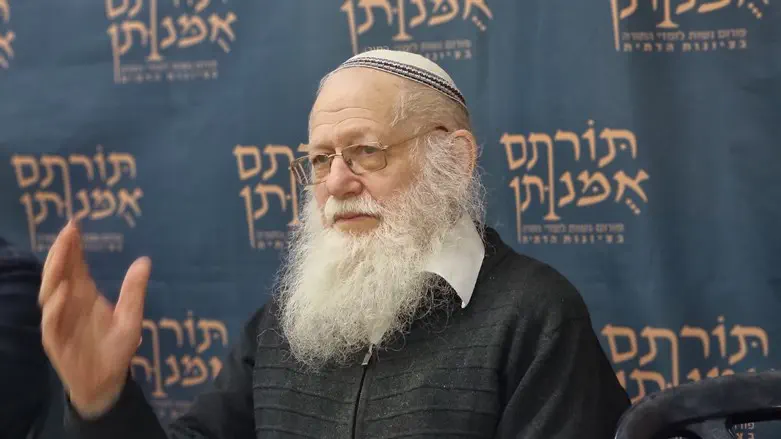
HaRav Dov Begon is Head of Jerusslem's Yeshivat Machon Meir
Why did our sages say, “There were never such good days for Israel as Tu B’Av (the fifteenth of the month of Av) and Yom Kippur” (Ta’anit 26b)?
Our sages explain that Yom Kippur contains the element of forgiveness, and it is the day on which Israel were given the second Tablets. Thus, on Yom Kippur we turn over a new leaf in our relations with God and with our fellow man. Such a day is a holiday and a day of joy for the community and for the individual (Ta’anit 30).
And Tu B"Av ? Tu B’Av is the day of matchmaking and weddings. It is the day on which it was declared permissible for the tribes to intermarry, and for the tribe of Benjamin to intermarry with the other tribes. It was the day on which the Desert Generation ceased dying off, and God resumed speaking to Moses. It was the day on which the roadblocks, set up by Yeravam ben Nevat on the road to Jerusalem to keep the Kingdom of Israel from making pilgrimages to Jerusalem, were dismantled. It was the day on which the martyrs of Beitar were handed over for burial, and the blessing of Hatov U’Meitiv [God is good and bestows goodness] was established. It was the day on which the Temple custodians would cease cutting wood for the altar pyre. At that point the days began getting shorter and the nights longer [hence the sun had less strength to dry the wood]. Longer nights allowed for increased Torah study, thereby prolonging one’s life (Ta’anit 31, Rashi).
It follows that Tu B'Av is a day of good beginnings and great hope for the community and the individual. Ta’anit 31a records:
“On the fifteenth of Av the daughters of Israel would go out dancing in the vineyards (wearing borrowed white clothing in order not to embarrass those who did not have). Whoever did not have a wife would go there. The most beautiful girls would say, ‘Pay attention to beauty, for the essence of a woman is her beauty.’ The women of fine lineage would say, ‘Pay attention to family, for the essence of a woman is her children.’ The homely ones would say, ‘Make your selection with sincere intent. Only be sure to adorn her with gold jewelry.’” The Talmud continues:
“In the future God is going to hold dances for the righteous, and He will sit amongst them in Eden. Every one of them will point with his finger, as it says, ‘It shall be said on that day: This is our God. We have waited for Him to save us. This is the Lord. We have waited for Him, and we will be glad and rejoice in His salvation’” (Isaiah 25:9).
What connection is there between the daughters of Israel dancing in the vineyards and the future dancing of the righteous in Eden?
It is known that the circle is a form that expresses equality. Everyone in the circle is equidistant from the center. By contrast, with a square, for example, the distances change. Dancing in a circle proclaims the equality of the dancers.
On the fifteenth of Av, the day of matchmaking, the noble and saintly daughters of Israel would go forth. Although they were not all equal in beauty and lineage, the exceptional ones would not make themselves conspicuous, nor would they compete with one another or be jealous of one another. Quite the contrary - they would go forth in borrowed clothing, whose white color was an allusion to kindness, and they would dance in a circle as equals, each possessing a trait that the others lacked. Thus, there was equal opportunity for all, and they knew that God, the true Matchmaker, is good to all, and His mercy is over all His works. Hence, “There were no days as good for as Israel as the fifteenth of Av” (Ta’anit 31a).
The holy souls dancing in a circle in Eden likewise represent goodness and kindness, with “each one pointing at God with his finger, as it says, ‘This is our God. We have waited for Him. . . . We will be glad and rejoice in His salvation’” (Isaiah 25:9. Tosafot, Ibid.). This alludes to the future, when “the earth shall be full of the knowledge of the Lord, as the waters cover the sea” (Isaiah 11:9). When that time comes, all men will know and recognize that Hashem, the God of Israel is King, and His kingdom has sovereignty over all. No longer will there be hunger or war, jealousy or competition. There will be goodness in abundance. The whole world will be preoccupied only with knowing God (Rambam, Hilchot Melachim 12).
The circles of Jewish maidens on the fifteenth of Av and the circles of the righteous in Eden have the same purpose: love and faith, goodness and light, and these elements must be increased and strengthened. Through this, we will merit to see with our own eyes the fulfillment of the blessing: “Father, bless us all as one, with the light of Your countenance” (Shemoneh Esreh). May it be soon in our day, Amen!