

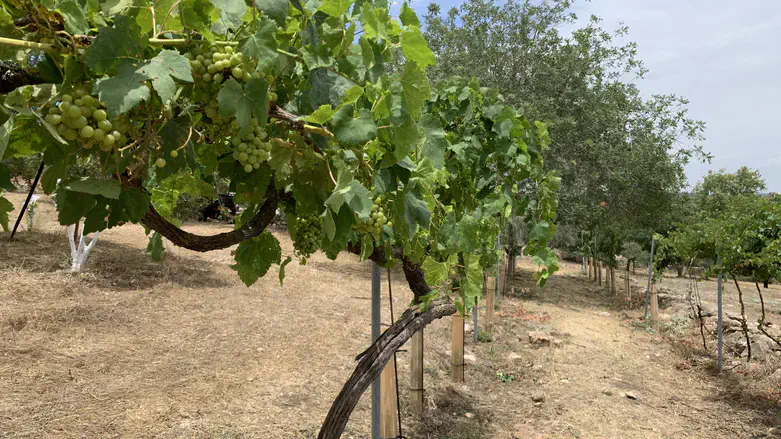
A new study conducted at University of Haifa, published in the Journal of Interdisciplinary History, reveals that Jewish sages in Late Antiquity were actively involved in viticulture and managed vineyards, carefully observing agricultural laws that aligned with Mediterranean cultivation traditions.
The study found that the distances mandated by the sages between vine rows to prevent crossbreeding (kilayim) are nearly identical to those found in classical vineyards in Italy and France.
Moreover, the study shows that the halakhic prohibition against consuming or benefiting from libation wine used in non-Jewish rituals took effect only at the grape-pressing stage. This allowed halakhically observant vineyard owners to employ non-Jews or non-observant Jews during the early stages of vineyard work.
“The sages’ rulings were not detached from the realities in which they lived. On the contrary, they reflect an intimate familiarity with agricultural work. The sages fully understood the economic systems in which they operated and sought ways to allow Jewish farmers to remain part of the wine industry without compromising halakhah,” explained Dr. Shulamit Miller of the University’s Haifa Center for Mediterranean History, one of the study’s authors.
During the third and fourth centuries CE, wine production was a major economic driver in the Land of Israel and a key component of local and regional commerce. While most existing studies have focused on the production stages — such as wine presses and pottery vessels used for storage and transport — little attention has been given to vineyard cultivation itself. This includes elements such as plot size and layout, vine training methods, crop diversification, and propagation.
Rabbinic literature contains numerous halakhic discussions related to vineyards, but it remains unclear whether this reflected practical agricultural knowledge or purely theoretical considerations. The current study, undertaken by Dr. Miller along with Professors Gil Gambash and Guy Bar-Oz of the School of Archaeology and Maritime Cultures, and Professor Eyal Ben-Eliyahu of the Department of Jewish History and Biblical Studies, sought to answer three central questions: How did vine cultivation in the Land of Israel compare to other regions of the Mediterranean? Were the sages themselves involved in viticulture? And if so, how did they shape Jewish law to reflect the agricultural reality of their time?
Using an interdisciplinary approach, the researchers combined textual analysis with archaeological evidence. They examined rabbinic texts — such as the Mishnah, Tosefta, and Jerusalem Talmud — alongside Classical Greek and Latin agricultural treatises, legal papyri from Egypt, Nessana (in the Negev), and Petra (in Jordan), as well as physical findings from vineyard excavations. Their comparative analysis included both halakhic concepts — such as the physical features of vineyards and methods for avoiding crossbreeding — and archaeological features such as rock-cut planting pits, agricultural terraces, boundary markers, and irrigation infrastructure.
The integration of textual and material evidence enabled the researchers to assess how halakhic rulings reflected real agricultural conditions and demonstrated the sages’ deep familiarity with vineyard planning and growing techniques.
The study found that viticulture in ancient Israel was adapted to the topographical and climatic diversity of different regions, from the Galilee and Carmel to the Jezreel Valley, Samaria, Judea, the coastal plains, and the Negev Highlands. Despite regional differences, viticulture in the Land of Israel followed the same general patterns observed across the Mediterranean.
Within this agricultural framework, the sages emerge not as theoretical legalists detached from the land, but as pragmatic experts deeply embedded in the agricultural practices of their time. The findings strongly suggest that at least some sages were personally engaged in viticulture. Their rulings reflect a conscious effort to harmonize divine law with the economic and environmental realities of their communities.
The researchers highlight that this reflects a practical and adaptable halakhic worldview — one that sought to balance religious commitment with daily life. The sages crafted a legal system that merged theological principles with a sophisticated understanding of environmental, social, and economic factors.
Ultimately, the study positions the sages not only as halakhic authorities but as active participants in the agricultural and economic systems of Late Antiquity. “Our research emphasizes halakhah as a dynamic, flexible force — one that operates within real-life circumstances, not just above them. It contributes to our understanding of halakhah as part of a living economy, and not merely as a system of restrictions,” the researchers concluded.