
The Jewish people as a whole have an amazing list of incomparable accomplishments: a return to their ancient homeland and creating a modern Jewish democracy which takes the Jewish religion into account, revitalization of their ancient language; repeated defeats of more powerful armies in many defensive wars; an influx and integration of Jews from a 2,000 year long global exile; and much more.
These great accomplishments result in the realization of Jews and Israel rebuilding an Am Echad (one nation) and Mispaḥah Echad (one family), regardless of custom (Ashkenazi, Sephardi, Mizrachi, Beta Israel), different levels of religiosity (from secular to Ḥaredi), or ethnicity (Eastern European to Ethiopian).
Yet each ethnic, cultural, or geographic group has made some adjustments in diet, language, community, and climate, to adjust to living in an Israeli/Middle East environment.
Except for perhaps one.
Before we start, it should be noted that this question and discussion is being raised by the author with all respect, as he is proudly related to a long lineage of Satmar Ḥassidim.
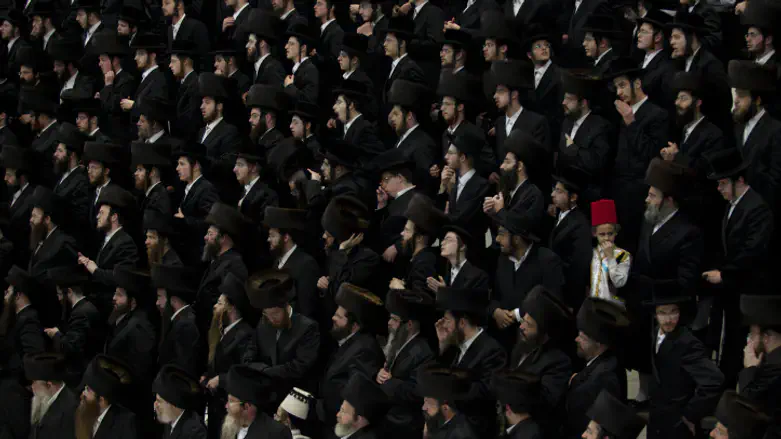
The question of dress is directed at the Ḥassidim, mostly European (Ashkenazi), Jews who live in Israel: Why continue to dress as an Eastern European when you live in the Middle East? Why not dress as Moshe Rabbeinu (Moses) or Rambam (Maimonides)? This includes the women, of course. Remember there is a core Jewish principal to follow the minhag ha’makom (custom of the place) and not to separate oneself from the community, al tifrosh min ha’tzibbur.
Throughout history, religious Jews in Israel and the Middle East generally dressed in ways that reflected both local customs and Jewish religious requirements, taking into account tzniut (modesty) and other religious laws. For example, in ancient Israel, men wore long, striped/multi-colored robes, that were influenced by local Semitic styles, while women wore modest robes and head shawls. That style has not changed much through the post-medieval times and even up to today, as can be seen from the dress of many local Druze and Bedouin and even the traditional dress of the U.A.E. and the Saudi people.
Today, Ḥassidic (part of the haredi sector) men are known for their unique style of dress. This includes: the long black coats (bekeshe, caftan); expensive, hot, fur hats (shtreimel, spodik); and other distinctive garments. In the 18th and 19th centuries, Jews in Poland, and surrounding Eastern European regions, who dressd that way, adopted the fashions of the local nobility and upper classes as a way to fit in with their surroundings. Over time, this European style of dress developed into a way that expresses their own distinct communal identity.
The current Ḥassidic dress is a comparatively recent cultural and sartorial adaptation. It is only a few hundred years old, relative to the thousands of years of Jewish history. Some style variations have developed between the different Ḥassidic courts that can make it easy to identify them (Ger, Satmar, etc.). For example, Chabad (Lubavitch) Ḥassidim tend to favor a fedora with a distinctive triangle-shaped crease, while non-Ḥassidic "Litvak" Ḥaredim wear a similar style hat but with a single crease down the middle. Some Ḥassidic groups wear round, brim-up hats with no creases, sometimes called "up-hats" or "biber" hats (originally made from beaver felt). Other groups chose other styles, not to mention the positioning that the hat sits on one’s head. The shape, height, brim style, and even the ribbon’s placement can indicate the specific religious community of the wearer. (The size of the Religious Zionist's knitted kippa does the same, ed.)
Old joke: “The Messiah hasn’t come yet because he doesn’t know which hat to wear.”
Let us also remember that Poland has a history of anti-Semitism, and its geographic location is a very cold climate. Which begs the question…why continue to copy the dress of cold-climate, anti-Semitic, Eastern Europeans? Why not adopt a dress code closer to your cultural, historic, and religious heritage that is more adaptive to this Israeli/Middle Eastern climate that you live in?
With some adaptations, Israeli Ḥaredim (the non-Hassidic haredim wear hot black suits) can make that style their own. It would be a more traditional look for living in our Promised Land, healthier (not overheating in heavy black clothing and better sun protection), and more comfortable (suited to a Mediterranean climate), while maintaining our devout religious standards. If black is preferred, Bedouin robes, which are black and made of light wool, can be copied. The look, of course, can be tweaked for individual each community’s personality.
Kitniyot, however, is another issue. Article to follow.
David S. Levine, MBA. is author of “Revolutions: In Their Own Words - What They Really Say About Their Causes” and “Hey Israel - You’re Perfect. Now Change!” (free eBook download). David is a former New York City advertising & marketing executive, and a retired university instructor at Rutgers University. Follow him on X (Twitter): @DavidsLevine