
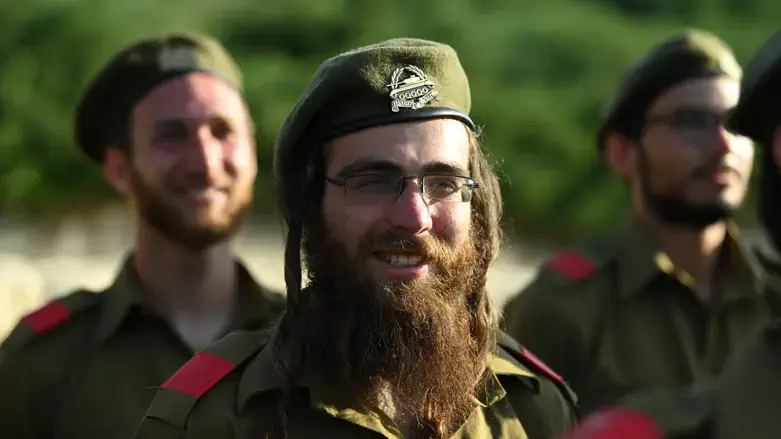
IDFCaptain Avraham Ben Pinchas recorded a message a short time before he fell in battle, a few succinct words that grant us a last glimpse into the depths of his pure and selfless soul, words that do not surprise those who knew and loved him:
“I, Avraham Ben Pinchas, service no. 8626693, request that if I am taken captive or my body is kidnapped, no terrorist is to be freed in order to achieve my return, nor should the war be stopped in any way in order to gain my freedom.”
This, so revealing of Avraham’s stalwart character, now remains the last memory of his voice. The words resound with us, more than a year after they were said, as we are still caught in the need to decide between trying to save the hostages and fighting a no-holds-barred campaign in Gaza to destroy Hamas.
Avraham Ben Pinchas Hy”d had made his personal decision.
Who was this young IDF officer who had the courage to record that message?
First and foremost, he was true to his beliefs. And modest about his considerable abilities.
Anyone who saw videos of IDF soldiers in the Swords of Iron War could not help but notice the significant number of religious IDF soldiers, among them many who wear large knitted yarmulkas, long sidelocks, beards and tzitzit (fringes) outside their clothes. However, there are very few who go on to officer training as Avraham did - and receive the coveted Outstanding Officer Award at its end. Being Avraham, his parents said, he did not tell them and they did not know about it until his name was called.
In fact, since Avraham was too modest to wear the symbols of his rank unless absolutely necessary, he once gave orders to new recruits who saw his sidelocks and fringes and thought he was an IDF rabbi overstepping his bounds. They called headquarters to complain, only to be yelled at to get moving because Avraham is their commanding officer!
Avraham ben Pinchas was born on 5 Adar I, 5760, 11.2. 2000 in the Binyamin community of Charesha, the eldest of the 11 children of David and Naomi Ben Pinchas. He fell in the Gaza Strip on 6 Kislev, 5784, December 7, 2024, at the age of 24. The Ben Pinchas family had known tragedy and challenge before. The sister born after him was killed by a speeding Arab driver 4 years before her brother fell, shortly after her wedding to Avraham’s learning partner (chavruta) and closest friend. And the third sibling was diagnosed with cancer in her early teens, but has made a miraculous recovery, thank G-d. She married her late sister’s widower recently, providing a source of comfort as well as remembrance to the family.
"Avraham had a heart of gold and golden hands, a heart that had room to hold everyone and hands always willing and able to help,” says his mother Naomi, a teacher, wistfully. “He loved to learn, but he also loved to create.”
“He would come home from the battlefield, change out of his uniform - when his little brother asked him to come to school so he could show off in front of his friends, he did not want to, telling me that he doesn’t want those learning Torah to feel uncomfortable - and ask me what needs fixing, going out to buy the materials he needed right away, but could never finish the repairs because he had to return to the army. Before his army days, though, he built a pergola, swings, a storage shed (machsan) and more. He would also build things with the younger children, helped his married sisters set up their homes, putting up shelves for them and installing light fixtures. He was a kind and helpful brother, close to his siblings, guiding them and always willing to listen to their hopes and fears. I called him ‘ach tov vachesed’ - a play on part of a verse in Psalms meaning ‘only good and kindness,’ but which if misspelled with a chet instead of a chaf, means ‘a good and kind brother.’ “
Avraham knew his siblings so well that he told his sister not to waste any more time dating because he had the perfect match for her, then arranged for her to meet his best friend and learning partner, not telling the friend that it was his sister so as not to pressure him. No one was happier than he was at their wedding.
“He was not a man of words, but a man of action,” recalls his grandmother Chaya Kaufman. “He knew how to fix everything, loved to help. When I moved, he came to my house, made a list, bought what he needed and then came to install curtains, put up closets, hang pictures using a bubble level. Everything was perfect. Professional. He worked quietly and happily. Where would you like this, he would ask cheerfully. Every corner of the house is a reminder of him. Every minute.”
“He was also a man of books,” says his father David, who studied at Merkaz HaRav and teaches in a Bat Yam yeshiva, “and that, more than his manual skills, was the most central part of his life. He had wide-ranging knowledge in a variety of subjects, deep understanding of issues, intellectual curiosity and an open mind, was one of those people who read all the time, even the pamphlet explaining his mother’s pension rights, left on the table at supper time, for want of anything else. In the army he read all the manuals that no one looks at so he could get optimum results, know how to repair things. When he fell, his soldiers asked me to send them a weekly Torah thought as they missed Avraham’s...”
Avraham’s chavruta (learning partner), Shmuel Shalem, remembers how Avraham raised the level of their Talmud study by showing him how to study commentaries beyond Rashi, but used their breaks to listen to podcasts on AI, economics, administration, politics, geopolitics, technology, everything he could. “He loved to learn and study all his life. He even took a date to the Haifa Science Museum.”
Avraham’s most outstanding trait, his father said in answer to my question, was truth and honesty. He spent time thinking about being honest with himself, a trait that was clear when he enlisted in the IDF after three years of serious learning in post high school Roeh Yisrael Yeshiva in Yitzhar, a yeshiva for older students, focusing on the teachings of Rabbi Kook and Hassidism, alongside in depth Talmud and Halakha studies.
His intellect and inquiring mind made him eminently suitable for the Intelligence Corps, and having lost a sister he needed his parents’ signature to be able to enlist in a combat unit instead, but he felt that the country needed more combat soldiers. He chose the Tank Corps because he was a man of action and there his technical abilities stood out as well. Naomi signed the papers, thinking that if G-d wants her to sacrifice two children for Eretz Yisrael, she is prepared to do so...praying for that not to happen.
Only in this Akeidah story Avraham himself was the sacrifice, going up to Mount Moriah on his own.
Early years:
Avraham was the first child born in a new and unique idealistic community, Charesha, founded by students of the religious Zionist flagship Merkaz HaRav Yeshiva and located in the Binyamin region of Judea and Samaria. It has been called a nature preserve of holiness, modesty, purity and simplicity. The families who elect to live there maintain a consciously spiritual environment, suffused with love of Torah, the Land of Israel, and its people. Avraham grew up along with that vibrant community, imbued with its ethos of settling the land despite any material hardships.
In fact, the Ben Pinchas family spent 18 uncomplaining years in a small caravan, moving to a proper home before the birth of their 9th child. How central those ideals were to Avraham can be seen in the essay he had to write before his acceptance to officers training, describing what he feels he is bringing to the army as a commander. Avraham wrote that he grew up in a community filled with the ideal of settling the land of Israel and that he is bringing those ideals with him.
He was 5 years old when the 2005 expulsion from Gush Katif took place and the family moved to Kfar Darom to support its residents during that traumatic period. That was part of his life, too. During the war, he hoped to reach Kfar Darom and bring his family sand from the place in which they had lived, but he only reached the ruins of Netsarim. Fighting in Gush Katif had special meaning for him, he spoke about it to his soldiers and played them a song about the Gush.
Courage as an acquired trait
As a child Avraham was not a daredevil, quite the opposite. He liked to be at home, eschewed sports, was awell-behaved child who loved school, loved to learn and recite things by heart. When he began dorming in Jerusalem’s Morasha yeshiva high school, after attending elementary school in close-by Neriya, he worked on himself, trying to become less fearful.
David explains: “He told his sister that at the age of 16 he was upset about his timidity and then heard a lecture from a rabbi on fear which made him decide he could change. He set himself small incremental challenges, we noticed the change and didn’t know why it happened. By the time he reached the combat unit his soldiers said that he did not know what fear was, took on the hardest challenges. He had overcome it. Had dealt with it. He worked on his character traits.”
In the IDF - severely wounded and back on the battlefront within a month
Avraham was a highly esteemed commander in the Tank Corps, somewhat older than the others due to his yeshiva years. On Oct 7, 2023, he was in the middle of officers’ training, rushed to the Gaza envelope and helped “cleanse” the area of terrorists after the massacre, then to Kochav Hashachar’s defense where he closed gaps in the small community’s security preparedness.
He would tell his superior officers what he thought of their battle plans, adding that he would do whatever they said even if he disagreed - and in the end, they mostly gave the orders he had suggested. He had amazing powers of persuasion, even convincing one of his soldiers to add a few months to his service, saying: “Find me a rabbi who will allow you to go back to Yeshiva while there are still hostages.”
It was important to him that soldiers go out to battle with minimal emotional stress and so he invested time, even during the war, in heart-to-heart talks with each one. His was such a mature and stable personality that when soldiers fell or were wounded, he could talk the others through it. He admitted to all kinds of machinations to get his soldiers what he felt was best for them, even made them coffee after battle.
In line with the thorough way he worked on gaining courage and learning battle skills, Avraham worked on the psychological aspects of being a commander. He went to Grandmother Chaya, a therapist, and told her “I know that I am really good technically, but I need to learn more about interpersonal relations because I wasn’t a youth group counselor and have no experience.” She knew that had been part of the officers’ course, but agreed to his request to enact simulations.
The soldiers soon learned that his long sidelocks and beard were deceptive, that he found it easy to connect to all kinds of people, finding common ground on subjects from AI to technology to carpentry, winning everyone’s heart.
How do they accept you the way you look, he was asked. It takes them 5 minutes, he said, and it passes.
Avraham blossomed in the IDF, and when Swords of Iron began, fought in Battalion 401 for 9 months, took part in conquering Jebaliya, Shifa and then was deployed in the Rafah area.
He was often in direct danger, but brushed it off. You would hear him on the phone, saying “listen bro, I have to go. I am in the midst of an attack/being shot at/ just eliminated a terrorist/rammed another/ saved a wounded soldier (including once under fire where a film shows him dragging a wounded soldier to cover and quickly applying a tourniquet.) At first he counted how many terrorists he eliminated, but after 30 he stopped counting.
On Rosh Chodesh Av, while commanding several tanks, he put his head out to see the situation and was badly wounded in the head by shrapnel from an RPG that hit the tank, but miraculously did not penetrate his skull. He didn’t say anything, checked that his soldiers were all okay, moved the tank back to the central gathering area, evacuated himself and passed out. A helicopter took him to Ichilov Hospital and he insisted on telling his parents by himself that he was there. He made it sound so minor that Naomi went to buy him gifts on the way and they operated before she arrived, although David came in time. Avraham told her that it is bad for soldiers to see their commander collapse, so he held himself upright until they reached the central area.
The Charesha community held an Oneg Shabbat to celebrate his recovery where he gave an impressive talk analyzing the situation in which Israel finds itself and captivated the audience with battle tales. But he also sent a personal message to each of his men, telling the commander who took charge not to get too attached to that tank. He insisted on returning to the fighting after a month.
He was killed four months later. Two weeks before that, the IDF skipped ranks and made him a company commander (Segen). He didn’t even get to tell his parents.
On 6 Kislev, Shabbat, Avraham fought from the most dangerous, upper part of the tank in the El Jenina neighborhood in Rafah, where they were given a mission in an area that had not been “cleansed” first. It was a joint operation with the infantry, engineering corps and his one tank protecting them. They would check if the tank cameras caught anything, advance and shoot, and this time an anti-tank missile killed him instantly. His tank driver said that the last conversation they had was when he asked Avraham why they are always given the most dangerous missions, why they are leading, and Avraham answered: “That is why we are here, to protect everyone, wherever they need us.”
Bereaved parents say that the shiva is the time they learn things they did not know about their sons:
- A technician who volunteered to put cameras on the tanks came because he remembered Avraham’s face when he saw the notice in the paper. Avraham was the first commander who asked him to explain how the camera functions, not just how to use it, he said.
-An older soldier from Tel Aviv said that it was almost time for him to be discharged when Avraham became his commander. He told Avraham: “I just want to get through this doing the minimum, so lower your expectations,” but the new commander called him for a private talk within two days and asked what he had done in the war the past year. He answered in detail and Avraham said: “Don’t you realize what a mission you have? And you want to leave this?” resetting his entire outlook.
- An American lone soldier under Avraham’ command cried at the shiva, speaking of how he could not understand much Hebrew and certainly not army jargon, while Avraham knew no English at all. Avraham placed him nearby so he could talk with his hands, also learned to say “good morning” and “excellent” so as to communicate a bit, gave him time to smoke a cigarette, once got him a burger. “He could not speak to my parents but arranged for me to fly home for the holidays. Flights were problematic when we first attacked Iran a year ago, and Avraham got the IDF to give me a 20,000 NIS ticket to go see them.”
- Another soldier told the story of Sergeant Itai Fogel from Yakir, Avraham’s close friend, who had returned from a vacation to fight and was killed erev Yom Kippur. It was a blow for the other soldiers and Avraham raised their spirits although he himself was falling apart. He used to say: “I have no problem dying myself, but what do I tell the parents of a soldier who will not return?” The responsibility weighed on him. He took Fogel’s soldiers to his tank and spoke to them, took care of them, spoke to their parents as if he was a social worker.
-Another added: His family always came before his personal needs. The nation as well. I never heard him say he was too tired if there was something to do for the Jewish people.
Grandmother Ruti Ben Pinchas (full disclosure, she and I were pen pals in grade school and she sent me dried flowers from Israel, making me the envy of my friends) helped put out a booklet in Avraham’s memory, "There was only one Avraham" (a reference to what the Sages said about the Patriarch Abraham). She writes: “My Avraham…I cannot write about you. I can only write to you. The heartbreaking news accompanies me every day, your face is always in front of my eyes, so alive, smiling your charming, quiet smile. You were our first grandchild, you made me a grandmother, and at the time, I couldn’t even imagine the joy that awaited me. Pictures of you fill my thoughts… aged one year, laughing as we hike in a wadi… your bar mitzva…but that was just the beginning. You grew up into a unique and special young man and the connection between us deepened. Long, serious conversations, always thought provoking…you never took the easy way out on an issue. We once walked side by side on a family trek, you were guarding me so I wouldn’t fall, but at the same time analyzing the factors that go into building character and talking about what creative arts are supposed to be. One Shabbat, you made the effort to come to our house in Kiryat Arba even though you were exhausted, on leave from the battlefront. And that was the last time I saw you… “
And Shmuel Shalem eulogized his chavruta/friend: “The most special person I ever knew, a man of action and a talmid chacham, true to himself and to those around him. He always tried to go forward, got up early and studied hassidut before davening, Eretz Yisrael was vital to him, he helped organize demonstrations in response to terror attacks, was always in charge of the data and computers, did the excel page for the buses, would walk around to see if all is well and take part. He went up to Chomesh after his dear friend Yehuda Dimentman was murdered, helped establish Evyatar, sleeping there when they needed it, laying bricks, building roads. He went to Lod and Ramle when the police were overwhelmed in the riots there during the Shomrei Hachomot Operation. Helped create defense systems in the city’s Jewish neighborhoods, knew how to read the map on where to defend and where to attack.”
“’I don’t mind dying, he said to me, ‘but for a good reason. I am at peace with myself, I know I am doing something right and significant, so I am ready for danger - that’s why my head will be out of the tank because if my head is inside, I cannot fight well enough.’
“He wanted the world to know what happens to those who go out against the Jewish People.
“Avraham, you lived to sanctify G-d’s Name. You were filled with Torah, humor, idealism and when you were cynical, you called it ‘constructive cynicism.’ You knew how to comment, direct us to the right things to do. You were not afraid to criticize to help fix things, to compliment us on the good things we did. But when we tried to compliment you, you would find a million reasons why it wasn’t you or wasn’t accurate. You knew how to be happy for a friend’s joy and to join his sorrow. Your uncompromising truth to your own self and others is what we will miss the most.”
The IDF memorialized Avraham in this Hebrew film titled: Leavdecha be'Emet - To Serve G-d with Integrity and Truth.
May Avraham Ben Pinchas Hy”d’s memory be blessed.
.
.