
When Israel gave the Sinai away to Egypt in 1993, the evil seed of October 7th was planted. After all, if Israel had remained in control of the Sinai, the mass smuggling of weapons and rockets into the Gaza Strip would not have been possible.
The next tragic stepping stone to October 7th came when Yitzhak Rabin, Shimon Peres, and their cohorts in crime welcomed the PLO into Gaza and awarded them with rifles, ignoring the warnings and cries of the Right that their Nobel-Prize winning gesture would lead to mass bloodshed and disaster.
Ariel Sharon’s destruction of Gush Katif was the third national betrayal which brought October 7th and the war with Hamas upon us. Twenty years have passed since that terrible Tisha B’Av day. Many of today’s ardent hilltop youths had not been born. Therefore it is appropriate to recall some poignant aspects of the story.
Many people participated in the campaign to prevent the evacuation and destruction of Gush Katif, too many to name. On the official side of the campaign, Moetzet Yesha (the Council of Communities in Judea, Samaria, and Gaza), along with the Council of Gush Katif Communities, took the lead in the struggle. In addition, many grassroots groups, and individuals on a partisan level, did their best to foil Ariel Sharon’s nefarious plan to erase the 21 flourishing Jewish communities, along with 4 settlements in northern Samaria.
No doubt, the fact that there were so many different groups and individuals, with conflicting opinions on how the opposition to the disengagement should be conducted, contributed to some extent to the ultimately unsuccessful effort to save the threatened communities. But in the Jewish world, that’s the way things go. Thus what follows is only my limited involvement in the overall, many-sided campaign. The full picture can only be obtained by hearing other recountings as well.
During the campaign against the Oslo Accords, a decade earlier, a group of former Gush Emunim activists, called “Mateh Maamatz,” led the stormy protests in the streets of Jerusalem and Kikar Malkei Yisrael in Tel Aviv (later renamed Kikar Rabin). I produced many of the protest posters that accompanied the angry demonstrations which were marked by the zero patience of the police, mass arrests, water cannons, stampeding horses, and clubbed and bloodied protestors.
When the campaign against the “Hitnatkut” came along, I continued producing the protest posters that were pasted all over the country. Since “Mateh Maamatz” chose to remain on the sidelines throughout most of the Gush Katif campaign, the production and distribution of the posters had to be done as a largely partisan effort. In addition, Moetzet Yesha and the Gush Katif Community Council had adopted a non-belligerent protest campaign marked by the slogan, “With Love We Will Win.” The campaign was highlighted by human chains of passive protest stretching kilometers along highways, with demonstrators sporting orange head bands, orange wrist bracelets, and orange flags, the main color of the Gush Katif emblem.
The leaders of the two official councils also adopted a decision not to attack Prime Minister Ariel Sharon in their literature and campaign propaganda, clinging to the hope that they could persuade him to abandon his obsessive resolve to demolish the thriving pioneering communities. After all, Sharon himself had stated many times in the past, “Gush Katif is a sterling model of the Zionist enterprise built by the idealist pioneers of our day, and a vital outpost of national security.”
Sharon, it should be remembered, faced at the time several serious charges of political corruption, with the possibility of a long prison sentence if found guilty by the courts. Knesset Member, Zvi Hendel, a resident of Gush Katif, stated that the extent of the withdrawal would parallel the depth of Sharon’s involvement in the political scandals, implying that the evacuation from Gush Katif was a gift to the Left in exchange for a verdict of innocence in his upcoming trial, since, as is widely known, the Left controlled, then as today, the court system in the country.
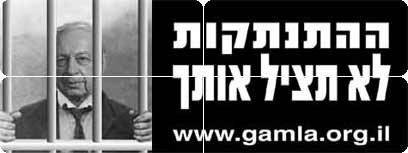
My posters portraying Sharon behind jail bars with the caption, “The Disengagement Won’t Save You!” and others of a similar ilk, were banned as being too inciteful by Moetzet Yesha and the leaders of the Gush Katif Council who were determined to win through open dialogue and their unaggressive “Love Will Triumph” campaign.
Another poster I made for the “Jews Don’t Expel Jews” movement, portrayed a soldier staring at a family in the doorway of their home with the caption, “Commander, I Can’t Do It!”
Led by Rabbi Gadi Ben Zimra, the “Siruv Pekuda” movement, which called upon IDF soldiers to refuse orders to oust Jews from their homes, received a big boost when the Rosh Yeshiva of Mercaz HaRav, Rabbi Avraham Shapira, former Israel Chief Rabbi, signed his name to a petition supporting the initiative. Supporting the controversial declaration were Rabbis Moshe Levinger, Dov Lior, Zalman Melamed, Eliezer Melamed, Avigdor Nebenzhal, Yitchak Ginsburgh, and Yaacov Yosef. Rabbi Chaim Drukman told students to tell their army commanders that they were not able to fulfill the command, and Rabbi Tzvi Tau told students to disobey quietly but not to not make a banner issue out of the matter.
Nevertheless, the large majority of Dati-Leumi Rabbis opposed this Halakhic decision. I worked with the group led by Rabbi Gadi Ben Zimra, whose call for soldiers to disobey evacuation orders was supported by Rabbi Shapira.
The “Siruv Pikuda” (refuse army order) poster was rejected by the official leaders of the “Save Gush Katif” campaign and their Rabbis who stridently warned that a revolt in the ranks of Tzahal could lead to the disintegration of Medinat Yisrael, even if it meant having their homes and communities bulldozed into dust and given away to the Arabs.
In a similar light, Moshe Hirshtig, a former film student of mine at the Maale Film School in Jerusalem, and a resident of Neve Dekelim, contacted me to make a protest film with him, commissioned by the Gush Katif Communities Council. When we finished the short eight-minute film, the Council rejected it, claiming it was too militant for their tastes.
As the time approached for the Knesset to approve the “Disengagement Law,” a group within the Likud, led by Uzi Landau, was formed to oppose what they termed, “a dangerous and dictatorial escapade that will explode in our faces with a bombardment of rockets from a site formerly controlled by Jews.” He demanded that the Likud Central Committee hold an emergency meeting to vote on the Sharon Plan, which seemed like the most effective way to derail it, burying it before it could reach the Knesset.
In response, a group of past “Mateh Maamatz,” activists, Yaacov Novik, Meir Indor, Chico Ben Zimra, and others, approached me to make a short protest video that was distributed to every member of the Likud Central Committee before the dramatic vote. In the course of making the video, accompanied by Baruch Mazel, I went to film statements from the two Chief Rabbis. We asked the Ashkenazi Chief Rabbi Avraham Shapira if the Government of Israel was permitted by Jewish Law to surrender portions of Eretz Yisrael to an enemy. “There is a yetzer to do evil,” he replied. Not understanding his meaning, we asked him once more. Again, he gave the same answer. “Ariel Sharon is possessed by a yetzer to do evil.”
“HaRav,” Marzel explained. “Sharon is planning to give Gush Katif away to the Arabs. The Likud is voting yes or no. Does the Halakhah allow this?” The Chief Rabbi looked disturbed by the question. “Why do you ask me a question to which every child in Heder knows the answer? Go to any Heder in Jerusalem and ask the children. Why do you ask me?” I filmed the Chief Rabbi’s answer. Then Marzel asked the question, “If a soldier is commanded to oust a Jew from his home in the Land of Israel and to destroy a Jewish community, should he obey the command?”
“Of course not!” HaRav Shapira replied. The octogenarian Sage went on to give us a long and detailed explanation. I didn’t include the halakhic discourse in the short, fast-moving film, but this is a concise gist of what he said:
According to Torah Law it is absolutely forbidden to give away Jewish land in Eretz Yisrael to a non-Jew, because of the negative commandment “Lo Tichanem,” and because of its nullifying the Torah commandment to settle and conquer the Land, which falls upon every individual, whether a citizen or soldier. Any military or government command to oust a Jew from his home in order to relinquish the Land to a non-Jew is in violation of our holy Torah, and it is forbidden to take part in it in any shape or form.
In addition, it is forbidden to listen to any command calling a Jew to violate the Torah, and it is forbidden to carry out such a heretical command, as the Rambam makes clear in the Laws of Kings, that if a Jewish king issues a decree opposed to the Torah, it is forbidden to heed his decree, and a person who does so will not be found clean in this world or the next. Rabbi Shapira cited several side issues regarding the laws of theft and the desecration of synagogues, and emphasized that it was everyone’s duty to prevent such evil deeds, and to protest against proposals like the “Disengagement” with all non-violent means. He concluded that only the Gedolei HaDor were allowed to decide such vital matters to Clal Yisrael, and that if Rabbis of lesser stature were to do so, they increase division in Am Yisrael and destroy the world, like little foxes that destroy the orchards of the King, as the Rambam vividly explains.
Next, we went to the home of the HaRav Mordechai Eliahu, the Sephardic Chief Rabbi. I set up the camera and microphone, and Baruch Marzel asked him the same question, whether a Jewish Government can give away portions of the Land of Israel to an enemy. The Rabbi replied with a lengthy Dvar Torah, explaining a Gemara which stated that withdrawal is the beginning of surrender. Because of its length, there was no way I could use his answer in the film. Fortunately, the Rabbi’s wife was present. She told him, “You forgot to say, ‘Vote against the Sharon proposal.’” He smiled and nodded his head. “All right. Please, let me do it again.”
Once again, he delivered a full Dvar Torah, totally different from the first, explaining why relinquishing parts of Eretz Yisrael was strictly forbidden by the Torah. I was too embarrassed to tell the honored Sage that Dvar Torahs were wonderful for yeshiva and synagogues, but not for hard-hitting 6-minute videos. “Once again, the Rebbetzin reprimanded him: “Mordechai, again you forgot to tell them to vote no!” Again, he smiled and started all over, again with a completely new Dvar Torah. I only mention the anecdote because of the incredible patience, calmness, and honor he showed toward his wife.
Five successive times, we filmed him and he concluded each Torah discourse without telling the Likudniks to vote against the Disengagement. Each time his wife took note and made him do it again. The smile never left his face. He showed absolutely no sign of disturbance or anger at all. Finally, he gave a clear, one sentence command to vote NO! The edited video was distributed to all members of the Likud Central Committee.
While I was packing away the camera equipment, I overheard the Rabbi’s assistants telling him that arrangements had been made for a group of Kabbalists to accompany him on a flight around Gush Katif during which Kabbalistic prayers would be recited to overturn the evil decree. Summoning up my nerve, I asked the Chief Rabbi if I could accompany the group in order to film the prayer. He said that it was fine with him, as long as there was room on the small private aircraft.
Unfortunately, at the last moment, the fellow who organized the flight wouldn’t allow me to bring my camera aboard, explaining that some of the holy Kabbalists who had agreed to the venture asked that no publicity be involved, not wanting to connect themselves with a political issue of such national controversy. Camera-less, I boarded the 12-seater plane and recited the prayers along with the airborne Tzaddikim. Miracle of miracles, the Likud Central Committee voted against Sharon. But like with all other opposition, the famous army commander stomped forward, ignoring the democratic decision of his party, treading down everything in his path, like the giant bulldozers which later destroyed Gush Katif and the settlements in the Shomron.
Which brings us to the showdown at Kfar Maimon. I was among the tens of thousands of protestors who gathered in Netivot for a mass prayer rally before marching on toward Gush Katif to aid in the defense of the threatened communities. Prime Minister Sharon had ordered twenty-thousand soldiers and policemen to stop us. After an eight-kilometer walk, the army of protestors reached Kfar Maimon, where the leaders of Moetzet Yesha and the Gush Katif Communitee Council told them to wait while they and their Rabbis negotiated with the police and the army to reach an agreement that would avoid a confrontation between the governments armed forces and the demonstration which could lead to possible bloodshed.
Protestors demanded to break down the fence surrounding Kfar Maimon, in which they found themselves imprisoned. Yesha leaders and their Rabbis called for patience. To charge forward, or not to charge forward, that was the question.
Decades earlier I was a young college student in America during the Vietnam War protests. When government forces gunned down a few students at Kent State University, the protest movement gained massive support. The famous photograph of the murdered students lying dead on campus grounds, and the cry of moral indignation which followed, led to the government’s downfall. L’havdil, at Kfar Maimon, if protesters has charged forward toward Gush Katif, and if soldiers had opened fire, killing people in the crowd, the immorality of the act could have swayed national opposition to the evacuation and destruction of the beleaguered communities in Gush Katif.
On the other hand stood the horrible scenario of bringing about a situation where Jews might be killed. Perhaps the dilemma in some ways resembles the plight of the hostages today in Gaza.
All through the night and the following morning, the tension increased. In the end, the official organizers of the “Save Gush Katif” campaign, the leaders of Moetzet Yesha and the Rabbis against “Siruv Pekuda” proclaimed that both sides (the government and official Yesha leaders) had reached the unanimous decision that the march had come to its end, so that Jewish blood would not be spilled in a war between brothers.
Apparently swayed by false information that the army had already been given orders to open fire, Rabbi Shapira agreed with the decision (or didn’t agree - the matter was never made clear). The official settlement leaders and Rabbis who supported them stood in front of the gate of the fence, blocking the way. Feeling anger and deep sense of betrayal, the marchers turned back, rolled up their sleeping bags, and headed home, understanding that the fight for Gush Katif had been lost. I personally was not privy to the inside negotiations. A few years after the showdown I asked Rabbi Gadi Ben Zimra, the head of the “Siruv Pekuda” faction, what had happened during the crucial discussions that evening. This is what he answered:
“In the wilderness following the Exodus, there were two major sins - the sin of the Golden Calf, and the sin of the Spies who turned their backs on the Cherished Land. Which sin did the betrayal at Kfar Maimon most resemble? In my opinion, the sin of the Golden Calf. It wasn’t that the heads of Moetzet Yesha and the gathered Rabbis didn’t love the Land of Israel as much as we did. But it turned out that they loved Medinat Yisrael more than they loved Hashem and His Torah.
"They claimed that refusing to obey the commands of the Medinah would bring about its ruin. In contrast, we claimed that it would add spiritual strength to the State. They claimed that preventing a war between bothers would bring about another national Churbon and destruction, G-d forbid. We claimed that adhering to the commands of the Torah would bring Am Yisrael greater blessing, and that abandoning large and flourishing tracts of our Homeland would lead to the national weakness, spiritual weariness, and the cultural decay we are experiencing in Israel today, not to mention the very real danger of turning all of Aza into a launching site of terror against Israel.
"Obviously, surrendering Gush Katif would give fuel to the Arab dream of wiping Israel off the map. Our Sages inform us that every generation suffers for the sin of the Golden Calf. Likewise, we continue to suffer for the sin of worshipping the Medinah more than we worship Hashem. For a large segment of the settlers of Judea and Samaria, and for the young generation that grew up in Gush Katif and fought for its preservation, the trust in our government’s commitment to Eretz Yisrael and our trust in our political leaders has been terribly weakened.”
“The solution?” I asked him.
“We must return to Gush Katif, and to Homesh and Sa-Nur in the Shomron, and to the increase Israelite settlement all over our Land. We must return to Torah on a national level, in all of its national facets, in the government, in the army, and in the courts, along with the shattering of false idols. All of these things must be accompanied by a renewed commitment to Hashem. It won’t be long before rockets fired from the terrorist haven we are creating in Gaza will rain down on Tel Aviv. We can blame the Arabs but we are the ones who will have brought it to pass with our betrayal of the Covenant of our Forefathers and the gift of the Land. May Hashem have mercy.”
Our Sages inform us that a man has many plans in his heart but it is Hashem’s will which brings things to pass. Many sought to give away chunks of our cherished Land and now Hashem is forcing us back to the very same places. The Gaza Strip will be reconquered and her children will return to rebuild what was destroyed and more. Hashem bequeathed to His Chosen People the Land of Israel and all of it biblical borders. Hashem is not a man that he should lie. The saga is still unfolding. See you next year in Gaza City.