
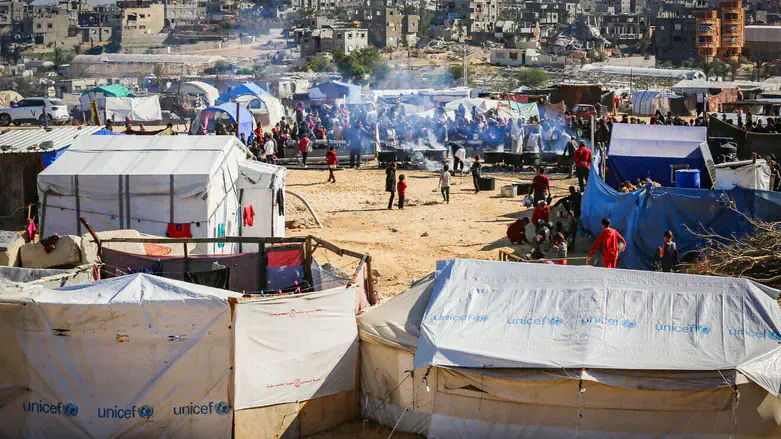
Once again, Israel finds itself the target of a powerful and misleading media campaign — one that has elevated imagery over facts, sentiment over truth, and propaganda over responsible journalism. At the center of the controversy is the case of a young boy, Muhammad Zakaria Ayoub al-Matouk, whose image has been used by international media outlets to suggest that Israel is deliberately starving Palestinian Arab children in Gaza.
The story gained traction when investigative journalist David Collier exposed the lie and Rachid Hammami, better known as “Brother Rachid,” a Moroccan terrorism expert and former Muslim who converted to Christianity, exposed the misrepresentation on his social media page. In his post, Hammami explained that al-Matouk was not a victim of starvation at all but rather suffers from a degenerative genetic illness unrelated to malnutrition. The photographs, taken by Ahmad Jihad Ibrahim al-Arini, a photojournalist employed by the Turkish state-run Anadolu news agency, were nevertheless circulated globally, framing the child as an alleged victim of Israeli policy.
“None of them bothered to verify the context before publication — and it seems none of them are interested in correcting the narrative,” Hammami wrote, referring to The New York Times, NBC News, The Guardian, and the BBC, all of which published or shared the images.
For Israel, the implications are grave. The dissemination of such photographs, stripped of context and used to buttress claims of deliberate starvation, feeds directly into a long-standing pattern of anti-Israel disinformation that has plagued international reporting for decades.
Israeli officials and pro-Israel media outlets, including Israel National News and World Israel News, have long argued that Israel is subject to a unique double standard in global coverage. While the IDF and civilian agencies have facilitated countless deliveries of humanitarian aid into Gaza — often under dangerous conditions and at great logistical cost — the prevailing narrative presented abroad is one of systematic deprivation.
This latest case, involving al-Matouk’s genetic condition, mirrors past instances in which photographs or video footage have been selectively framed to portray Israel as the aggressor. The Second Intifada, for example, was rife with manipulated imagery. The infamous case of Muhammad al-Durah in 2000, in which footage showed a Palestinian Arab boy allegedly shot by Israeli fire, was later revealed to have been doctored and staged — yet the initial broadcast cemented an indelible impression of Israeli culpability in the minds of millions.
Similarly, during the 2014 Gaza conflict, major outlets ran images of Syrian casualties from Aleppo, miscaptioned as victims of Israeli strikes in Gaza. The photographs of devastated apartment blocks and suffering civilians, though unrelated to Israel, circulated widely online, reinforcing an image of the Jewish state as an indiscriminate aggressor. Corrections, when issued, rarely reached the same audience as the original claims.
What distinguishes the al-Matouk case is the clear medical evidence that the child’s frail condition is the result of a genetic illness rather than malnutrition. Yet his image has been strategically deployed by outlets and advocacy groups to bolster accusations of “collective punishment” and “deliberate starvation.”
Israeli commentators, writing in Israel National News, have noted that Hamas and its allies have repeatedly weaponized children’s suffering — or the perception of suffering — as a tool in their information war against Israel. “The exploitation of children in propaganda campaigns against Israel is not accidental,” one analysis argued. “It is deliberate, systematic, and designed to manipulate Western empathy without regard for factual accuracy.”
Hamas’s media strategy, bolstered by sympathetic international outlets, capitalizes on the power of images to provoke outrage. In this sense, the misrepresentation of al-Matouk’s illness is emblematic of a larger phenomenon: the calculated use of vulnerable populations to delegitimize Israel’s security operations.
Adding insult to injury, the misuse of the child’s image comes at a time when Israel has gone to extraordinary lengths to ensure that humanitarian aid reaches civilians in Gaza. As Israel National News recently reported, the IDF, in cooperation with regional partners such as the UAE, Jordan, and Egypt, has conducted multiple airdrops of food and medical supplies. In one recent operation, 52 aid packages were parachuted into both northern and southern Gaza within hours.
Yet footage released by the IDF shows Hamas operatives seizing these supplies, often violently, before they can reach ordinary residents. Contrary to Hamas’s claims that such individuals are legitimate security personnel, the IDF has confirmed that they are in fact armed terrorists. “Even when aid is delivered into Gaza — Hamas loots it for its own use, blatantly disregarding the needs of the population,” the military stated.
This evidence directly undercuts the central claim of starvation propagated by international critics. If food is entering Gaza, but Hamas prevents its distribution, then the responsibility for humanitarian suffering lies not with Israel but with the terrorist organization that rules Gaza with an iron fist.
Despite these facts, leading Western outlets have shown little inclination to revisit their framing. The New York Times (which today admitted the child had pre-existing issues), NBC, The Guardian, and the BBC have not issued corrections acknowledging that al-Matouk’s condition was unrelated to hunger. Critics argue that this reluctance reflects a deeper institutional bias: when it comes to Israel, narratives of victimhood and oppression are too politically convenient to relinquish.
The failure to correct the record raises serious questions about journalistic ethics. As Rachid Hammami noted, it appears that accuracy takes a back seat when the story aligns with a broader ideological framework that casts Israel as the perpetual oppressor.
For Israel, the battle over narrative is no less consequential than the battle on the ground. As Israel National News has emphasized, international pressure, fueled by distorted media coverage, directly affects negotiations with Hamas and shapes global opinion. Israeli leaders, including Prime Minister Benjamin Netanyahu and Foreign Minister Gideon Sa’ar, have warned that such distortions embolden Hamas, harden its negotiating position, and ultimately prolong the conflict.
This dynamic reflects a broader struggle Israel has faced since its inception: the weaponization of global institutions and media platforms to delegitimize its right to defend itself. From UNESCO’s attempts to rewrite Jewish history at holy sites to the UN Human Rights Council’s disproportionate focus on Israel, the pattern is clear. Media misrepresentations, such as the al-Matouk case, are part of the same continuum of efforts to isolate the Jewish state.
The exploitation of images to demonize Israel has echoes in earlier eras. During the 1982 Lebanon War, Western media ran with reports of a “massacre” in Jenin — a narrative that unraveled under scrutiny, revealing far fewer casualties than initially claimed (and twelve israeli soldiers fell in Jenin because the IAF decided not to bomb the populated area, ed.). Yet the damage was done: Israel’s image suffered, while corrections went largely unnoticed.
The al-Matouk case, therefore, is not an anomaly but rather the latest chapter in a decades-long pattern. It illustrates how quickly disinformation can spread and how stubbornly it persists, even when confronted with incontrovertible evidence.
The misuse of Muhammad Zakaria Ayoub al-Matouk’s image is more than a journalistic oversight. It is a deliberate act of narrative construction that weaponizes a child’s suffering to serve a political agenda. By uncritically amplifying the falsehood that Israel is starving Gaza’s children, major Western outlets have once again contributed to the demonization of the Jewish state.
Israel remains unique among nations: the only country in the world expected to provide aid to a hostile territory governed by terrorists sworn to its destruction. The reality is clear — food and medicine are entering Gaza, but Hamas seizes them for its own purposes. The international community’s fixation on blaming Israel ignores this fundamental truth.
The case of al-Matouk serves as a stark reminder that in the ongoing information war against Israel, facts are often the first casualty. And until leading Western outlets commit to accountability and accuracy, the cycle of misrepresentation — and the delegitimization it fuels — will continue unabated.
Fern Sidmanis Senior News Editor at the Jewish Voice.