
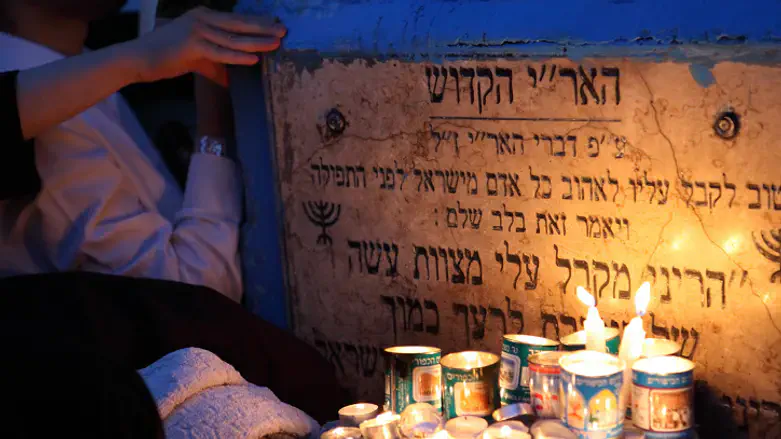
The 5th of Av marks the yahrtzeit of the Arizal, Rabbi Yitzhak ben Shlomo Ashkenazi Luria, who died some 450 years ago at the young age of 38. The appellation Arizal stands for “Ari-z’l,” the Ari of blessed memory. Often he is called “the Holy Ari.” The Hebrew letters of “Ari” ((אר"י stand for “Elohi Rabenu Yitzhak”- the divine Rabbi Yitzhak. No other Sage ever had this extra letter, standing for Elohi (divine) prefaced to his name.
His teachings come down to us through the voluminous writings of his most gifted student, Rabbi Chaim Vital, an incredibly gifted Torah Giant himself. The teachings of the Arizal are considered on the same level as the Zohar. The great halakhic codifier, the “Magen Avraham,” takes the Arizal’s personal customs as legally binding precedents. In deciding disputes that had remained unresolved for centuries, he often cites the Ari’s custom as the final authority.
The Arizal’s distinguished student, Rabbi Chaim Vital, wrote a book called “Shivchei Ha’Ari” about his teacher. He relates that the Arizal knew all the wisdom in the world, both the physical and spiritual. For example, he knew the language of the birds and trees, and the history of reincarnations. Rabbi Vital testifies that the Arizal could communicate with inanimate objects like stones and the flame of a candle.
He relates that when a person would come to the holy Ari for a soul-rectification, the Arizal, who knew “the wisdom of the face,” would glance at the person’s forehead and see, in the form of letters, all the positive deeds that he had performed and all of the forbidden. He would then tell the person what Tikun he needed and exactly how to go about it. In addition, the Arizal often spoke to the soul of the person and the soul would tell him everything he needed to know to explain the needed rectification.
The Arizal, stated that he attained exalted levels of Divine Inspiration because he performed the commandments with transcendent joy. While the majority of the Ari’s teachings are grounded in difficult Kaballistic codes and terminology, the commandments and their kavanot (intentions) are sometimes explained in a more down-to-earth fashion for the layman. For example, here are some of his teachings on prayer, taken from the beginning of Rabbi Haim Vital’s book “Shaar HaKavanot.”
The Arizal on Prayer
It is forbidden to pray when one is depressed. If a person does so, his soul cannot receive the celestial light that descends upon him during prayer. However, during vidui (confession), especially when enumerated his sins, sorrow is appropriate. But everywhere else in his prayers, depression will cause him great harm. It is important to be as exceedingly joyous as possible, like a servant who happily serves his master. For if a servant were to serve in a depressed fashion, his service would be despised by the master. To a very great extent, all of a person’s spiritual ascent and wholeness, and the attainment of Divine Inspiration, depend on being joyous, whether at the time of prayer, or during the performance of any other mitzvah.
Before a person begins his prayers in the synagogue, from the portion of the “Akeida” of Yitzhak and onward, he should accept upon himself the mitzvah of loving his neighbor as himself, by having the intention to love every Jew as himself, for in this way his prayer will rise up with all of the prayers of Israel, enabling it to ascend higher and higher and produce a fruitful response. This love should especially be directed to his companions, the scholars of the Torah who learn together with him. Every person should see himself as if he is connected, body and soul, to these companions, and if there is someone amongst them who is in difficult straits, all of the others should lend him a hand, and pray on his behalf.
When entering the synagogue, one should be very careful to pause for a moment at the entrance before entering, and feel reverence and fear, as if overwhelmed to enter the inner chamber of the King of the World. This is most beneficial in a person’s striving for perfection and in advancing his spiritual attainments.
Also, I (Rabbi Haim Vital) saw that my teacher of blessed memory (the Arizal) was exceedingly careful, to the upmost degree, not to converse at all in the synagogue, even when the congregation wasn’t at prayer. Even when it came to matters of repentance, reprimand, and mussar (ethical admonishment), he did not want to speak, in order that no profane words leave his lips in the synagogue.
The Study of Kabbalah
As noted, most of the Arizal’s teachings are stated in the Kabbalistic language which he developed. To the newcomer, the mystical realm of the “sefirot,” “partzufim,” “binah,” “Zer Anpin,” “nukva,” “yetzirah,” “azilut,” and “Saba Yisrael,” to mention but a few, may seem indecipherable. Realizing this difficulty, Rabbi Avraham Yitzhak HaKohen Kook took the exalted insights of the Arizal and dressed them in a language more with the times, explaining how the esoteric understandings of the universe find expression in the Redemption of Israel with the return of the Israelite Nation to Zion and its rebuilding in the Land of Israel. Throughout all of his writings, Rabbi Kook stresses the necessity of learning the secrets of Torah at the time of Israel’s national Renaissance and Redemption. He writes:
“The revelation of the secrets of Torah in the last generation, in order to purify the hearts and to fill the minds with noble thoughts, whose source lies in the secrets of Torah, this is an absolute necessity in the last generation to insure the survival of Judaism” (Orot HaKodesh, Part 1, Pg. 141).
In his public proclamation, “The Great Call,” Rabbi Kook wrote:
“Dear brothers, sages of Torah, and influential scholars! We too acted foolishly and sinned! We studied and researched the sources; we debated the fine points of the Talmud and discovered new insights; we wrote and explained; but we forgot Hashem and His might. We failed to hear the words of the true prophets, the exalted voice of our eternal Sages, to hear the voice of the Tzaddikim (righteous ones) and Hasidim (saintly ones), the Sages of Musar (ethics), and the possessors of the secrets of Torah, who called out and proclaimed in the most strident of voices, that in the end, the river of Talmudic analysis would turn arid and dry if the deep ocean of Kabbalah, and the Torah’s inner understandings, weren’t constantly drawn into the learning - the waters of the knowledge of Hashem, the pristine waters of pure faith which flows from our inner souls, and which stream forth from our life source” (Orot, pg. 101).
When we talk about Kabbalah, we are not speaking about the fake, Kabbalah for Hollywood stars that some hucksters try to peddle to the masses, but the genuine Kabbalah as brought down to us by the great Torah Scholars of Israel. Our Sages have repeatedly emphasized the necessity of learning the secrets of Torah at the time of Geula.
Rabbi Chaim Vital, foremost student of the Arizal, emphasizes in his introduction to the “Eitz HaChaim,” that the prolongation of the exile, and all of its sufferings, stem from the fact that the inner secrets of Torah have gone unlearned.
The Gaon of Vilna writes: “This Geula will only come about through the learning of Torah, and the main factor of the Geula depends on the learning of the Kabbalah” (Even HaShelma, 11:3).
On the other hand, the Zohar states: Whoever causes the Kabbalah and the wisdom of the inner Torah not to be considered a part of the Oral and Written Torah, and causes others not to learn it (the inner wisdom) by saying that there is nothing more to the Torah and the Talmud other than the simple meaning of the text, it is certainly considered as if he had cut off the flow of blessing to the world. It would have been better for him if he had never been born, or ever learned Torah. It is considered as if he returned the world to a state of chaos and void, and brought poverty to mankind, and lengthened the exile of the Jewish People.
While there exist several pathways to the knowledge of Kabbalah, the system formulated by the Arizal stands as a frontrunner. Certainly it can be said that his teachings embody “a new light on Zion” which we hope for in our everyday prayers. May his memory be blessed.
Rabbi David Samson is author of four popular books on the teachings of Rabbi Kook, and the recent books “Contact” about Prophecy and Divine Inspiration, and an English translation of Rabbi Kook’s “Rosh Milin” on the Hebrew letters, all available at Amazon Books.