

Stephen M. Flatow is an attorney and the father of Alisa Flatow, who was murdered in an Iranian-sponsored Palestinian terrorist attack in 1995. He is author of A Father’s Story: My Fight for Justice Against Iranian Terror and is the president of the Religious Zionists of America-Mizrachi.
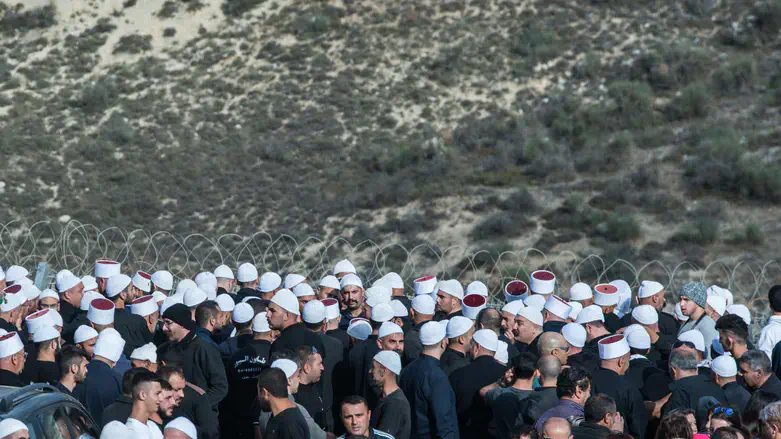
It is heartbreaking—soul-wrenching—to watch the horror unfolding in southern Syria, where Druze communities are again under violent siege. Reports of massacres, rape, and the systematic destruction of homes and villages by Syrian regime forces and allied Bedouin war bands have emerged from Suwayda and its surroundings. These are not just the tragedies of war; they are targeted assaults on an ancient, peaceful religious minority that has long sought only to live in dignity on its ancestral land.
And yet—almost total silence from the international community.
There have been no emergency sessions of the United Nations Human Rights Council, no widespread condemnation, no international outcry. University students are not erecting encampments; there are no demonstrations under the banner of “Queers for Druze.” It seems the only time the Druze attract global attention is when their deep-rooted ties to Israel become politically useful for critics of the Jewish state.
This hypocrisy is intolerable.
In Israel, the Druze are not a curiosity or a cultural footnote. They are an inseparable part of our national fabric. Israeli Druze men and women serve proudly in the IDF, take part in the highest levels of government, judiciary, and society, and stand shoulder-to-shoulder with their Jewish neighbors in defense of the country. That partnership is not just political—it is spiritual and historic.
The Torah tells us of Yitro (Jethro), a priest of Midian and the father-in-law of Moses, who advised the prophet to create a system of courts and judges. That advice, given by a non-Israelite sage, laid the foundation for a legal tradition that continues to shape Jewish society to this day. The Druze believe they are descendants of Yitro, and thus, the connection between Jews and Druze, rooted in shared values and mutual respect, is thousands of years old.
And in modern times, that bond has only grown deeper—particularly when Druze communities in neighboring Syria have come under threat.
While much of the world looked the other way, Israel didn’t just watch, it took action to defend the Syrian Druze. In 2015, when jihadist groups threatened to overrun the Druze village of Khadr near the Golan Heights, Israel issued a rare and clear warning: it would not tolerate the massacre of the Druze. That was not a mere statement—it was backed up by military deployments and deterrent messaging to the rebel factions operating nearby.
Israeli hospitals have treated injured Syrian Druze—combatants and civilians alike—without discrimination. Behind the scenes, Israel has helped coordinate local defense strategies and share intelligence to ensure that extremist groups do not wipe out vulnerable Druze communities across the border.
These were not political calculations. They were moral decisions, driven by a sense of kinship and obligation.
Where Is the Global Conscience?
Today, the Druze in Syria are again under brutal assault. And once again, the world is mostly silent. Where are the global human rights organizations? Where are the newspaper editorials, the hashtags, the diplomatic condemnations?
The silence is especially deafening from countries that rush to scrutinize every Israeli counter-terrorism operation, yet find no outrage for a religious minority being butchered in plain view. This double standard is not just offensive—it’s deadly.
It is time for Western democracies, international institutions, and human rights groups to stop looking away. The new leader of Syria, X, being cozied up to by the West must be held accountable. Concrete pressure—diplomatic, economic, and legal—must be brought to bear. The Druze cannot be left to their fate while the world debates irrelevancies.
If Israel can act to protect the Druze beyond its borders, the least the international community can do is raise its voice.
We are reminded again of Yitro—who saw a problem and offered wisdom, clarity, and a path forward. The world must now decide whether to follow that example—or once again fail a people in desperate need.