
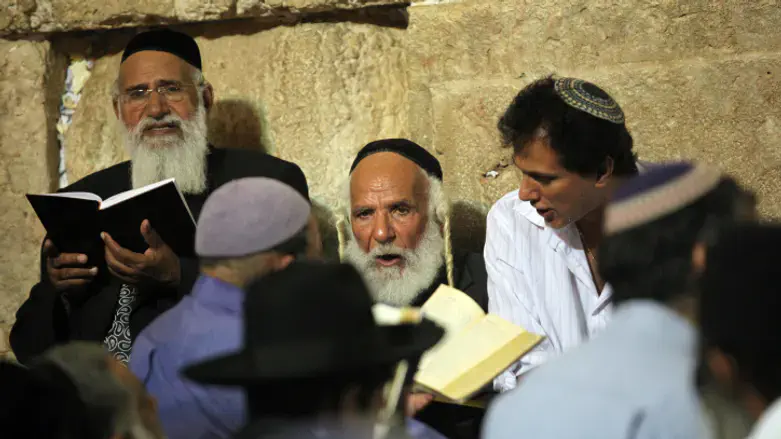
I’m not sure I’ll be reading Kinot this year.
Not because I don’t believe in mourning the destruction of the Beit HaMikdash. Quite the opposite. It’s because I’m already living in that mourning—every single day. We all are.
The traditional Kinot—those heart-wrenching lamentations written by our sages over the centuries—were meant to help us feel the pain of what we lost. They’re poetry, designed to crack open a heart that’s grown numb over time.
But my heart isn’t numb.
It’s raw.
It’s torn.
It’s already reciting Kinot with every headline, every funeral, every fallen soldier.
Since October 7, 2023, we’ve been living through a national trauma that has no comparison in modern Jewish history.
Thousands of rockets. Hundreds of hostages. Massacres that will take generations to process. And war—an ongoing, existential war for our very survival, on multiple fronts.
I don’t need to read about destruction in ancient Jerusalem to know what exile feels like.
I feel it when I stand over a fresh grave in Har Herzl.
I feel it when I hug a friend goodbye before he returns to the front—hoping that I’ll see him again.
I feel it when I explain to my children why they can’t sleep without the sound of sirens in their dreams.
Every day in Israel has become a Kinah.
Every funeral is a verse.
Every mother’s scream is a stanza.
Every picture of a fallen soldier, every wounded survivor, every empty chair at a Shabbat table is a living, breathing lamentation.
Our sages tell us that the destruction of the Beit HaMikdash wasn’t just a historical event—it’s a spiritual wound that still festers in our world. And we are seeing that wound bleed in real time.
All of this—all of it—is happening because we still don’t have the Beit HaMikdash. Because the Divine presence is still in exile. Because we, the Jewish people, are still not whole.
Since 1948, and especially over the past two years, Israel has buried more Jews than we can count. But these are not just tragedies. These are symptoms. They are the clearest, most painful signs that we are still living in a broken world—a world without redemption, without peace, and without the Temple.
So no, I may not sit and read Kinot this year.
Because I’m already saying them—every day.
With my eyes. With my tears. With my feet planted on this holy, blood-soaked soil.
But I’ll tell you what I will do.
I’ll cry out to God—not just for what we’ve lost, but for what we still don’t have.
I’ll pray not for a return to history, but for a future in which we no longer have to live in lamentation.
I’ll pray for the day when we can finally close Eicha, set down the Kinot, and open the Sefer HaChaim—the Book of life.
I’ll pray for a life without exile.
Without terror.
Without graves.
Just the sound of joy returning to the streets of Jerusalem.
May it be soon.
May it be today.