
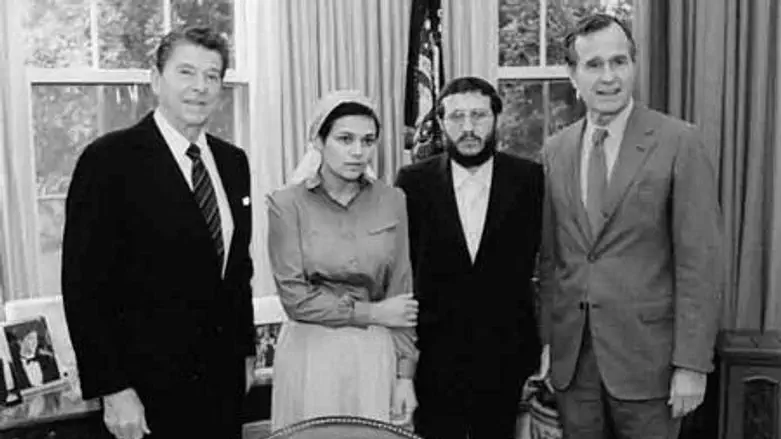
Photo: l. to r. Pres. Reagan, Avital Scharansky, Yosef Mendelevich
Have you ever wondered why there is no museum commemorating the plight of Jews in Soviet Russia behind the Iron Curtain and the subsequent Struggle for Soviet Jewry? When it comes to the Holocaust, there is Yad Vashem and Holocaust museums in Miami, New York, Philadelphia, Los Angeles, Washington D.C., and twenty other cities throughout America. There are another 25 Holocaust museums in countries around the world. I don’t propose to compare disasters, but the story of the Jewish People in Russia is certainly a saga of epic proportions.
For me and for hundreds of thousands of Jews in the United States, the struggle to free Soviet Jewry awakened Jewish identity like no other cause, perhaps even more than the Six-Day War, because we, Jews on the streets of New York and in cities throughout the world, personally participated in a struggle that changed the course of history.
This monumental impact on the Jewish Nation is even more true for the State of Israel. The struggle succeeded, communism fell, and the two events brought one-and-a-half million immigrants to Israel. According to everyone, they are the ones who transformed the country with 150,000 engineers and 60,000 other professionals, raising the technological and military level of the State. Even the Berlin Wall fell in the wake of the struggle of Soviet Jewry to reach the Western Wall. The Iron Curtain fell—and with it, the Soviet empire.
Doesn’t this world-shaking struggle deserve a museum that can educate and inspire Jews for generations to come? Many of the infamous jails, and the prison and work camps in Siberia still stand. Why not bring Jewish youth there to learn about the heroism of the Prisoners of Zion, those such as Anatoly Scharansky and Yosef Mendelevich who served long prison terms for trying to leave Russia?
Please remember that before the rise of Lenin, Stalin and the Soviet regime, Russia housed the largest and most flourishing Jewish population in the world. Both culturally and religiously, with famous yeshivot and legendary Rabbis. Chabad and other hassidic dynasties began in Russia. Rabbi Kook was born in Russia. In the early 20th century, Rabbi Moshe Tzvi Neriya and Rabbi Dov Lior immigrated to Israel from Russia.
Then during decades of oppression by the communists, Jews were stripped of all freedom and all connection to Judaism until nothing remained but the unquenchable spirit of members of the Jewish underground.
The era has ended, but its impact remains. True, the heroes of the struggle are passing away. Major Mark Dymshits, commander of “Operation Wedding,” an attempted escape from the USSR, has passed away. Edward Kuznetsov, one of the operation’s leaders, passed away. David Hevkin, who was considered in Russian Jewish circles “the Herzl of our generation,” has died, as has Vitaly Svechinsky who founded the Zionist movement in the USSR in the late Sixties, as well as Ida Nudel, and others. The need to commemorate the struggle is clear. But to the Jewish and Israeli establishment, this is not the case.
Seemingly, why should such an effort be necessary? Natan Sharansky, one of the struggle’s heroes, has served as a Israel Government minister and as chairman of the Jewish Agency; Yuli Edelstein has held key positions in the government and the Knesset; Ze’ev Elkin and Avigdor Liberman have reached the top of the power structure, but to the best of my knowledge they have not initiated or actively supported efforts to preserve the story of Soviet Jewry.
There was the initiative of David Schachter who was Sharansky’s spokesperson in the Jewish Agency. He wanted to establish a heritage center for Soviet Jewry. The idea was to create a serious museum, a building in a central location that would be a national and international center for Jewish Identity. Nothing developed from the idea.
The former Prisoner of Zion, Yosef Mendelevich, was among the founders of the initiative and resigned out of disappointment, like with several other similar projects he tried to push forward in the past. Last week, I bumped into him in the Kiryat Moshe neighborhood in Jerusalem where we live. He asked me if I had heard about the new forest that had been dedicated in the memory of the Prisoners of Zion. I hadn’t. Not on the radio; not on TV; not on the Internet news. He explained:
“The freedom fighters in Soviet Russia were like trees, standing tall and not bowing down. That’s how the idea came to me to create a forest for the Prisoners of Zion. For years I spoke to people to elicit support for the project. I sent endless inquiries. But there was no money for such a project. Then I happened to meet an old neighbor, Mordechai (Moti) Yogev, who was on the board of Keren Kayemeth LeYisrael (KKL). He offered to get the organization involved. Thanks to the chairwoman of KKL-JNF, Yifat Ovadia-Luski, the idea began to move. I traveled to the area of the city of Nof HaGalil and chose a site on Mount Churchill, near the city of Tzipori (Sepphoris).
“Two weeks ago, at the opening ceremony, I said - this forest will be a symbol of the rebirth of the People of Israel. Tzipori -the place where Rabbi Yehuda HaNasi compiled the Mishnah and Rabbi Yochanan the Jerusalem Talmud, during the period after the destruction of the Temple - a place from which Jews went into exile with the Mishnah and Talmud in hand. Here will rise a forest dedicated to the sons who fought to return to the Land and its borders.
“People who have been involved in the creation of the forest spoke about the project, including Ifat Ovadia-Luski, Moti Yogev, Ofer Sofer, Minister of Aliyah and Klita, and myself. But for me, the speeches are only a beginning. I have a dream to establish on the site a Memorial Center for Prisoners of Zion, where groups of young people can come and learn about the difficult journey involved in reaching the Land of Israel.
Ideally, each tree of the forest would bear the name of a specific prisoner - “every tree has a name.”
There would be trails based on themes:-a trail for pioneers who were arrested on their way to the Land of Israel;
-a “Refusenik Trail” featuring the history of the underground Jewish movement and a recreated Leningrad trial;
-a trail honoring activists in the United States whose efforts led to the public pressure that forced the evil Soviet regime to open its gates;
-and a building housing an educational center on the lines of Yad Vashem which would document and visualize the saga of Soviet Jewry.”
Let’s hope it comes to pass, but like with all dreams, a lot of dedicated people, hard work, and money are needed to make the dream come true.