
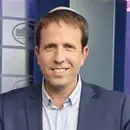
In an interview with Arutz Sheva, Jewish-Israeli activist Rudy Rochman shared his insights on his commitment to both the physical and ideological battle for Israel, discussing his reserve duty, personal journey, and vision for the future of the Jewish people.
Rochman, who has been serving in the IDF in the reserves for over a decade, including in the Paratroopers as a sniper, reflected on his military service, including his recent deployment. "I joined the army in 2011 as a sniper in the paratroopers," he said. "On October 7th, my unit was called back. We served in Kfar Aza. We fought and we liberated Kfar Aza. Then we were sent as the first unit into Khan Yunis and then after that sent as the first unit into Al-Aadaissah in Lebanon."
Rochman spoke candidly about the emotional weight of his service, recalling the loss and injuries shared among his fellow soldiers. "None of us want to be in that situation," he said. "All of us are proud to be there to fight for the Jewish people, but no one wants to have to see people dying or friends or even people on the other side." Despite the hardships, he emphasized the necessity of their mission. "We hope that we can create the right conditions for all of us to live in a safe land and no longer have to deal with those issues," he said.
On his engagement in pro-Israel activism, Rochman shared his early experiences, recounting an incident at the age of seven that deeply influenced his future work. "I went to London with my mom, my younger brother. We got onto the red tour bus that does a tour of London," he explained. "The bus driver sees my mom's shirt, asks us if it's written in Jewish. My mom laughs and says, 'No, it's written in Hebrew, but it's linked with the Jews.' And he says, 'Oh, so you guys are Jews?' She says, 'Yeah, we're Jews. What's the problem?' It's like, 'Get off my bus.'"
The incident sparked a personal vow to fight injustice. "In that moment, everything inside of me was telling me, 'You have to do something.' But I had nothing to do," he said. "And this moment me promised to myself that the next time I would see any form of injustice, especially if it's an attack against my own, I'd be prepared in every aspect." This was the turning point where his commitment to standing up for Israel began.
When asked about his efforts on college campuses, where anti-Israel sentiments are often prevalent, Rochman likened the ideological battle to a physical one. "They're both like the same battle but using different weapons. One is using a physical gun and the other is using your tongue and your ideas," he said. "They’re both different, whether it’s like physical or ideological, but they’re both spiritual."
Rochman noted that the rise of anti-Israel sentiment on campuses and intellectual spaces had been growing for decades. "There have been movements for over 20 years going in intellectual spaces, especially on college campuses, trying to indoctrinate the future political, intellectual, and even like let’s say any class, like medical class, lawyers, anything to convince the next generation that the source of all problems is the Jewish people," he explained.
He described how the anti-Israel narrative often associates Jews with colonialism and oppression. "They go to every single minority group and they convince them that the source of suffering that they're dealing with... is the same thing that Israel is doing to the Palestinians," Rochman said.
When he first encountered this challenge as a student, he sought to raise awareness within the Jewish community. "I went to the leaders of the communities in Los Angeles, heads of organizations and federations... I'm telling them, ‘Wait a minute, these groups are convincing that aren't even pro-Palestinian,'" he recalled. "It's not even a pro-Palestinian movement. It's a purely anti-Israel movement, and I would even argue an anti-Palestinian movement."
Rochman underscored the need for Jewish communities to be more proactive in defending Israel. "We need to start empowering our students," he said. "Why do you go through 12 years of Jewish education? You don’t speak Hebrew. You don’t know how to physically defend yourself. You don’t know how to debate. You don’t know how to do public speaking. You don’t know any counter-narratives that exist against us."
Despite facing resistance from community leaders, Rochman pressed forward with his advocacy. "I realized that the problem is not how strong the anti-Israel movement is. It is how weak and non-existent our own movement is," he explained. "If I had to give an analogy, imagine you have two sports teams. Let’s say it’s soccer. And you have team anti-Israel recruiting the best players, the best coaches, the best facilities... and team Israel is on the sideline bench whispering to each other about how their jerseys are made with Israeli technology and wondering why we're not winning."
Rochman’s efforts to confront anti-Israel narratives continued throughout his university years. "I decided I have to transfer to the number one most antisemitic university. I did a Google search. Columbia came up as number one," he said.
Reflecting on the broader mission of the Jewish people, Rochman emphasized the responsibility to fulfill the Jewish people's role in the world. "The real reason why there’s antisemitism, it is a rejection and reaction to us failing our purpose," he stated. "Anything less than healing this world and creating a reality of Mashiach is Jewish failure."
As for his efforts to create a change, he encouraged everyone to find their own role. "What everyone needs to realize is we all have different tools, different skills. Use those skills to fix the problems that you see and be open with the evolution of your eyesight,” he said.