
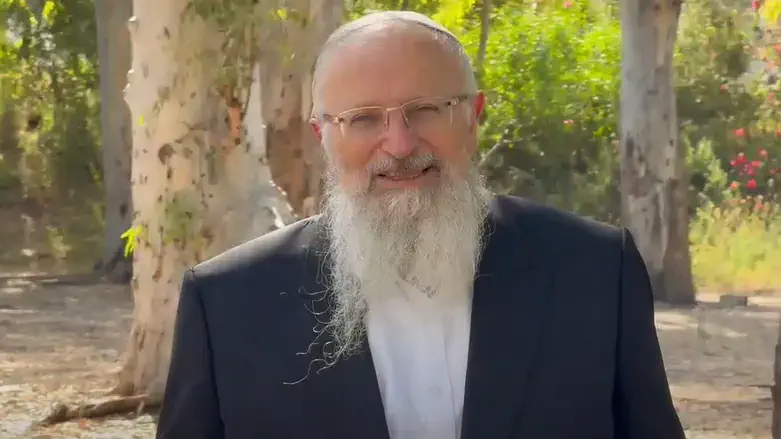
Rabbi Shmuel Eliyahuis Chief Rabbi of Tsfat.
The daughters of Tzelophechad loved the land. It is written in the Torah (Numbers 27): "Then came the daughters of Tzelophechad, the son of Hepher, the son of Gilead, the son of Machir, the son of Manasseh, of the families of Manasseh the son of Joseph. And these were the names of his daughters: Mahlah, Noah, Chaglah, Milkah, and Tirzah."
Rashi, in his commentary, asks why Manasseh is mentioned twice. "Why is it said 'son of Manasseh' again? Because the verse is telling us that Joseph loved the Land, as it is written (Genesis 50) 'And you shall bring up my bones from here.' And his daughters also loved the Land, as it is said 'Give us possession of land.'"
Their righteousness of the daughters of Tzelophechad was revealed through their love of the Land of Israel: "And to teach you that they were all righteous, for whoever’s actions and the actions of their ancestors are concealed, but the scripture does mention one of them with praise for their lineage — this is a righteous person, the child of a righteous person. But if their lineage is mentioned with disgrace, as in (2 Kings 25), 'And Ishmael the son of Nethaniah the son of Elishama' —and it is known that all those mentioned with him were wicked. Ishmael the son of Nethaniah, the son of Elishama, caused Israel to be exiled from the Land of Israel to Egypt after he murdered Gedaliah the son of Achikam. Therefore, his name and the names of his ancestors are mentioned as wicked."
Their love of the Land of Israel brought them to a great level. It is written (Numbers 27): "And the Lord spoke to Moses, saying: 'The daughters of Tzelophechad speak correctly; you shall surely give them possession of an inheritance among their father’s brothers, and transfer the inheritance of their father to them.'"
Rashi explains, "This portion was written before G-d in heaven, as He saw what Moses could not see." And later, it says, "Blessed is the man with whose words the Holy One Blessed Be He agrees."
Thanks to the daughters of Tzelophechad, all the women chose to dwell in the Land of Israel. Rashi explains the verse we read in the previous Torah portion about the heirs of the Land: "And of these, there was no man among those numbered by Moses and Aaron the priest, who had numbered the children of Israel in the wilderness of Sinai." Rashi points out the word "man" and says: "But for the women, there was no decree of [the Sin of ] the Spies. Because they cherished the Land. The men said (Numbers 14), 'Let us appoint a leader and return to Egypt.' But the women said, 'Give us possession.'"
Thus, the story of the daughters of Tzelophechad is connected here to show the spirit of the women of Israel in the wilderness and how devoted they were to the Promised Land.
The daughters of Tzelophechad also influenced the men of their tribe, as it is written in the last chapter of the Parasha of the Journeys: "And the heads of the fathers of the family of the children of Gilead the son of Machir, the son of Manasseh, of the families of the children of Joseph came near and spoke before Moses and before the princes, the heads of the fathers of the children of Israel."
They were concerned that the inheritance of Manasseh would be diminished if the daughters of Tzelophechad married someone from another tribe: "And it will be that if they marry anyone of the sons of another tribe, their inheritance will be removed from the inheritance of our fathers, and added to the inheritance of the tribe into which they marry, and it will be taken from the lot of our inheritance."
They were then told in the same language as the daughters of Tzelophechad: "Thus speaks the tribe of the sons of Joseph" (Numbers 36:6). Blessed is the man with whose words the Holy One Blessed Be He agrees.
Long Life
The Gemara (Berachot 8) discusses the long life of the inhabitants of the Land of Israel and those who love it and desire it, as is written: 'So that your days may be multiplied and the days of your children upon the Land' (Deuteronomy 11). The fact that there are also elderly people outside of the Land is attributed to their coming early to the synagogue and leaving last. Rabbi Yochanan said that because of this, they merit long life.
It is worthy to note that through prayer, devotion, and attachment to the Land of Israel one receives the blessing of mezuzah, which adds life. It is written: 'So that your days may be multiplied and the days of your children upon the Land.'
The Gemara states: "As Rabbi Yehoshua ben Levi said to his sons, 'Arrive early and stay late in the synagogue, so that you will live long lives.' Rabbi Acha in the name of Rabbi Chanina explained: "What is the verse? 'Blessed is the man who listens to me, to watch at my doors day by day, to guard the mezuzot of my entrances' (Proverbs 8). As is written: 'For whoever finds me finds life.'"
Unfortunately, due to the rise of anti-Semitism throughout the Diaspora, we have heard that some people have removed the mezuzah from their front doors so that no one will know that Jews dwell in the house. The opposite is the case. The mezuzah guards and brings long life.
The tribe of Manasseh, who loved the Land of Israel, was granted an extension of life. King David spoke about the Land of Israel as the land of life: "I will walk before the Lord in the lands of the living" (Psalms 116:9). Rashi and Metzudat David explain that this refers to the Land of Israel. The Radak also brought this from the Jerusalem Talmud (Kelim 9:4). And this is still true today, that living in the Land of Israel leads to long life. Today, world surveys regarding longevity of the elderly place Israel among the top of the list. Also their care.
In contrast, the people who followed the Spies and rejected the Land of Israel were afflicted by death. It is written (Numbers 14:29): "In this wilderness, your bodies will fall, and all your counted ones, to the last of you..." And again: "Your bodies will fall in this wilderness, and your children will be shepherds in the wilderness for forty years and bear your iniquity until the last of your bodies has fallen in the wilderness." The rare word "bodies" appears here three times in a row. It also appears again in Parashat Bechukotai, describing the harsh exile: "And I will destroy your high places and cut down your incense altars, and I will cast your dead bodies on the bodies of your idols, and my soul will abhor you" (Leviticus 26).
This is an extremely rare word, appearing only six times in the entire Torah and 16 times in the entire Tanach. Three out of the six times it appears in the context of the Spies, teaching us how strongly the Spies and their supporters were associated with death.
In contrast, it is said about Yehoshua and Kalev who adhered to the Land of Israel and clung to life: "Yehoshua the son of Nun and Kalev the son of Yefuneh lived from among those men who went to spy out the land" (Numbers 14:38). Rashi explains: "What does it mean, 'lived from among those men'? It teaches that they took the share of the Spies in the Land and rose up in their place, to live." Here we see that attachment to the Land of Israel brings life.
As we see now, those who live in the Land of Israel are blessed with many children. The promise G-d made to Abraham regarding the settlement of the land is being fulfilled: "And I will make you a great nation, and I will bless you and make your name great, and you will be a blessing. I will bless those who bless you, and whoever curses you I will curse, and all the families of the earth will be blessed through you" (Genesis 12). The children of Israel in the Land of Israel also live longer lives than any other people on earth. They also show more courage than anyone else in the world.
All of this comes from the Torah of the Land of Israel, which is the Torah of our Forefathers. May it be increased with the ingathering of all our brethren. Amen.