
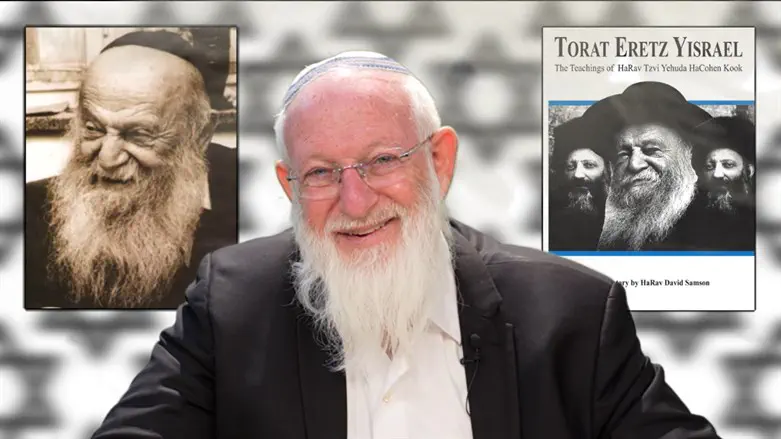
During my 12 years as a student at the Mercaz HaRav Yeshiva in Jerusalem under the tutelage of the Rosh Yeshiva, HaRav Tzvi Yehuda Kook, of blessed memory, every year he would give the same class on what he termed a fundamental understanding of Torah. The Rosh Yeshiva said that there were well-known perspectives on Torah which categorized Judaism as a religion of commandments. Clearly, Judaism does contain many mitzvot, but the essential factor is one’s orientation to them.
Are they the sum total of Judaism? No. The essence of Judaism is not the mitzvot. Rather, its focus is on Torah and mitzvot. The Torah is the source and foundation of all the mitzvot. Within the Torah, mitzvot are to be found. But Torah is much more than just the commandments.
As HaRav Tzvi Yehuda explained:
“There are people who say that Judaism is a religion of practical observance, of practical Orthodox observance - ‘Orthopractice.’ This can lead to the dry emptiness of mechanical observance. However, the proper orientation is more enlightened than this. The observance of the mitzvot has to be grounded in Torah. The proper observance evolves from the true understanding of Emunah (belief) in Hashem.
"The acceptance of Hashem’s Kingdom precedes everything else. One must be very exacting with the language of the Mishna, as it says, ‘And afterwards to accept upon himself the yoke of the mitzvot’ - after understanding the true meaning of believing in Hashem (Berachot 2:2).
"First, before undertaking the performance of the commandments one must adopt the proper method of learning and the proper way to approach Hashem and the Torah. Then the practical learning and doing begins.”
Children imagine Hashem as a king who sits on a throne in Heaven. Of course, the concept of Hashem is far more complex than that. What is the acceptance of Hashem’s Kingdom which leads to the true path to Torah? Rav Tzvi Yehuda explained that the Kingdom of Hashem is established in the world through Clal Yisrael - the all-encompassing manifestation of Am Yisrael in the world, past, present, and future. The Nation of Israel is the historical, cosmological channel which brings the word of Hashem to the world. Hashem’s Kingdom appears in the world through the existence and life of Clal Yisrael - in this way, and no other.
The Maharal teaches: “The accepting of Hashem’s Kingdom (at Sinai) is not meant for each individual, but, rather, for Clal Yisrael; for Hashem doesn’t single out the individual in saying, ‘I am the Lord, your G-d.’ Rather, this is meant for all of the nation... for Hashem’s Kingship isn’t over the individual, since there isn’t a kingship without a nation...” (Tiferet Yisrael, End of Ch.l7).
Thus, the true acceptance of Hashem’s Kingdom demands an understanding of Israel’s Divine Role in the world. HaRav Tzvi Yehuda taught that the proper approach to the Torah is to be found in the teaching of our Sages. From the Mishna, we come to the Gemara, where matters are clarified and explored to their depths.
Rav Tzvi Yehuda pointed to a question of Chazal, in the name of Rav, which appears twice in the Gemara, in Tractates Nedarim and Baba Metzia:
“Why is the Land lost?” (Nederim 81A and Baba Metzia 85B).
Rav is described by the title, “the Rav of all the Jews in Galut” (Betza 9A and 9B. See Rashi). Rav and Rabbi Yochanon were two outstanding students of Rebbe. When there is a disagreement between them, the Halakhah is always according to Rabbi Yochanon who was the Rosh Yeshiva of Eretz Yisrael. Rav brought the Torah of Eretz Yisrael to Babylon. The majority of Jews were then outside the Land, and from the Torah center of Israel, Rav brought the learning to Bavel.
The treasure of Torah in the Babylonian Talmud is derived from this source of Torah in Eretz Yisrael, the Mishna which was written in the Holy Land.
The Gemara states: “A question was asked of the Sages, the Sages of holiness and truth, and they didn't know how to explain. It was asked of the Prophets, and they too were unable to explain.''
“This is truly something intriguing,” HaRav Tzvi Yehuda said. “The Gemara informs us that there was a particular matter which the Sages and Prophets didn’t know how to explain. Until they asked the Almighty Himself .The question was taken from a verse in Jeremiah: ‘Why is the Land lost?’ (Jeremiah 9:11). The meaning of lost, in this verse is Exile, as is written in the verse, ‘And you will quickly perish from the Land’ (Deut. 11:17).
Seemingly, there isn’t a need for this question, for we know that the First Temple was destroyed for the sins of idol worship, immorality, and murder; and that the Second Temple was destroyed for senseless hatred (Yoma 9B).
However,Rav’s question is a deeper, more exacting inquiry, whose understanding is illuminated, specifically, in the Oral Law. ''Why is the Land lost? Hashem provides the answer: ‘Because they have forsaken My Torah’” (Jeremiah, 9:11-12).
How were we to understand this, HaRav Tzvi Yehuda asked? Didn’t they learn Torah and practice mitzvot at that time? A careful survey of history reveals that Torah was practiced and learned in all generations. A richness of Torah scholars and Torah erudition existed in every age. There were many more students of Torah then, HaRav Tzvi Yehuda said, than there are in our time. Who could count all of the names which appear in the Gemara! The Rambam, in the forward to the Mishna Torah, states that in every generation, thousands, and hundreds of thousands, were engaged in Torah study. Out of this dedication to Torah came the overflowing richness of the Oral Law, as manifested in the Jerusalem and Babylonian Talmuds.
Throughout all of our history, the Torah was dynamically alive in our midst. If so, how are we to understand the Almighty’s answer, “Because they have forsaken My Torah.” The Gemara responds, “Rav Yehuda said in the name of Rav, they didn't say the blessing before learning Torah” (Nedarim 81A).
“They occupied themselves with Torah in all of its greatness,” Rav Tzvi Yehuda explained. “In all of its study and extensive debate, in all of its intensity and breadth, but they failed in their approach to Torah. It wasn’t with the blessing which must precede all Torah learning. And what is this blessing?
‘Blessed art Thou, Hashem our G-d, who has chosen us from all of the nations, and given us His Torah.’
“They learned and practiced Torah, but not out of its national character, not out of our national pride, the pride of, ‘Who has chosen us from all the nations.’ This is the blessing which must precede all Torah learning. They were industrious learners and masters of Piipul (Talmudic dialectics), they were haredi in their religious observance, but they didn’t approach the Torah from its national character, and for this, the Land of Israel was lost.
When you come to learn Gemara and Tosefot without being filled to the core of your being with our pride in being a Divinely created NATION, chosen by Hashem from amongst all of the nations, there is a danger of national destruction.”
HaRav Tzvi Yehuda emphasized this Gemara for a reason. He wanted us to know that there is a proper way to learn Torah and to practice Judaism, and a misguided way. He was teaching us something which seemed revolutionary and new, yet was really the age-old tradition of our Sages.
Many times in the course of a year, HaRav Tzvi Yehuda would return to this basic foundation of a true understanding of Torah. The Torah was not just given to individuals. It was given to a NATION. A Divinely created and appointed nation, which was distinguished from all other nations and peoples by its Divine selection. When seen in its truest light, the Torah is first and foremost the constitution of the Israelite Nation, and, contained within this, is a code of individual conduct and laws.
But when the Torah is studied from a perspective which focuses on a person’s individual service of Hashem, the national character of Torah is lost. The individual is stressed, and the national, communal fabric of Israel is threatened. Disunity appears in the nation when individuals, or groups with common interests, place their own needs before the needs of the Clal. When this occurs, the Jewish people no longer deserve the fundamental requirement for national independence and sovereignty - a national land. The result is Galut.
HaRav Tzvi Yehuda would emphasize that this individual orientation to Torah characterizes the Judaism of the Diaspora which lacks all national Jewish essence. The lands of the Diaspora are ruled by the Gentiles. Thus the national foundations of Torah are irrelevant to Jewish life in foreign countries. Many main essential to true Jewish existence are simply not to be found in Galut - foundations of Torah like Jewish sovereignty over the Land of Israel, a Jewish army, a Jewish kingship, a national Jewish calendar, the Hebrew language, and the like.
When the Jewish people preoccupy themselves with the ritual observance of precepts, and not on the service of Hashem by the Clal, the Torah is deemed forsaken, and the unity and health of the nation is shattered. Thus, our Sages tell us, in Divine punishment for ignoring the national, communal, aspect of Torah, the Land is lost. Exile is not only an expulsion from the Land of Israel; it causes the destruction of our nationhood, and distorts the underlying character of our Torah.
This perspective on Israel and Torah was much different than what I had learned in America. There, the accent was on the Torah - it was the Torah which made Israel so special. However, the Rosh Yeshiva of Mercaz HaRav in Jerusalem was saying something different - the Nation of Israel is special in and of itself, a unique Divine creation which Hashem had formed and chose for Himself. Only afterwards, to complement Israel’s Divine uniqueness, was the Torah given to us. As the Torah blessing says, “Who chose us from all of the nations” - and afterwards - “Gave us His Torah.”
Once, a student wrote to HaRav Tzvi Yehuda and asked if a person should learn in a Yeshiva where a national awareness is fostered along with Gemara learning, like in Mercaz HaRav, or to learn in a place where only Gemara is studied, without any “external distraction.”
HaRav Tzvi Yehuda answered that this type of thinking was distorted and false, stemming from a lack of true Torah comprehension. National awareness is not something external which is brought into the Yeshiva from outside. National awareness lies at the very essence of Torah!
“The nationhood of Am Yisrael, of Am Segula, of the Kingdom of Kohanim and an Am Kadosh is a Torah commandment, in accordance with our teachers, the Rambam (Laws of Kings 5:1) and the Ramban (Supplement of the Sefer MaMitzvot of the Rambam, Positive Commandment 4) to conquer and rule over the Land of Israel in perpetuity.”
HaRav Tzvi Yehuda said that this commandment, to establish and maintain the Nation of Israel in Eretz Yisrael, is the foundation of all of the truth, of all of the Torah.
‘‘All Torah learning, all observance of Torah, all greatness in Torah, of every Rosh Yeshiva, and every Yeshiva student, must begin with the knowledge that Hashem chooses His nation Israel with love. Only from the foundation of ‘Who chose us from all of the nations’ comes the true understanding of ‘And gave us His Torah.’ In this way alone.”
HaRav Tzvi Yehuda concluded the class:
“The key to understanding the question. ‘Why is the Land lost’ lies in our understanding what happens when the study of Torah neglects the historical, cosmological, and practical foundation that Hashem chose His nation with love - all of the nation, and not just elite individuals and Tzaddikim; not just the Haredim and Dati-Leumi. The secular soldier and the secular pioneer are also including in Hashem’s all-encompassing love for His children.
“When the detailed learning of Torah doesn’t emanate from the recognition of Israel’s Divine National Creation - this is what Hashem calls a forsaking of Torah. There is no other way to learn and to observe Torah except through the recognition of the Divine Creation of all of Am Yisrael. If one comes to the detailed learning of Torah without this enlightened recognition, there is a danger of perishing from the Land, for the individual, and for the congregation as a whole, Heaven forbid.”