

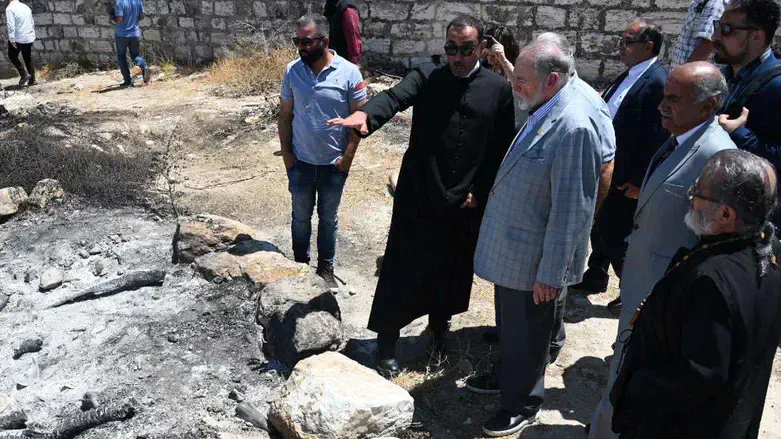
An investigation by Tazpit Press Service(TPS-IL) has revealed serious discrepancies in claims that radical Israelis deliberately set fire to a 1,500-year-old church in the Palestinian village of Taybeh. Contrary to initial accusations, TPS-IL found evidence suggesting that local Jewish residents attempted to extinguish the flames, raising doubts about the source of the fire and suggesting possible political motives behind the accusation.
On July 14, Greek Orthodox Patriarch Theophilos III, alongside Latin Patriarch Cardinal Pierbattista Pizzaballa and diplomats from 20 nations, visited the Church of St. George and accused nearby settlers of arson. “This was a targeted attack on a community that symbolizes peace,” said Theophilos.
Church officials and the Taybeh municipality released a video they claimed showed settlers igniting the fire. However, footage reviewed by TPS-IL showed several young men from a nearby Jewish farm arriving with firefighting gear, attempting to contain the blaze. One teen, labeled an arsonist on Palestinian social media, was seen with a device commonly used to fight brush fires.
Speaking to TPS-IL, the teen—identified only as Y due to his age—said he was grazing sheep when flames broke out nearby. He alerted the farm owner and tried to smother the fire. He reported being pelted with objects by Palestinians emerging from the cemetery.
Additionally, fires broke out on July 7, 8, and 11 in grazing fields near the church, prompting police complaints from the adjacent Jewish farmer. Time-stamped records confirm the reports. Yet church representatives claimed those same fires were deliberate attacks on the church itself, describing settler entry into the village and incidents of local tension during that time.
The Israel Police confirmed the case is under investigation by a Special Unit and urged the public to provide any relevant information.
Amid growing international criticism, Amit Barak, a veteran advocate for Christian integration into Israeli society, warned of politicization. “These church leaders have become pawns,” he said. “In the past, it was ‘the Jew.’ Today, it’s ‘the settler.’”