

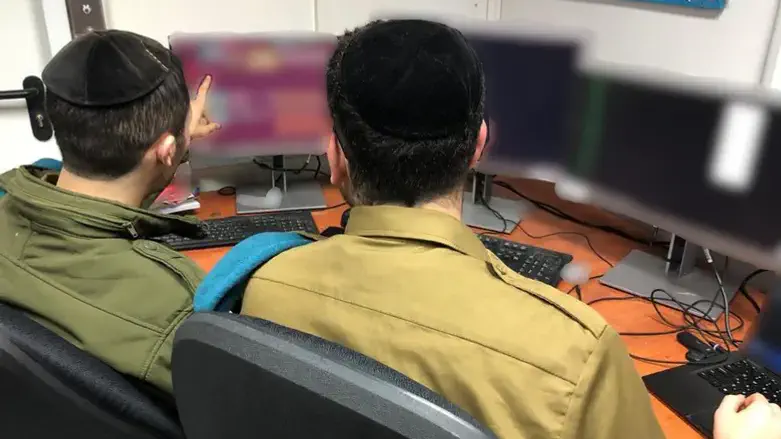
Cpl. Y., a programmer in the IDF’s "Maof" unit under the Telecommunications Branch, arrived at his military service as a Haredi soldier whose family had recently made Aliyah to Israel from Chile.
In an interview with Israel National News, he shares his personal journey and experience in one of the IDF’s dedicated tracks for Haredi youth.
The decision to immigrate to Israel came after his family realized that the local school in Chile followed an American-style education system, emphasizing vocational studies without Torah learning. Seeking a more Torah-centered education for their children, his parents consulted with the community rabbi and decided to make Aliyah.
At the age of 11, Y.’s family moved to Tiberias, where they found a Hebrew-language ulpan for the parents and a Haredi Talmud Torah for him. After three years in a small yeshiva and one in a larger institution, he concluded that he needed to enlist in the IDF. “I was raised in a home that emphasized action. Learning is important, but what I felt missing in the yeshiva was the application of that learning in the wider world,” he explains.
Y. joined Yeshivat Derech Chaim, a hesder-style program that integrates Torah study with military service, which led him to the Maof unit in the IDF’s Telecommunications Corps. While he cannot disclose details of his work, he develops software that significantly streamlines operations within the branch.
Regarding the issue of Haredi enlistment, Y. says he is grateful every day for the path he chose. He rejects the notion that the IDF fails to accommodate Haredi needs. “It is absolutely possible to join the IDF as a Haredi and remain one throughout the service,” he affirms, noting that his track is just one example. “There are all the tools and opportunities needed to remain Haredi,” he says, adding that there are even programs that allow soldiers to retain their traditional dress.
He describes a daily schedule that includes set times for prayer and Torah study, as well as a command structure that encourages religious growth and aims to preserve the soldiers’ Haredi identity. In his Beit Shemesh neighborhood, where he does not hide his identity as a soldier, Y. receives both support and criticism. Both responses, he says, strengthen his conviction that he made the right decision. “I have no regrets,” he concludes.